Full Article
about Espinosa de los Caballeros
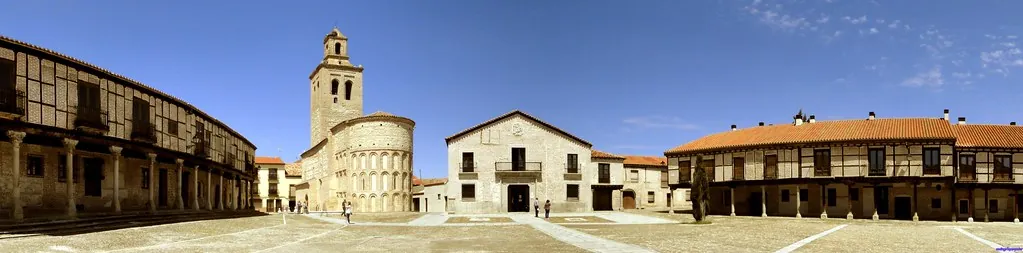
Near Arévalo; noted for its Romanesque-Mudéjar church, listed as a Bien de Interés Cultural.
Ocultar artículo Leer artículo completo
The wheat stops only where the sky begins. Stand on the single road into Espinosa de los Caballeros and every direction looks identical: ochre earth, silver-green stalks, and a horizon so flat you could balance a spirit level on it. At 858 m above sea-level the air carries the dry smell of straw; the loudest noise is usually a lark. This is La Moraña, Castile’s grain store, where villages are spaced like punctuation marks in a very long sentence.
Espinosa itself is little more than a comma: 104 residents, one bar, one food shop that opens when the owner feels like it, and a seventeenth-century church whose tower is the only vertical object for miles. Yet the village name—"of the Knights"—hints at grander days. Medieval nobles once held land here; their coats of arms still hang above cracked stone doorways, bleached almost blank by sun and wind. Nobody charges admission, nobody offers guided tours; you simply walk the single street and piece the story together from lintels, initials and the occasional date carved into plaster.
What the plateau does to time
The plateau alters your sense of scale. Distances feel longer because there is nothing to break the view, yet the village itself can be crossed in three minutes. That brevity is useful: Espinosa works best as a pause rather than a destination. Arrive mid-morning, when tractors have finished the milk run and old men in berets occupy the bench outside the bar. Order a café con leche (€1.20, no menu needed) and you will probably be asked where you left your car and whether the wheat has already turned gold in England. These conversations rarely last; once the coffee is finished locals retreat indoors for the two-hour stillness that divides the day.
If you need lunch, drive ten kilometres east to Arévalo, a market town with full services and several restaurants serving cochinillo—roast suckling pig—under brick vaults. Espinosa itself has no restaurant, no hotel, no cash machine. Plan accordingly: fill the tank before leaving the A-50 motorway, carry water between April and October, and expect mobile reception to vanish at exactly the moment you need directions.
Following the threshing tracks
What the village does offer is space. A lattice of farm tracks fans out across the cereal plain, wide enough for a combine harvester and perfect for an undemanding walk. There are no signposts, simply choose a track opposite the church and keep the tower in sight as a reference point. Within twenty minutes the settlement shrinks to a grey smudge and you are alone among skylarks and the occasional avutarda—the great bustard that looks like a turkey in evening dress. Spring brings red poppies scattered so thinly they seem hand-painted; by July the palette narrows to gold and ash. Shade is non-existent: take a hat and at least a litre of water per person.
The tracks double as drove roads, part of the historic Cañada Real Leonesa that once funnelled Merino sheep from the northern uplands to winter pasture in Extremadura. You can still see the shallow dips where centuries of hooves have carved a gutter into the earth. Farmers greet walkers with a nod but rarely speak; the etiquette is to acknowledge and pass on, leaving the silence to reassemble.
A roof, a bed and a bottle of Rueda
Because Espinosa has no accommodation, most visitors base themselves in Arévalo or in the wine town of Rueda, forty minutes north-west. From either place it is an easy detour before heading to Segovia or Salamanca. If you want to stay within earshot of wheat, book one of the casas rurales scattered through the district: thick-washed farmhouses where keys are left under a flowerpot and the fridge contains half a chorizo loaf as a welcome gift. Expect to pay €80–€100 a night for a two-bedroom house, firewood included. Evenings revolve around the kitchen table; restaurants are a drive away, so buy ingredients in Arévalo’s Saturday market—judiones (giant white beans), morcilla de Burgos, a bottle of Verdejo white that rarely tops €7.
Winter changes the arithmetic. At 858 m frost can arrive overnight in October and linger until April. Roads become glassy, wheat stubble turns white, and the village empties further as retirees migrate to family flats in Ávila city. Driving is still possible, but carry snow socks and allow extra time; the N-502 is cleared last. Photographers prize these months for the low sun that throws every haystack into relief, yet for most travellers late March to mid-June offers the kindest combination of mild mornings, green shoots and empty paths.
When the bells ring twice a year
The quiet ruptures only during the patronal fiestas: the weekend closest to 15 August, and again around 25 November for La Matanza, the traditional pig slaughter. August brings inflatable castles in the plaza, a makeshift bar rigged from a shipping container, and paella cooked in a pan wide enough to bathe a toddler. November is more intimate: families gather in stone sheds to butcher two or three pigs, the meat destined for chorizos that will hang from rafters until Easter. Outsiders are welcomed, yet the event is work, not pageant. If you are invited, bring a practical gift—cheap red wine, or newspaper to wrap offal—and expect to be handed a knife.
Between these weekends Espinosa reverts to hush. The wheat grows, is harvested, is sown again; church bells mark the hours with a mechanical indifference that becomes weirdly comforting. You will not tick off blockbuster sights, but you will remember how Spain used to feel before every hamlet branded itself an "experience". Bring binoculars, good shoes and a full tank, and the plateau will repay you with one of the easiest silences left in Europe.