Full Article
about Flores de Ávila
A town on the plain with a notable Mudéjar church; farming and livestock area.
Ocultar artículo Leer artículo completo
The grain silo on the edge of Flores de Ávila is taller than the church tower. That single fact tells you most of what you need to know about this scatter of low houses 40 km north of the provincial capital: the harvest still dictates the rhythm of the day, not the tourist coach timetable.
At 895 m above sea level, the village sits on a gentle rise in the centre of La Moraña, Castilla y León’s breadbasket. From the last bend of the AV-901 the view opens into a calendar photograph: kilometre-wide stripes of wheat and barley rolling to a horizon so straight it looks drawn with a ruler. The only verticals are the church tower, the silo and the occasional poplar line marking a dried stream bed. On a clear spring morning the Sierra de Ávila floats 60 km to the south like a grey paper cut-out, close enough to count the folds.
Flores has 262 registered inhabitants, though you’d be hard-pressed to meet more than a dozen at once. The centre is two streets and a plaza without benches. Shutters are painted the same oxidised red, and every second doorway still has the family name chalked on the lintel from the last fumigation. There is no hotel, no gift shop, no interpretive centre. The nearest bar is in the next village, 7 km away. What the place does have is space, silence and a very particular quality of light that makes the stone walls glow honey-coloured long after the sun should have turned them dull.
Stone, Adobe and the Memory of Wheat
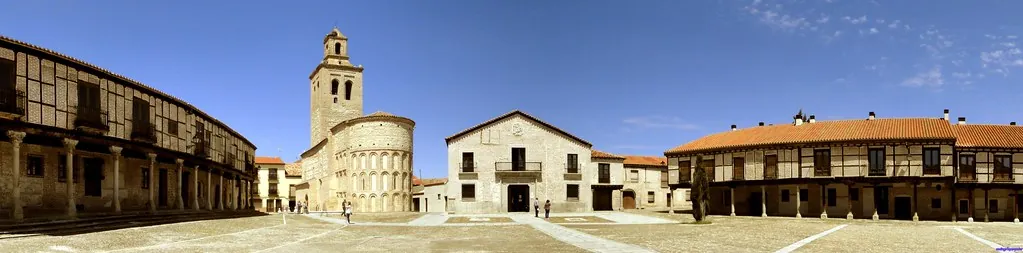
The parish church of Nuestra Señora de la Asunción is older than the unified Spanish kingdom: the base of the tower is twelfth-century, the nave was rebuilt after a fire in 1525, and the baroque altarpiece arrived when the local wheat trade was paying for two new side chapels. Step inside and the temperature drops ten degrees; the air smells of candle wax and centuries-old pine resin. No-one will offer you an audio guide. Instead, the sacristan – usually the baker’s mother – appears with a massive iron key and a warning that the tower stairs are “un poco empinadas”. The view from the top is worth the vertigo: a chessboard of cereal plots, each one edged with a low dry-stone wall built to stop the plough from sliding into the neighbour’s strip.
Round the corner, Calle Real preserves three manor houses whose coats-of-arms still show a sheaf of wheat and a hare. The stone is soft enough to scratch with a fingernail; centuries of wind-blown grit have eroded the lower courses so that each building looks slightly drunk. Behind the main façades are the older dwellings: single-storey adobe structures whose walls are thicker than a London terrace is wide. Keep an eye out for the wooden granaries on stilts – hórreos transplanted from neighbouring Asturias in the 1920s by a returning migrant who preferred northern storage to Castilian mice.
Walking the Lines
You don’t need a permit to follow the farm tracks that radiate from the church like spokes. The most straightforward loop heads north-east for 5 km to the abandoned hamlet of Villavieja, whose last resident left in 1973 and whose church clock stopped at ten past three. The path is a grassy lane wide enough for a tractor; skylarks rise in vertical spurts and the only sound is the wind combing through the barley. In May the verges are polka-dotted with crimson poppies and the air smells of wild fennel. By mid-July the same verges have been shaved to stubble and the temperature at midday touches 34 °C – start early or risk a lecture from the local farmer about mad dogs and Englishmen.
Birders arrive with telescopes rather than binoculars. The flat steppe is perfect for great bustards that stride between the rows like feathered businessmen, and for little bustards performing their crackling display flight. Bring water and a hat; there is no shade for kilometres and the nearest fountain is back in the plaza.
What You’ll Eat and Where You’ll Sleep
Flores itself has no restaurant, but the asador in Piedrahíta, 12 minutes by car, will roast a suckling lamb for four and throw in a terrine of judiones – the giant butter beans of La Granja – for €22 a head. Locals phone the order in on Thursday for weekend collection. If you want to eat on the spot, the weekday menú del día in Mingorría (population 384) costs €12 and includes a carafe of sharp young red wine that tastes of tempranillo and graphite.
Accommodation is similarly scattered. The closest rural house is a converted nineteenth-century manor in Narros del Puerto, 9 km away, with three double rooms and a kitchen that still has the original pilón – a stone sink big enough to bathe in. Rates hover around €90 per night for the whole house mid-week, rising to €130 at weekends when families from Madrid fill the province. Book by WhatsApp; the owner, Marisol, answers within minutes and will leave a bottle of local pitarra wine on the table.
When the Year Turns
Visit in late April and you’ll meet more tractors than cars. The wheat is knee-high and the fields shimmer like green taffeta. Dawn starts cold enough to see your breath; by 11 a.m. jackets are tied round waists and the smell of cut grass drifts from the municipal mower. August is the opposite: the village doubles in size as former residents return for the fiesta of the Assumption. A sound system appears in the plaza, children chase each other through the arcs of a garden hose, and someone’s uncle fries churros in an oil drum at two in the morning. If you want silence, come in February when the stubble is grey and the thermometer can fall to –8 °C. The roads stay clear, the light is crystalline, and the bar in Mingorría keeps its wood stove burning all day.
Getting There, Getting Away
From London, the quickest route is Stansted to Madrid, then a 90-minute drive north-west on the A-6 and AP-51. Hire cars are essential: there are only two buses a day from Ávila, one at dawn and one at dusk, and neither runs on Sundays. Petrol stations are scarce once you leave the motorway; fill up in Arévalo where the Repsol next to the bullring also sells decent coffee for €1.20.
Leave the A-6 at junction 104 and take the CL-501 towards Ávila. After 18 km turn right on the AV-901; the road narrows to a single lane bounded by stone walls. If you meet a lorry full of grain, someone has to reverse 200 m to the nearest passing bay – locals always volunteer the visitor.
Parting thought: Flores de Ávila will not change your life. It will not furnish your Instagram with turquoise coves or Moorish palaces. What it offers is a calibration point for the scale of rural Spain – a place where the horizon is measured in harvested hectares, where church bells still mark the hours, and where the loudest noise at midnight is the wind rattling a loose sheet of corrugated iron. Bring walking boots, a sense of proportion and enough cash for the lamb. The rest sorts itself out.