Full Article
about Fontiveros
Birthplace of San Juan de la Cruz; key literary and religious center with a large Mudéjar church.
Hide article Read full article
A village shaped by the plain
Fontiveros appears on the map of Castilla y León for a clear reason: it is the birthplace of San Juan de la Cruz, born here in 1542. The village lies in La Moraña, a flat district in the north of the province of Ávila. Today, around 700 people live here. The setting is agricultural and wide open. Fields of cereal crops surround the town and set the tone of the landscape.
La Moraña has no mountains or dramatic landmarks. Its identity comes from the breadth of its horizon and from its adobe-built villages. Fontiveros fits that pattern closely. Streets run straight, houses are low, and towers often carry stork nests at their tops. The layout reflects a rural logic that has changed very little over the centuries.
Walking through the centre, the sense of space is constant. Nothing interrupts the line of sight for long. The land and the sky seem to meet without effort, and the built environment follows that same simplicity. It is a place where form follows function, shaped by agriculture and long habits rather than by display.
The presence of San Juan de la Cruz
The best-known site in Fontiveros is the Casa Museo de San Juan de la Cruz. It stands on the spot where the Carmelite poet and religious figure was born. The house recreates the domestic setting of the 16th century. Rooms are small and plain, offering a clear sense of the modest background of the family of Juan de Yepes.
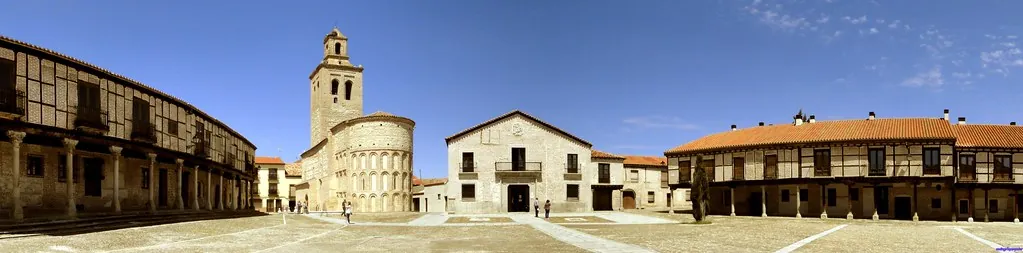
Opposite the house stands the church of San Cipriano. The building combines different construction phases. Part of its structure is older, while other sections were added later. Inside, the baptismal font is preserved where, according to local tradition, the future saint was baptised. The church follows the same restrained style seen across the region.
A short distance from the centre is the hermitage of Nuestra Señora de Sanchomillos. It is reached by paths that cross cultivated fields. The building is simple and stands in isolation. On clear days, the surroundings show the open character of La Moraña particularly well.
Beyond these key places, the village reveals itself in smaller details. Old doorways appear on certain streets. Walls built from adobe and doors made of dark wood speak quietly of local construction methods. These elements may seem modest, yet they reflect a way of building closely tied to available materials.
Paths across La Moraña
The area around Fontiveros can be explored along agricultural tracks. Many of these routes connect nearby villages and have been used for generations. The terrain barely changes, staying consistently flat. What does change is the colour of the fields as the seasons move on.
In spring, green cereal crops dominate the landscape. By summer, the fields shift to the golden tones of ripened wheat. Storks are a constant presence. Their nests are visible on towers and on posts, becoming part of the everyday scene rather than a rare sight.
The rhythm here is set by farming cycles. There is little in the way of sudden variation, but that steadiness is part of the character of La Moraña. The landscape does not try to impress through scale or drama. Instead, it offers continuity and clarity, with long views and subtle shifts.
Food and nearby places
Local cooking follows the traditions of Castilla. In this district, judías de La Moraña are well known. These beans appear in simple dishes linked to the agricultural way of life. Other familiar options include patatas revolconas and beef from Ávila. The recipes are straightforward and rooted in the work of the land.
Not far from Fontiveros lies Arévalo, a town reached within a few kilometres by road. There, brick-built Mudéjar architecture shapes the profile of several churches. Its castle also points to the historical importance of the town.
A place understood through detail
Fontiveros can be seen in a short time and without hurry. The interest lies less in individual monuments and more in the overall atmosphere. Adobe walls, towers with storks, and the quiet of the surrounding fields all help explain the place more clearly than any single landmark.
This is a village where scale remains human and the environment remains consistent. The connection between land, buildings and daily life is easy to read. The figure of San Juan de la Cruz gives Fontiveros a clear place in history, yet the village itself continues to reflect a broader rural identity that has endured with little alteration.