Full Article
about Fuentes de Año
A farming village with a grain-growing tradition; it keeps the spirit of the northern plateau towns.
Hide article Read full article
Midday Light and the Church of San Andrés
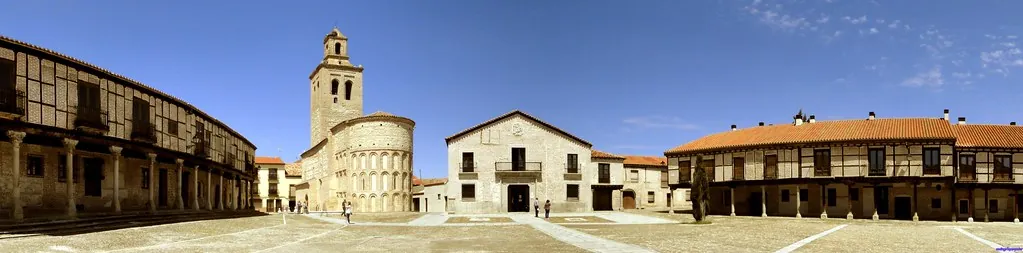
At four in the afternoon in summer, the sun falls almost straight down on Fuentes de Año. Light bounces off adobe walls and the pale stone of some façades, giving everything that earthy tone so common in the villages of La Moraña at the height of the day. In the centre stands the church of San Andrés, sober in appearance, with a square bell tower and narrow windows. It is not a monumental building. It sits naturally among the houses, as if it has always been there watching over the square.
Inside, the atmosphere is usually cool and quiet in the way of many village churches. Thick walls keep the heat at bay even in August. Small details hint at the generations that have passed through: worn religious images, wood darkened by time, and the trace of older paintings beneath more recent layers.
On the Open Plain of La Moraña
Fuentes de Año lies in the flatlands of La Moraña, a comarca in the province of Ávila known for its wide, open landscape. From the edge of the village, the view opens up quickly. Fields of cereal stretch out and change colour as the months pass. Spring brings strong greens. By late June the tones begin to turn, and in summer the land becomes golden and dry.
Farm tracks cut across the fields in straight lines or gentle curves. Many are simple dirt paths still used more by tractors than by cars. A short walk along them leaves you with a clear sense of sound rather than sight: wind brushing through the grain, or the call of a skylark somewhere above, often heard before it is seen.
There are no nearby rivers and no wooded areas to break the horizon. That feeling of openness shapes the character of the place.
Houses, Yards and Everyday Structures
The older houses define much of the village’s appearance. Thick walls of adobe or brick, large gates opening into interior yards, and low roofs built to shield against winter cold and the strong summer sun.
In some corners, dry-stone enclosures still appear, along with old dovecotes. Many are no longer in use, yet their whitewashed walls make them easy to recognise. Underground cellars can also be found, dug into small slopes or beneath courtyards. This was a common solution in the area to keep wine at a stable temperature throughout the year.
These features are not marked out or presented as attractions. They are simply part of daily life and the built landscape.
Walking Out at Dusk
Late in the day is a good time to walk beyond the village. The lower light softens the colours of the fields, and a breeze often picks up, moving the grain or the straw left after harvest.
This part of La Moraña is home to birds that favour open spaces. With some patience, it is possible to spot great bustards or sandgrouse in the distance, especially if you stay on the paths and keep your distance from cultivated land.
Walking here comes with a basic rule. Stick to the tracks and respect the fields, as most of the land is privately used for agriculture.
A Quiet Place with Few Services
Fuentes de Año is a small village with a very limited population for much of the year. It is not a place to arrive expecting shops or bars to be open at any given moment. A more realistic approach is to visit after lunch or to treat it as a short stop while travelling through the comarca.
Arévalo lies relatively nearby and often works as a practical point before or after passing through. Roads across La Moraña are long and straight, with little traffic. In winter, fog banks are not unusual towards the end of the day.
When the Village Comes Alive
For most of the year, the pace remains slow. In mid-August, the atmosphere changes during the patron saint festivities. People who live elsewhere return, and the village becomes livelier for a few days. Processions take place, music fills the square, and families gather for long meals.
These moments reveal the connection between people and the place. Houses that remain closed for months open again, and the streets regain voices and movement.
A Brief Pause in La Moraña
A visit to Fuentes de Año has more to do with stopping for a while than with ticking off sights. The experience comes from simple things: looking out across the horizon from a dirt track, listening to the wind over the cereal fields, or walking through the streets on a quiet afternoon.
In a region as open as La Moraña, that can be enough to understand where you are.