Full Article
about Gimialcón
Town in western Moraña; flat landscape, utterly quiet.
Hide article Read full article
Some places come with a checklist of sights. Others ask for something different. Gimialcón belongs firmly in the second group. You arrive, park more or less wherever suits, look around and realise that the only real plan here is to slow down.
Tourism in Gimialcón does not follow the usual pattern. There are no headline monuments and no streets designed for quick photographs. What you find instead is a small village in La Moraña, in the province of Ávila, going about its daily routine: low houses, open countryside and a silence that settles in when hardly any cars pass through.
With around 73 inhabitants, Gimialcón sits in the wide, flat landscape known as the Morañega plain. The scenery is not dramatic in the sense of mountains or gorges. It offers something subtler: an open horizon, agricultural plots stretching into the distance and a vast sky that shifts in colour as the day moves on. Anyone who has driven through this part of Castilla will recognise the feeling.
The Plaza and the Church
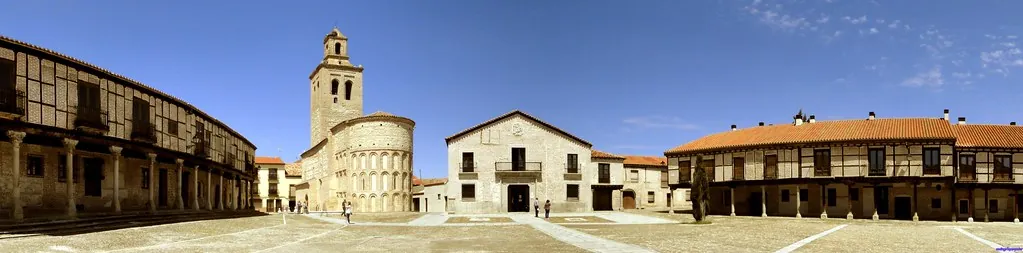
As in many villages of this size, life in Gimialcón revolves around the main square. Here stands the parish church of La Asunción, a simple stone building with a tower visible from several points around the village.
It is not a monumental church. It is the kind of parish temple that has accompanied village life for centuries: baptisms, funerals, local celebrations and bells marking the hours back when not everyone owned a clock. Its presence feels steady rather than showy.
Around the square and nearby streets are the traditional houses of the area. Many have adobe walls, with stone reinforcing corners and doorways. Large wooden gates open onto former yards or storage spaces, reminders of a time when homes and agricultural work were closely linked. Some houses are well kept and lived in year round. Others show the wear of time and the absence of younger generations, a reality shared by many villages across this part of inland Spain.
Short Streets, Unhurried Days
Walking through Gimialcón feels less like sightseeing and more like a gentle circuit. In ten or fifteen minutes, most of the streets have come into view.
Even so, it is worth paying attention to the small details. There are patios with modest vegetable plots, chicken coops tucked into corners and agricultural sheds where tools or tractors that have worked the same fields for decades are still stored. The boundary between home and farmland has always been blurred here, and that closeness remains visible.
The rhythm of the village also reflects the demographic pattern common to much of rural interior Spain. Many houses are closed for much of the year, opening up at weekends or during holiday periods when families return. At those times there is more movement, more voices in the square, more signs of seasonal life.
Outside those moments, calm defines the atmosphere. The quiet is not staged or curated. It is simply what happens in a small farming village with a limited population and very little traffic.
The Landscape of La Moraña
If anything truly defines Gimialcón, it is what surrounds it. La Moraña is an agricultural plain in the most literal sense. Cereal fields dominate the landscape, and their appearance changes markedly with the seasons. Spring brings green expanses that ripple in the wind. Summer turns the fields gold. After the harvest, colours become more muted and earthy.
Rural tracks lead out from the village in several directions. They are suitable for walking or cycling without much difficulty. There are no major signposts, so it is sensible to have a map on a mobile phone if the area is unfamiliar. Orientation here depends largely on the straight lines of fields and the distant silhouette of the village tower.
These open fields are also part of a steppe ecosystem typical of central Spain. With patience and a bit of luck, it is sometimes possible to spot bird species associated with this habitat. Great bustards, known in Spanish as avutardas, can be found in parts of the wider comarca. As with any wildlife, sightings depend on timing and quiet observation rather than certainty.
The appeal of this landscape lies in its scale and its simplicity. There are no dramatic viewpoints or engineered attractions. The horizon itself becomes the main feature, stretching uninterrupted in every direction.
When Night Falls
Visitors arriving from a city often notice the darkness first. Light pollution here is minimal.
Step just outside the village and look up. The sky appears larger than expected, the stars more visible. There is no organised stargazing activity and no formal viewpoint. It is simply the effect of being in open countryside with only the necessary street lighting.
The sensation can be striking for anyone used to urban glow. In Gimialcón, night returns to a deeper shade, and the surrounding fields dissolve into shadow.
What You Really Come For
Gimialcón is not a destination for ticking off attractions. It works better as a place to understand how many small villages in inland Castilla function today.
Life continues to revolve around the land: sowing and harvest seasons, agricultural routines and the social moments that bring people together. The village festivities, traditionally held in summer, are among those occasions when neighbours gather and houses reopen.
The rest of the year follows a quieter pattern. A handful of residents keep their homes open throughout, maintaining a sense of continuity in streets that might otherwise feel empty. The plaza, the church of La Asunción and the surrounding fields remain constant reference points.
Passing through Gimialcón calls for a certain mindset. Take a walk, observe the Moraña landscape, listen to the absence of noise for a while, then continue the journey. Villages of this size often serve as brief pauses on the road, places where the value lies less in what is displayed and more in what is simply there.
In a region shaped by agriculture and wide horizons, Gimialcón reflects a way of life that persists quietly. It does not ask for attention. It offers space, sky and a reminder that not every stop needs an itinerary.