Full Article
about Grandes y San Martín
Municipality made up of two small settlements; noted for its Romanesque church and rural setting.
Hide article Read full article
A pause in La Moraña
Some places act like a pause button. You arrive, park, step out of the car, and the first thing you notice is that almost nothing is happening. Tourism in Grandes and San Martín is very much about that feeling. These are two tiny settlements in La Moraña, an area of the province of Ávila, which together barely add up to a few dozen residents and a landscape that seems to repeat itself as far as you can see.
They sit in that part of Castile where the horizon is a straight line and the sky takes up half the scene. Anyone who has driven through La Moraña will recognise it straight away: cereal fields, farm tracks, and villages that appear suddenly, as if a handful of houses had been placed in the middle of the plain.
Two villages, one setting
Grandes and San Martín feel almost like a single place split into two small neighbourhoods, separated by fields. There are no major monuments and no streets designed for browsing shop windows, because there are no shop windows here.
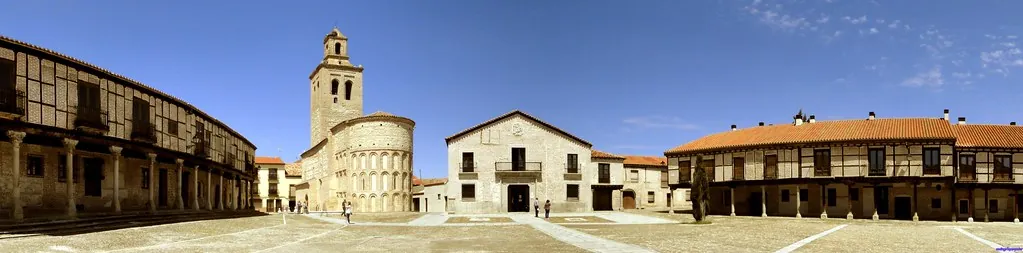
The clearest landmarks are the parish churches. The one in San Martín is often noted for its tower of Romanesque origin, quite plain but sturdy, the kind that has watched harvests come and go for centuries. Around it, the buildings are what you would expect in this part of Ávila: brick, adobe, enclosed courtyards, and the occasional balcony overlooking the street.
The houses speak more of agriculture than tourism. There are animal pens, half-collapsed haylofts, and walls that have been repaired countless times. This is not a staged rural setting. It is a village that continues to function as best it can.
The look of La Moraña
If someone asked what La Moraña is really like, this is a place where you could simply point and show them.
Fields of wheat or barley depending on the season stretch out in wide, open plots with hardly any trees. An isolated holm oak may break the pattern now and then, but most of the time the same view repeats in every direction.
On clear days, looking south, the nearby mountain ranges around Ávila can sometimes be made out as a faint blue line in the distance. It is not a dramatic landscape in the classic sense, yet there is something absorbing about it. Like watching the sea, but made of grain.
Walking the tracks and hearing the quiet
Connections between villages in this area are often traditional agricultural tracks. Some of them can be walked without much difficulty.
It helps to arrive with the mindset of the open plain. There is almost no shade here. In summer, starting early in the day makes a difference, and carrying water is sensible if you plan to leave the village behind.
What stands out is the quiet. Not a polished, postcard version, but the real thing: wind moving through the cereal, a tractor in the distance, and, if you are lucky, birds crossing the sky.
Open skies and steppe birds
La Moraña is known for steppe birds, and around Grandes and San Martín it is still possible to spot some if you take your time.
A harrier may appear gliding over the fields. Flocks of great bustards can sometimes be seen in the distance, looking like stones that start to move when they walk through the crops. Little bustards are also fairly common at certain times of year, either heard or seen crossing the open ground.
There are no viewing platforms or information boards. The usual approach here is simple: stop, take out binoculars if you have them, and watch.
Eating in the area
Within the village itself there are hardly any services, so sitting down for a meal means heading to nearby towns.
In this part of Castile, the food follows long-established traditions: local pulses, roast lamb when it is on offer, cured meats from the annual pig slaughter, and filling dishes designed for life in the countryside rather than presentation. Nothing elaborate, but meals that tend to keep you going for the rest of the day.
Festivities and village rhythm
Local celebrations are usually concentrated in summer, when many residents who live elsewhere return for a few days.
There are religious events, gatherings in the streets, and shared meals. These are not designed to attract visitors. They are more about the moment when the village regains a bit of movement and people reconnect.
Is it worth the detour?
That depends on what you are looking for.
Grandes and San Martín are not places to travel to from far away on their own. But if you are exploring La Moraña and want to understand what many of these small plateau villages are like, stopping here makes sense.
In the end, the place sums up the wider area quite well: open fields, quiet settlements, and the sense that time moves more slowly than in most other places. And sometimes, that is exactly what is needed.