Full Article
about Gutierre-Muñoz
Place where King Alfonso VIII died; small town on the plain with a past
Hide article Read full article
Where Gutierre-Muñoz Sits
Any look at tourism in Gutierre-Muñoz starts with its setting. The village lies at the centre of La Moraña, a broad agricultural plain in the north of the province of Ávila, in Castilla y León. At around 885 metres above sea level, the land stretches out in long, uninterrupted horizons of cereal crops, with barely any change in relief.
This is not a place that grew around major monuments or busy trade routes. Its origins are tied to cultivation, to working the land rather than passing through it. Today, just over sixty people live here, and daily life still follows the rhythm of farming. That sense of continuity shapes the experience of being in the village as much as any building or landmark.
Practical Buildings and a Quiet Centre
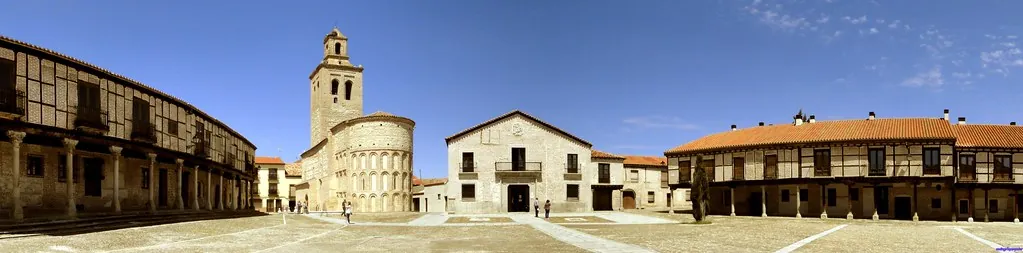
Architecture in Gutierre-Muñoz reflects necessity rather than decoration, much like in other settlements across La Moraña. Traditional houses combine adobe, brick and stone. Their thick walls were designed to deal with the extremes of the local climate, holding in warmth during the cold winters and keeping interiors cooler during the dry summer months.
Large gateways can still be seen on many properties, a reminder that these homes were closely tied to agricultural work. Storage, animals and tools all played a part in how these spaces were organised.
The main square is small and unadorned. It acts as a meeting point when there are local gatherings or celebrations, but otherwise remains quiet. Close by stands the parish church of Santiago. The building has been altered at different moments in its history. In some sections, features of rural Romanesque architecture can still be recognised, a style that spread through this area during the medieval repopulation of the region. Later modifications have changed its appearance, so what stands today is the result of several phases rather than a single design.
The Open Landscape of La Moraña
Beyond the village, everything opens out into farmland. Wheat and barley dominate, with sunflowers appearing in some years. The landscape shifts noticeably with the seasons. Spring brings green fields, summer turns them gold at harvest time, and winter strips things back to a more austere palette.
Scattered among the fields are isolated holm oaks, standing alone rather than forming dense woodland. A network of agricultural tracks runs between the plots. These paths can be followed on foot or by bicycle. There are no marked tourist routes or signposted trails, but the tracks are clear enough and link Gutierre-Muñoz with nearby villages.
This kind of open terrain also supports birdlife associated with steppe environments. Species such as the great bustard and the little bustard can still be found in parts of the region, although they are becoming less common. Their presence adds another layer to an otherwise quiet, expansive setting.
Paths Between Villages
Rural tracks lead out from Gutierre-Muñoz towards neighbouring settlements across La Moraña. The routes are straightforward and almost entirely flat, which makes them accessible in terms of terrain. At the same time, two factors shape the experience of moving through this landscape: the lack of shade and the wind.
In summer, the sun can be intense with little natural cover. In winter, the wind often moves freely across the plain without obstruction. Water sources are also scarce outside the villages themselves. These are not walking routes designed for leisure in the modern sense, but working paths that have connected farms and communities for decades.
That distinction matters. The appeal here lies less in curated trails and more in understanding how the land has been used and crossed over time.
Looking Beyond the Village
Gutierre-Muñoz works best as a brief stop within a wider journey through the comarca. Within less than half an hour by car lies the city of Ávila. Its walled complex holds much of the province’s historical heritage and offers a strong contrast to the simplicity of the surrounding plains.
Across La Moraña, other villages feature Mudéjar churches and brick-built temples linked to the medieval history of the area. These buildings tend to be modest in scale, but they help explain how this territory was organised following the Christian repopulation during the Middle Ages. Seen together, they form a scattered but coherent picture of the region’s past.
Visiting with Realistic Expectations
Gutierre-Muñoz can be explored quickly and does not have services aimed specifically at visitors. Anyone passing through should come prepared, carrying water and planning stops in larger nearby towns.
Spring and autumn are generally the most comfortable times to walk in the area. During these seasons, the agricultural landscape shifts in colour, and the light of the Meseta, particularly in the early morning, highlights the breadth of La Moraña. The sense of space is one of the defining features here, and it is most noticeable when the light is soft and the air is clear.
This is not a destination built around attractions in the conventional sense. It is a place that reflects a way of life shaped by open land, changing seasons and long-standing agricultural routines. Understanding that context makes a short visit feel more grounded, even if it remains a quiet and understated stop along the way.