Full Article
about Hernansancho
A farming municipality in La Moraña, noted for its church and preserved traditions.
Hide article Read full article
A Bell Tower in a Sea of Fields
There is a particular moment on the secondary roads of Castilla that stays with you. You drive through seemingly endless farmland and, without warning, a bell tower rises ahead in the middle of open country. It feels a little like spotting a lighthouse, except instead of sea there is cereal stretching to the horizon. That is Hernansancho.
Tourism in Hernansancho does not work in the way it does in better-known villages. This is not a place for ticking off sights all day. It is somewhere to stop, look around and understand what La Moraña is really like: flat terrain, wind that can blow with force, and fields that shift in colour as the seasons pass.
The village has around 140 inhabitants and sits at about 900 metres above sea level, right in the Morañega comarca. Cereal dominates the landscape, especially wheat and barley. In spring the countryside turns a vivid green. By summer it becomes a dry gold that could belong in a western film, tractors replacing horses.
A Village Best Understood on Foot
Hernansancho can be walked in a short time, and that is simply its scale. Quiet streets run between houses built of stone and adobe. Large wooden gates, once wide enough for carts, still frame many entrances. Here and there, underground bodegas recall the period when many families made their own wine.
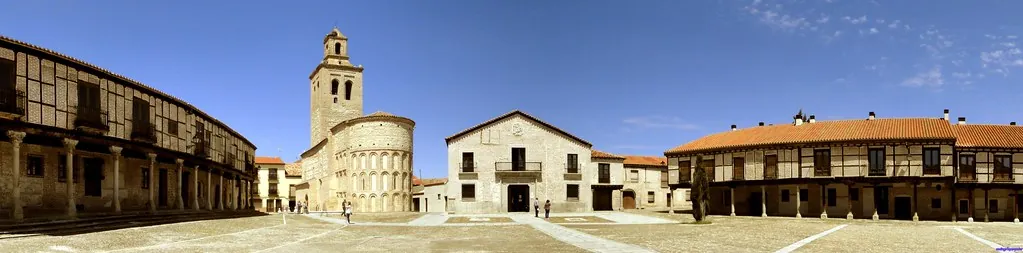
The Iglesia de San Pedro is the building you notice first from a distance. Its tower rises above the rooftops and acts as a reference point when approaching by road. The church is old, probably dating from the early modern period. It has the restrained character common to many rural churches in Castilla: solid stone, simple proportions, no unnecessary decoration.
There are no grand monuments or showpiece architecture. What you do find is the sense of a place that continues to function as it always has. People step outside to read the sky and judge whether the weather is about to turn. Tractors come and go. Mid-afternoon brings a marked quiet.
Bodegas, Wind and the Shape of Daily Life
A slow walk on the outskirts reveals small, curious details. Entrances to underground bodegas appear along the edges of the village, some still in use, others closed for years. These spaces were traditionally dug out to keep wine or food at a stable temperature throughout the year.
The climate plays a decisive role here. La Moraña is known for cold winters and for the wind, which at times feels as though a giant door has been opened across the plateau. Thick walls and sheltered courtyards are practical responses to that reality.
Life moves at a pace set by the land and the weather. Agricultural work dictates much of the rhythm of the year. Silence settles easily over the streets, broken mainly by the sound of machinery during busy periods in the fields.
The Open Landscape of La Moraña
Walking along the agricultural tracks around Hernansancho is perhaps the most rewarding thing to do. These are straight paths that cut between vast plots of land. You can see someone approaching from far away, long before they reach you.
The appearance of the countryside changes noticeably with the seasons. In spring, fields are intensely green and agricultural activity is constant. Summer brings tall wheat and a dominant golden tone. Autumn shifts the palette towards ochres, with newly worked plots marking the land.
This is not a dramatic landscape of mountains or deep valleys. Its appeal lies elsewhere. The beauty here is steady and understated. Anyone interested in observing how farmland evolves through the year will find plenty to hold their attention.
Hernansancho also works as a base for exploring other small settlements in La Moraña. Local roads and farm tracks connect it with neighbouring villages. The terrain is very flat, so distances feel short whether travelling by car or by bicycle. In summer it is wise to carry water, and at certain times of year there is considerable movement of tractors and trailers along these routes.
Steppe Birds and Early Mornings
La Moraña is territory for steppe birds, species that favour open and quiet farmland. With patience, and preferably an early start, it is possible to see great bustards, little bustards and other birds adapted to this environment.
There is no need for a major expedition. A pair of binoculars and a respectful approach along established paths are enough. Entering cultivated plots is neither necessary nor appropriate. The wide horizons and low vegetation make observation part of the experience.
Food Rooted in the Fields
The cooking of this area remains closely tied to what the land provides. Dishes are substantial, designed for long working days outdoors. Roast lamb appears frequently, along with pulses and cured sausages. The flavours are straightforward and robust.
In nearby villages, long shared meals are still part of local life. These are the kind of gatherings that leave you more inclined towards a siesta than to clocking up more miles on the road.
Summer Festivities and Returns
Patron saint festivals usually take place in summer, when many people with family roots in Hernansancho return for a few days. These celebrations revolve around reunion as much as ritual. There is a procession, music, lengthy dinners and a main square that fills with life for a brief period.
There are no vast stages or elaborate productions. The atmosphere is that of a village that suddenly feels full again because those who moved away have come back.
Is Hernansancho Worth a Stop?
The answer depends on what you are looking for. Anyone expecting a historic centre packed with monuments or streets lined with shops open all day will not find that here.
Hernansancho offers something quieter. It provides a way to understand La Moraña through its fields and its wind, through the scale of its houses and the presence of its church tower on the horizon. It is a place to pause and take in the colour of the crops, to notice how weather shapes buildings and routines, and to see how a small community continues in step with the land around it.
For travellers curious about rural Castilla beyond the better-known routes, that may be reason enough to turn off the main road when the bell tower comes into view.