Full Article
about Herreros de Suso
Near the sierra; known for the Ermita de Nuestra Señora de las Fuentes and its romería.
Hide article Read full article
A Village You Don’t Plan For
Some places are reached almost by accident. You’re driving along a secondary road, glance at the map and think, “let’s take a quick detour”. Tourism in Herreros de Suso often begins like that. It is not somewhere marked by large roadside signs. It tends to appear once you are already deep into the flatlands of La Moraña, a wide agricultural area in the province of Ávila.
On arrival, the first thing that stands out is the quiet. Not a staged or dramatic silence, but the everyday stillness of a small village where life moves slowly. A parked car, a door left open, someone crossing the street without hurry. With around 140 residents, Herreros de Suso keeps a rhythm that has largely disappeared from city life.
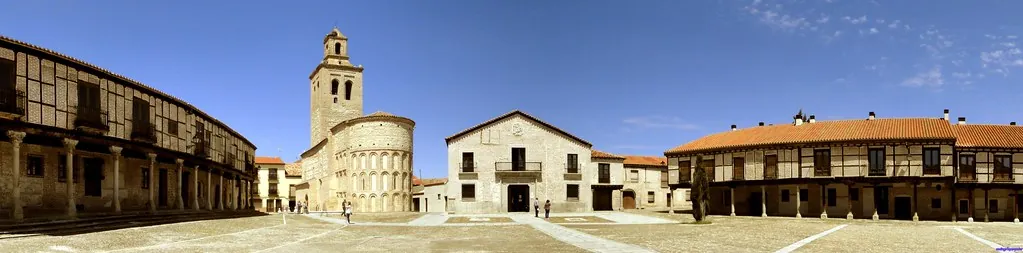
There are no major monuments and nothing designed to keep visitors occupied for hours. The interest lies in something simpler: the way the village remains closely tied to its agricultural surroundings. Stone and brick houses, calm streets, and the sense that everything has been built out of necessity rather than for appearance.
The name itself reflects that practicality. “Herreros” points to traditional metalworking trades, a common feature in many Castilian place names. “De Suso” usually indicates a higher position in relation to nearby settlements. From the village, that idea becomes clear. The landscape stretches out in every direction, a wide horizon of fields that shift colour with the seasons. Spring brings green tones, while after the harvest the land turns golden for weeks.
Houses, Courtyards and Everyday Life
A walk through Herreros de Suso reveals buildings that do not try to stand out. These are solid constructions, designed to withstand cold winters rather than to impress.
The most recognisable building is the parish church. It is not especially large, yet it acts as a reference point for the whole village. Its appearance is restrained, in keeping with many churches found in inland Castilla: thick walls, minimal decoration, and a calm presence at the centre of the square.
Many houses still feature large wooden gates, a reminder of how they were once used. These entrances allowed carts to pass through, animals to be brought inside, or grain to be stored. Interior courtyards are also common, spaces where daily tasks were carried out. A closer look reveals how the village reflects its agricultural past without the need for explanatory signs or displays.
Beyond the last houses, the setting quickly returns to open farmland. Large plots, straight tracks, and a plain that seems to go on indefinitely. In summer, the heat can be intense, as in much of the Spanish plateau, though evenings often bring a noticeable drop in temperature.
Across the Plains of La Moraña
This is not a place for mountain routes or carefully marked trails. What exists here are traditional agricultural paths, used for generations.
For those who enjoy unhurried walks, these routes have their own appeal. They are flat tracks crossing cereal fields and linking nearby villages. It is the kind of landscape where distance slips by almost unnoticed because the terrain barely changes.
Cycling follows a similar pattern. Secondary roads carry little traffic, and the terrain is gentle. The main challenge is often the wind, which can appear suddenly in this part of Ávila and make progress harder than expected.
The open fields also attract those interested in birdwatching, particularly species adapted to steppe-like environments. There are no dedicated facilities or observation points, but with patience and a pair of binoculars, it is sometimes possible to spot birds suited to these cereal-growing landscapes.
As for food, expectations need to be realistic. Herreros de Suso is a small municipality and does not have a dining scene aimed at visitors. Those looking to sit down for a meal will usually find it more practical to head to nearby towns within the region.
Festivities and Village Rhythm
Celebrations in Herreros de Suso follow patterns seen across many villages in Castilla. They are simple gatherings tied to the religious calendar or to key moments in the year for the community.
Rather than events designed for outsiders, these are occasions when the village comes together. Residents return for a few days, families gather, and the squares become livelier than usual.
Herreros de Suso fits closely with the idea many people have of La Moraña when they picture the Spanish plateau: open fields, small settlements, and a way of life shaped by the land. It does not require much to understand the place. A short walk through its streets, followed by time spent on one of those straight paths disappearing into the crops, is often enough.