Full Article
about Horcajo de las Torres
Bordering Valladolid; noted for its grand Baroque church and farmland setting.
Hide article Read full article
A village that doesn’t try to impress
Some places make an effort to stand out straight away. Horcajo de las Torres does the opposite. The road runs through the long, straight stretches of La Moraña, with cereal fields on both sides, and then the village simply appears. No build-up, no signal. If you have ever driven through this part of Ávila, the pattern feels familiar: kilometres of flat land followed by a cluster of houses that seems to have always been there.
Tourism in Horcajo de las Torres does not revolve around major monuments or carefully signposted routes. With just over four hundred inhabitants, daily life continues at its own pace. The real interest lies in understanding the landscape of La Moraña and what it means to live in a place where the horizon always feels distant.
Walking the rhythm of La Moraña
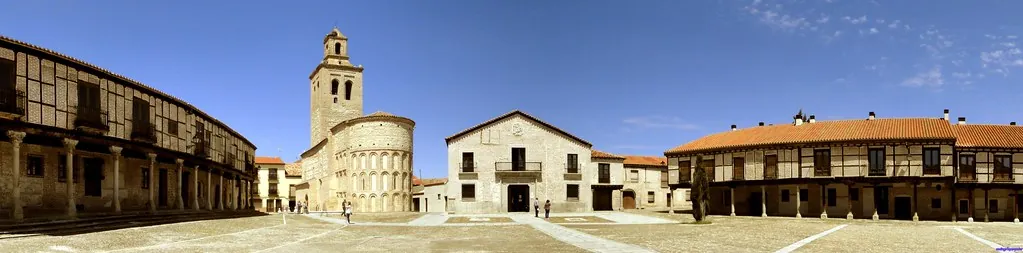
From the outside, Horcajo looks exactly what it is: an agricultural village on the Moraña plain. Streets are quiet. Houses are built with brick and adobe. Large gates, once used for carts, now often shelter tractors instead.
The village’s main landmark is the church of San Julián. Like many churches in the area, the building reflects different periods and alterations. It is not the sort of place that demands a detour, yet it helps explain the village’s past. Generations have extended, repaired and adapted the same structure over centuries.
A short walk is enough to get a sense of how everything has been shaped here. Thick walls protect against extremes. Streets remain open to the wind. Houses were designed to cope with both the dry heat of summer and the serious cold of a Castilian winter.
Once outside the built-up area, the defining feature of Horcajo comes into view: the cereal plain. In spring, the fields turn a vivid green. Summer brings an intense yellow that seems endless. Autumn softens everything into muted tones. The colours change, but the sense of space remains constant.
Look more closely and small details begin to interrupt the uniformity. An old dovecote appears in the distance. A narrow stream cuts quietly through the land. A line of trees marks a spot where birds tend to gather. These elements are modest, yet in such an open setting they stand out clearly.
Dovecotes and open land
A few kilometres from the village, traditional palomares can still be seen. These adobe dovecotes come in different shapes, some circular, others more square. For decades they were used to raise pigeons, a common activity in the region.
Many stand within private land, and some are partly abandoned. It is best to observe them from the paths rather than entering spaces that are not public. Even so, their presence in the middle of wide fields has a certain pull: a solitary construction surrounded by kilometres of crops.
Easy routes at a slow pace
The agricultural tracks around Horcajo are wide and mostly flat. Walking or cycling here is straightforward. The main challenge often comes from the summer sun rather than the terrain.
Early hours make a difference. The countryside feels calmer, and the light is softer. Wildlife is also more active at that time of day.
This area is still home to steppe birds. With some patience, it is possible to spot great bustards or little bustards moving among the crops, particularly in spring. There are no guarantees, as this is not a controlled reserve, but the possibility is there. Binoculars can help.
Observation works best from a distance. Staying on the paths and avoiding close approach is the sensible way to experience the area. The aim is to remain unnoticed within the landscape.
Food rooted in tradition
The local cooking is direct and tied to the land. When temperatures drop, meals centre on hearty stews. Roast meats appear regularly, alongside products that have been part of the local diet for generations.
Legumes, cured meats and aged cheeses are common on the table. When a wood-fired oven is involved, roast lamb or suckling pig still feature. These are meals that tend to call for a walk afterwards.
There is no focus on presentation or reinvention. The logic here is simple: eat well and eat enough, whether after a morning’s work or time spent out in the fields.
Festivities that belong to the village
Local celebrations continue to revolve around San Julián, the village’s patron saint. These are community-centred events, shaped by tradition rather than spectacle. Religious acts take place alongside gatherings between neighbours, with music in the evenings and a social atmosphere that fills the streets.
This is not the kind of festival that draws large numbers of visitors, and that helps preserve its character. Families return during these days. Conversations stretch out in the open air. The rhythm of the village follows its own calendar.
Horcajo de las Torres does not set out to impress. It is a place where a pause and a look around can reveal how La Moraña works: wide fields, small settlements, and a way of life still closely linked to the land that surrounds them. For some travellers, that is reason enough to stop.