Full Article
about Langa
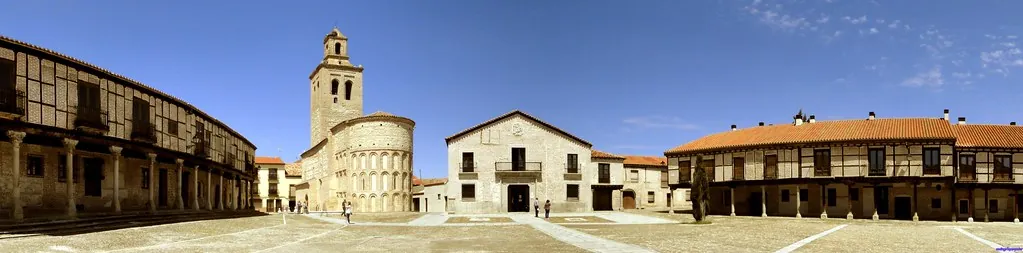
A Moraña town with farming roots, noted for its Mudéjar church and heraldic houses.
Ocultar artículo Leer artículo completo
The church bell strikes nine and the sound carries for miles across the flatlands. In Langa, perched at 865 metres above sea level, there's nothing to stop it. No valleys, no forests, just the endless cereal plains of La Moraña stretching to every horizon. It's the kind of place where weather arrives without warning and sunsets last forever, where the air feels thinner and the stars brighter than they have any right to be.
This is Castile at its most Castilian. Not the romanticised version of travel brochures, but the real thing: a village of 450 souls where tractors outnumber cars and the bakery van still does its rounds. The houses, built from local stone and adobe, stand shoulder to shoulder along streets that haven't changed their layout since medieval times. Their wooden doors, sun-bleached and wind-worn, open onto interior courtyards where wells still draw water and chickens scratch in the dust.
Where the grain grows and the wind blows
The landscape here operates on a different timescale to the rest of Spain. Spring arrives late at this altitude, painting the plains an almost violent green that gradually fades to gold under the summer sun. By August, the heat shimmers off the earth in waves, and the only shade comes from scattered oak groves that have survived centuries of agriculture. Autumn brings mists that roll in from nowhere, turning the village into an island in a white sea. Winter is serious business: temperatures drop below freezing, frost whitewashes the fields, and sometimes the road from Ávila becomes impassable.
This is cycling country, though not for the faint-legged. The roads connecting Langa to its neighbours—Fontiveros 12 kilometres away, Arévalo at 18 kilometres—roll gently but relentlessly across open plains. There's always a headwind. Always. Local cyclists have thighs like tree trunks and expressions that suggest they've seen things. Bring water, more than you think you'll need, and don't trust the distances on maps. Everything feels further when there's no shelter from sun or wind.
Stone, faith and the rhythm of centuries
The parish church dominates Langa's skyline, its bell tower visible from every approach road. Built in the typical rural Castilian style—modest proportions, thick walls, small windows—it's less architecturally significant than spiritually central. The bells still mark the day's rhythm, calling the faithful to mass and reminding everyone else of the time without anyone needing to check their phone. Step inside and the temperature drops ten degrees. The stone floors are worn smooth by centuries of worshippers, and the air carries traces of incense and candle wax.
Wander the streets and you'll spot heraldic crests carved above doorways, remnants of families who made their fortunes from the land and never saw any reason to leave. Some houses still have their original wooden balconies, others retain stone coats of arms weathered almost smooth. It's not preserved heritage so much as lived-in history, the kind that happens when people simply carry on living the way they always have.
The baker's been making bread the same way for forty years. The bar opens at seven for the farmers' breakfast of coffee and brandy. The village shop stocks everything from tractor parts to birthday cards, run by a woman who knows everyone's business and keeps it to herself.
What grows between the wheat
The plains around Langa aren't empty, though they might look it at first glance. Step away from the road and you'll find a patchwork of habitats: wheat fields, fallow land, oak groves, roadside verges thick with wildflowers in spring. This is steppe country, home to birds that prefer open spaces to forests. Little bustards strut through the crops, calandra larks sing from fence posts, and if you're patient (and lucky), you might spot a great spotted cuckoo being chased by an angry magpie.
The best time for wildlife watching is early morning, before the heat haze distorts everything. Bring binoculars, obviously, but also bring patience. This isn't the Serengeti; animals here are used to being hunted and aren't keen on being watched. Sit quietly by a field edge and wait. The plains will come alive around you: hares boxing in spring, bee-eaters hawking insects in summer, flocks of skylarks rising like smoke in winter.
Food that remembers
The local cuisine doesn't do fancy. It does filling. In winter, it's cocido stew thick enough to stand a spoon in, roasted meats that have seen the inside of a wood-fired oven for hours, pulses that taste of the earth they grew in. Summer brings gazpacho thickened with bread, tomatoes that actually taste of tomatoes, and pork from pigs that lived well before they died. The wine comes from nearby Rueda, though ask for "vino de la tierra" and you'll get something the barman's cousin made that's better than anything with a fancy label.
There's no Michelin-starred restaurant here. The nearest is in Arévalo, twenty minutes away by car. Instead, there's a bar that does three dishes well: callos (tripe stew, better than it sounds), tortilla that's all egg and potatoes, and roasted peppers that will ruin you for the supermarket version. They open when they open, close when they close, and don't take cards. Cash only, preferably in small notes.
When to come, when to stay away
Spring is generous: green fields, wildflowers, temperatures that don't require industrial-strength sunscreen. The village wakes up after winter, people emerge from their houses, and there's a sense of collective relief that they've made it through another cold season. It's also when the plains smell of wet earth and growing things, a scent that city dwellers forget exists.
Autumn brings its own rewards. The harvest is in, the stubble fields turn bronze in the low sun, and the village fills with the smell of wood smoke. It's photography weather, all long shadows and golden light, though you'll need a car to explore properly. The walking is good too, following ancient paths between villages, though paths that aren't always well-marked and can turn muddy after rain.
Summer is brutal. Temperatures regularly hit 35°C, shade is scarce, and the plains shimmer like a mirage. The Spanish come anyway, returning to family houses for August fiestas, filling the streets with children and the bars with conversation. Accommodation gets booked up, prices rise, and the peace that defines Langa most of the year disappears under a tide of celebration.
Winter is not for casual visitors. The cold is serious, the days are short, and some accommodation closes entirely. But if you do come, you'll see Langa as it really is: a working village where life continues regardless of whether anyone's watching. Just bring proper clothes. The wind at 865 metres doesn't mess about.