Full Article
about Madrigal de las Altas Torres
Birthplace of Isabel la Católica; a walled town with striking Mudéjar heritage and historic convents.
Hide article Read full article
A short stop in the Moraña
A visit to Madrigal de las Altas Torres is usually brief. Around an hour or an hour and a half is enough to see the main sights at an easy pace. Most people leave the car outside the historic centre, on wider streets that run alongside the town walls. It is straightforward and doesn’t require much planning.
It pays to arrive early or later in the afternoon. At those times the brick of the towers and churches shows its colour more clearly, and the walk feels easier, especially in summer. The Moraña, the surrounding plain, can be intense under the sun and there is very little shade.
The walls that define the town
The visit revolves around the town wall. It encircles the historic centre for roughly two kilometres and still retains a good number of towers. It has not been heavily rebuilt or turned into a staged attraction, which gives it a more grounded feel.
Several historic gates remain, including those of Cantalapiedra and Medina, along with the so‑called Arco. A walk along the wall helps place Madrigal within medieval Castile. The town is quiet today, yet the scale of the enclosure suggests a place that once held far more activity.
The Palacio de Juan II and its link to Isabel
The Palacio de Juan II has served as a hospital for centuries. Inside there is a small space dedicated to Isabel la Católica, who was born in Madrigal. The visit itself is short. The most notable part is usually the Mudejar cloister, simple in design but well preserved.
It is worth checking in advance whether it is open, as the timetable does not always match expectations.
Brick churches in the historic centre
For a town of this size, Madrigal has several significant churches. That alone hints at its past importance.
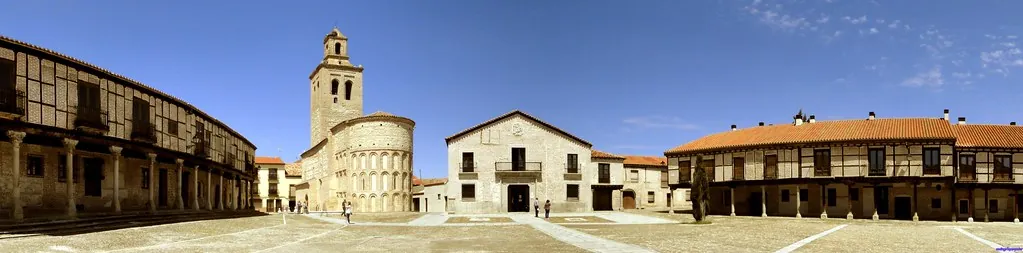
San Nicolás de Bari is one of the oldest. Its apse combines Romanesque elements with Mudejar brickwork, a style common in this part of Spain that blends Islamic and Christian building traditions. Inside, the altarpieces are restrained, similar to those found in many Castilian churches.
Santa María del Castillo also deserves a look. Its tower rises clearly above the rest of the town and works as a reference point when walking through the historic streets.
Convent life and religious traces
The Convento de Agustinas holds a number of artistic pieces and often organises visits to a small sacred art museum. These visits are sometimes arranged in advance, so it is best to check before going.
Elsewhere in the town there are remains or references to other religious buildings, such as the ermita de las Angustias or former convents. Not all of them are open to visitors, yet they help explain how many religious institutions once existed here.
Walking the perimeter
Those who feel like stretching their legs can walk around much of the walled enclosure. The route is simple and largely flat.
From the outside, the line of towers is easy to follow. In the opposite direction lie the open fields of the Moraña. Towards sunset the brick takes on deeper reddish tones and the whole setting becomes more striking.
The flat landscape of the Moraña
Beyond the town, the terrain is mostly flat. There are cereal fields, straight tracks and the occasional dovecote scattered across the landscape. This is not an area for dramatic mountain routes.
Walks along agricultural paths are easy and accessible. They serve more to understand the character of the land than to offer a particularly varied route. In summer, midday is best avoided due to the lack of shade.
Local food and traditions
The food follows the patterns of the region. Dishes are based on legumes, along with roasted lamb or suckling pig, and hearty stews during colder months.
There are also sweets linked to convent traditions, such as biscuits or small pastries with pine nuts. In some smaller places, cash is still preferred.
Festivities through the year
The main local celebrations take place around 10 September, for San Nicolás. During those days there are processions and community events, and the atmosphere shifts noticeably compared with the rest of the year.
In spring, there are usually festivities connected to the Virgen de las Angustias, typically between late April and early May. These include a romería, a traditional pilgrimage, along with religious acts.
From time to time, events related to Isabel la Católica are also organised. They do not follow a fixed pattern every year, so it is worth checking what is planned before visiting.
A place to pause, briefly
Madrigal de las Altas Torres is not a destination packed with activities. The visit centres on the wall and a small group of historic buildings, and it does not take long to see them. For those interested in the history of Castile, it makes a worthwhile stop. Otherwise, most travellers tend to move on after a short visit.