Full Article
about Maello
Large municipality with several housing developments; noted for its church and holm-oak pasture.
Hide article Read full article
Where the Wind Whistles Across the Fields
Just before harvest, the heads of wheat brush against your knees. In Maello, at around 1,000 metres above sea level, the wind does not simply blow, it whistles. It slips down the collar of a shirt and draws your gaze towards the horizon, where the Castilian plateau rises and falls in soft waves. The village appears as a patch of stone between yellow fields and muted green.
Maello sits in Castilla Leon, in a landscape defined by open skies and wide cereal plains. There are no dramatic peaks or dense forests here. Instead, there is space, light and the constant movement of air across the meseta.
Before Midday on the Plateau
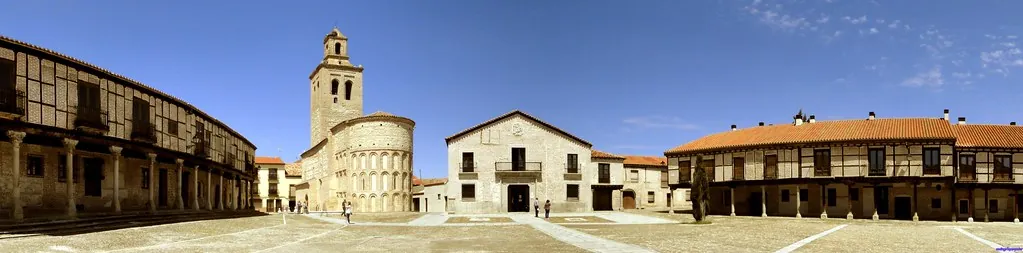
On a June morning, before the sun grows fierce, birds squabble over cherries in a tree in the square. The village church often stands with its door wide open once the warmer weather arrives, a common sight in rural parts of Spain. Inside, the stone carries the scent of old incense and polished wood. A handwritten sign asks for a small donation to help restore the altarpiece. Coins drop into a cardboard box lined with wrapping paper, beside a pair of forgotten reading glasses.
Outside, the silence can feel dense enough to notice the hum of a single bee somewhere in the square. An elderly man pulls up in a small car, the kind rarely seen now, and pauses to look at the bell tower.
Each bell, he explains, has its own tone. The largest rings when someone dies. The smaller ones sound when a child is born.
In villages like Maello, such details are absorbed over time rather than formally taught. The bells are part of the fabric of daily life, marking moments that matter without ceremony.
Bread That Lasts, Air You Can Breathe
One of the village shops doubles as a grocery and an improvised bar. A heavy round loaf sits on the counter, its crust firm. It is wrapped in brown paper with the assurance that it will last for days, unlike the softer baguette-style loaves that go stale almost immediately. This is bread made to accompany stews and soups, to be sliced thickly and eaten over more than one meal.
The shop smells of cured embutido, traditional Spanish cold meats, old-fashioned soap and freshly made coffee. Inside a fridge are soft drinks, a few containers of homemade food and bags of ice. On the wall hangs a slightly faded poster announcing the fiestas of San Juan, with an evening verbena, an open-air dance typical of Spanish summer celebrations. It seems to have been there for more than one season.
Conversation drifts easily. A daughter studying in Valladolid returns most weekends. She says she can breathe here, a comment delivered with a gesture towards the open door and the quiet street beyond. In Maello, breathing feels less metaphorical than factual. The air is clear, the horizon unobstructed.
A Track Through the Cereal
About two kilometres from the centre of the village, a dirt track cuts through the wheat fields. There are no clear signs, only a post with an arrow painted on in broad strokes. The path leads further into the landscape of La Moraña, the wider area known for its flat farmland and persistent wind.
Dust works its way into shoes. The wind forces you to lean slightly as you walk. After a while, an abandoned era comes into view, a circular threshing floor edged with stones where grain was once separated from chaff. In the middle stands a worn stone figure. It is difficult to tell whether it was once a small saint or simply a marker along the way. Around it, poppies tremble with every gust.
From here, Maello resembles a stationary ship in a sea of cereal. The reddish roofs catch the midday sun. Somewhere in the distance, a tractor can be heard though it remains out of sight, its engine rising and fading as it moves behind the gentle rises of the land. That sound, engines appearing and disappearing beyond the hills, is one of the most recognisable in this part of the plateau.
There are no interpretation boards explaining what you are seeing. No marked viewpoints frame the scene. The understanding comes from standing still and watching how light and wind change the colour of the fields.
When the Village Slows
Back in Maello around lunchtime, many shutters are half closed. From behind them drift the smells of cooking: a stew rich with pimentón, the smoked paprika so central to Spanish cuisine, sopa de ajo, the traditional garlic soup of Castilla, and something reminiscent of roast lamb.
On a small terrace, four tables sit in the shade. An orange cat sleeps on one of the chairs. Coffee is served in a glazed earthenware cup with a slightly chipped rim. Questions are simple and direct. Where have you come from? Madrid is a common answer, acknowledged with a slow nod. It is a journey many make, leaving the capital for a slower rhythm at weekends or in summer.
Maello does not have museums or signposted routes on every corner. There are no souvenir shops, no scenic lookouts equipped with panels explaining the view. What it offers is quieter: unhurried streets, brief conversations in the square, and a pace set more by the fields than by the clock.
That pace becomes particularly noticeable during the siesta hours. By mid-afternoon, the village slips into a pause that nobody announces yet everyone respects. The bells mark the hour. The wind continues to thread its way through the streets. Out in the fields, the wheat moves slowly, as if the land itself were breathing.
Getting There, and When to Pause
The road connecting Maello to the area of the AP‑6 motorway runs through open countryside, cereal fields stretching along almost the entire route. In good weather the drive is straightforward. In winter, however, fog frequently settles over the plateau and can drastically reduce visibility. Arriving calmly and avoiding the earliest hours of a misty morning is wise if the day has dawned overcast.
August brings a different atmosphere. Many residents who live elsewhere return for a few days, and the change is visible. More cars line the streets, children run across the square, houses that remain closed for much of the year open their doors and windows. The fiestas season, including celebrations such as San Juan, lends the village a livelier tone.
Those seeking the quiet of the surrounding fields will usually find it more easily on weekdays and in the early hours. At those times, Maello feels closest to its essential rhythm: wind over wheat, the murmur of distant machinery, a church door left open to the morning air.
When the bells strike four in the afternoon, the pause of siesta settles again. Nothing dramatic happens. The village simply continues, held between sky and field, with the wind whistling and the plateau stretching out in every direction.