Full Article
about Mamblas
A cereal-plain town; brick architecture and a quiet atmosphere.
Hide article Read full article
A village shaped by the plateau
Mamblas sits at the heart of La Moraña, in a stretch of the province of Ávila where the land opens out into broad, almost continuous farmland. At around 820 metres above sea level, it belongs to a network of small settlements that have long depended on cereal farming and on a climate that sets the pace of daily life: cold winters, dry summers and frequent wind sweeping across the open fields.
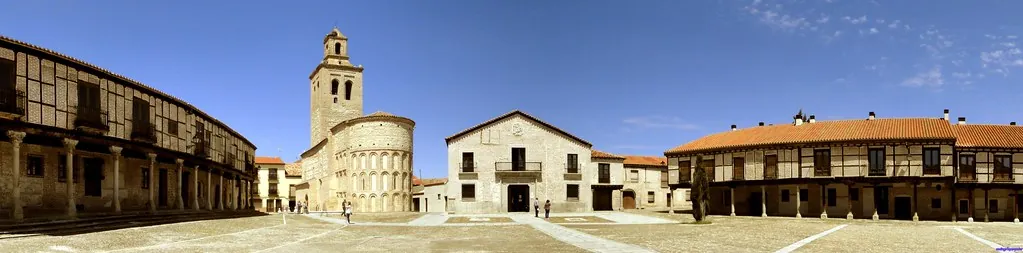
The built fabric of the village follows that same practical logic. Houses are mainly constructed from stone and adobe, sometimes whitewashed, using materials found nearby. They are designed with endurance in mind rather than display. The parish church stands in the main square, as it does in many villages across La Moraña. Its structure reflects different periods of work: extensions, repairs and alterations carried out whenever it was necessary to keep the building in use. Inside, there are usually simple altarpieces and popular religious imagery, pieces that speak more about continuity in parish life than about grand artistic commissions.
Fields that define the landscape
The countryside around Mamblas explains much of its character. Cereal fields stretch in every direction, and their appearance shifts with the seasons. In spring, the land turns green. By summer, it becomes a wide expanse of gold. After the harvest, the soil lies bare.
At first glance, the landscape may seem uniform. Spending time walking through it reveals small variations in relief, in how the light falls, and in the lines that mark the boundaries of each plot. These subtle changes give the area a quiet complexity that is easy to miss from a distance.
Several agricultural tracks lead out from the village and into the plain. They are not marked walking routes but working paths, still used by farmers and tractors. Even so, they offer a clear sense of the scale of the territory. Other villages appear faintly on the horizon. Silos and church towers act as visual markers across long distances. There are extended stretches where the only constant presence is the wind.
Steppe birds and quiet observation
La Moraña is part of a wider cereal-growing region where certain steppe birds still find suitable habitat. Around Mamblas, with patience and a pair of binoculars, it is sometimes possible to spot species such as the avutarda (great bustard), the sisón (little bustard) or the aguilucho cenizo (Montagu’s harrier). Sightings are not guaranteed. Often these birds are only glimpsed from afar, moving discreetly among the crops.
Anyone interested in birdwatching is expected to move carefully and remain on the paths, especially during the breeding season. The fields are both working land and a refuge for these species. Respecting that balance is part of understanding the place.
Silence plays a significant role here. Away from larger towns, sound carries differently. The wind, distant machinery, or the occasional call of a bird can define the atmosphere more than any constant background noise.
Food in the wider area
Mamblas itself is a small village and does not maintain services aimed at visitors. For meals, it is common to head to nearby, larger towns. Across the comarca, the food remains closely tied to agricultural life. Dishes tend to centre on legumes, cured meats and hearty stews, the kind of cooking that fits long winters and a rural setting.
In places such as Arévalo, a short drive away, it is easier to find somewhere to sit down and eat. These nearby towns provide a contrast in scale while still reflecting the same culinary traditions rooted in the land.
Seasons and village life
The rhythm of Mamblas shifts noticeably between the working year and the summer months. For much of the year, daily life is quiet and shaped by agricultural routines. The pace is steady, with activity linked to the needs of the fields.
In summer, as in many villages in the area, families who live elsewhere return. The population increases, and the main square becomes more animated. This seasonal change brings a different energy without altering the underlying character of the place.
Patron saint festivals usually take place during this period. They are simple celebrations, organised by local residents. The focus is less on spectacle and more on reunion and continuity. These gatherings reflect the social fabric of the village, where maintaining ties and shared customs remains central.
Mamblas does not present itself as a destination built for tourism. Its interest lies in how it reflects the wider landscape of La Moraña and the way of life that has developed there over time. The open fields, the restrained architecture and the quiet presence of both people and wildlife combine to form a place best understood at a slow pace.