Full Article
about Moraleja de Matacabras
Town on the northern plain; landscape of cereal fields and old vineyards.
Hide article Read full article
A village shaped by the plains of La Moraña
Tourism in Moraleja de Matacabras is less about ticking off monuments and more about understanding La Moraña. This small municipality in the north of the province of Ávila, with just over fifty inhabitants, sits at around 780 metres above sea level in the heart of this vast plain. The landscape sets the tone: wide cereal fields stretching with barely an interruption, and very small villages separated by kilometres of agricultural tracks.
Moraleja de Matacabras belongs fully to that agricultural world. The layout reflects it clearly. Houses cluster along a handful of streets, with corrals at the back and farmland immediately beyond. Over the past century the population has fallen sharply, as has happened across much of the comarca, yet the basic structure of the village has changed very little.
Even the name, Moraleja de Matacabras, raises questions. Various popular explanations circulate, some of them rather colourful, though clear documentation confirming any of them is hard to find. As with many ancient place names in this part of Spain, it is likely that the original form has shifted over time, gradually evolving into the version used today.
Everyday architecture and a parish church
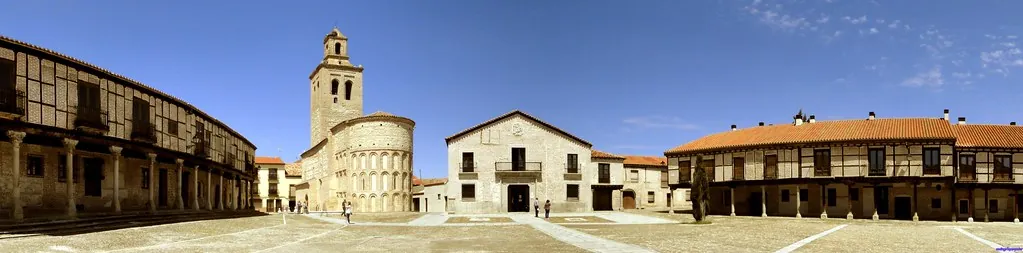
The main building in Moraleja de Matacabras is the parish church, positioned at one of the most visible points in the settlement. It is a simple structure built in masonry, with alterations from different periods that can be seen in its walls and later additions. Rural churches of La Moraña often served more than a strictly religious purpose. They functioned as meeting places and as visual reference points in an exceptionally open landscape.
Beyond the church, the interest lies in everyday architecture. Many houses still retain stone or rammed earth walls, large wooden gates reinforced with wrought iron nails, and stone lintels. On the upper floors it is still possible to identify spaces once used to store grain or tools. Corrals and small vegetable plots attached to the houses are reminders that, until only a few decades ago, household economies depended directly on the surrounding land.
Stepping outside the built-up area helps make sense of the place. Agricultural tracks encircle the village and cut through broad cereal plots. In spring the dominant colour is green; by summer the fields turn the golden shade of harvest. The horizon feels wide and horizontal, characteristic of La Moraña and central to its identity.
Walking through agricultural country
One of the simplest ways to approach the area is on foot, following the tracks that connect Moraleja de Matacabras with neighbouring villages. These are not signposted walking routes designed for visitors. They are agricultural roads used by tractors and machinery, so it is sensible to rely on a map or GPS for orientation.
The experience is defined by quiet observation. Partridges and hares are common sights in this cereal-growing countryside, and birds of prey can often be seen circling above the crops. The landscape reveals itself gradually: the pattern of fields, the occasional line of trees, the distant outline of another small settlement.
There are no tourist services in the village itself. Anyone looking for somewhere to eat or stay will need to head to larger municipalities in the comarca or to nearby towns elsewhere in the province of Ávila. Across the area, traditional dishes linked to rural Castile remain common, including dry-farmed pulses and classic roast meats. The cuisine reflects the same agricultural base that shapes the landscape.
Traditions tied to community
Local celebrations in Moraleja de Matacabras are usually concentrated in the summer months, when many former residents return. These fiestas are simple and organised by the inhabitants themselves. Religious acts form part of the programme, alongside gatherings in the square or along the village streets.
During these days, long-established customs come to the fore: shared meals, extended conversations outdoors, and evenings that stretch late into the night. In a settlement of this size, the primary role of the fiestas is reunion. They provide an opportunity for neighbours, relatives and friends to reconnect, reinforcing bonds that have been stretched by migration and the passing of time.
The rhythm of daily life outside the festive period is much quieter. With so few permanent residents, the village moves at a measured pace. The setting encourages attention to small details: the sound of wind across the fields, the changing light over the plains, the steady routine of agricultural work in the distance.
A visit within a wider journey
Moraleja de Matacabras can be explored quickly. A short walk is enough to cover its streets and to step out onto the surrounding tracks. The visit gains greater meaning when placed within a broader route through La Moraña. In this comarca, what matters most is not a single village or monument but the collective presence of the agricultural landscape and the understated history of its small localities.
La Moraña is defined by repetition and continuity: fields, horizons, compact settlements and parish churches punctuating the plain. Moraleja de Matacabras fits seamlessly into that pattern. Its value lies in how clearly it expresses the relationship between people and land, between settlement and cultivation.
For travellers interested in rural Spain beyond headline destinations, this corner of Castilla Leon offers a different perspective. There are no grand landmarks demanding attention. Instead, there is space, quiet and the sense of a landscape that has shaped generations. Moraleja de Matacabras stands as one small but telling example of that wider story, grounded in cereal fields, modest architecture and community life that still gathers strength each summer.