Full Article
about Muñomer del Peco
Moraña village with a seasonal lagoon that attracts birds.
Ocultar artículo Leer artículo completo
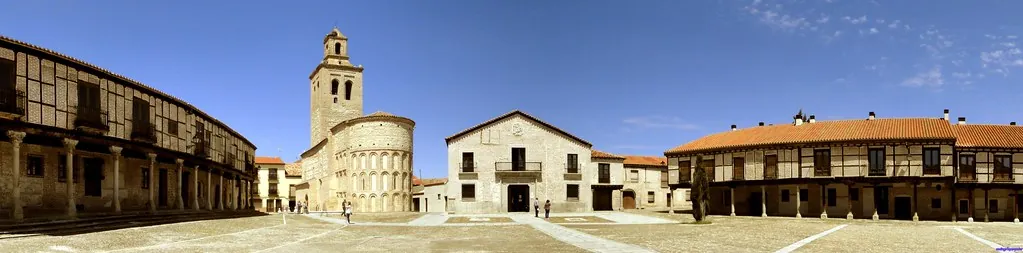
The cereal fields stretch so far that the horizon seems to bend. At 895 metres, Muñomer del Peco sits above the golden plain like a stone ship that forgot to sail. One hundred and ten souls, a handful of dogs, and a church tower are all that interrupt the wind here. If you want postcard Spain, keep driving. If you want to remember how quiet the world can be, stop.
The Village That Never Needed a Bypass
There is no ring road because traffic has never been a problem. The single street runs for 300 metres, narrows between adobe walls the colour of dry biscuit, then spits you back into the wheat. Houses are built from what lay underfoot: granite for the base courses, ochre earth for the bricks, timber hauled down from the Gredos foothills. Most front doors still carry iron studs forged in the local smithy—long closed, but nobody has bothered to remove the sign.
The plaza is not a plaza at all, just a widening where the road forgets its purpose. A stone bench, two plane trees and a drinking fountain dated 1897 complete the furniture. Mid-morning, the bench hosts the daily parliament: three retirees in flat caps who track strangers with polite suspicion. Say "buenos días" first; the reply comes slow but warm, and suddenly you are no longer a stranger.
A Church That Measures Time by Grain
The parish church of San Millán opens only for Mass at eleven on Sundays. The keyholder lives opposite—look for the house with the faded Real Madrid flag. She will let you in, provided you don’t mind her sweeping while you look. Inside, the air smells of beeswax and burnt straw; the floor slopes 12 centimetres from west to east, the result of centuries of foundation settlement on shrinking clay. Late-Romanesque arches frame the nave, but the real curiosity is the wooden Mudéjar ceiling: tiny pine planks fitted like a jigsaw, each numbered in Arabic numerals by the 15th-century carpenter who knew his beams would be hoisted by men who could not read.
Climb the tower if she offers. The bell is cracked—struck by lightning in 1936—and the view is mostly sky. To the north the Sierra de Ávila appears as a blue bruise; every other direction is a chessboard of cereal plots edged with poplars. In June the wheat is waist-high and the wind turns the surface into moving metal. By late July the harvesters have shaved it to stubble, and the colour drains to parchment.
Walking Without Waymarks
There are no signed footpaths because farmers never saw the need. Instead, tractor tracks radiate out like spokes. Pick any that leaves the village between stone gateposts topped with cattle skulls. After twenty minutes the only sound is your boots and the larks. The camino to El Barraco is the flattest: 7 kilometres of hard gravel that never rises more than 30 metres. Cyclists love it—until the wind flips round and they discover why the province is building Europe’s largest wind farm on the ridge behind.
Early risers may see great bustards stalking the fallow: turkey-sized birds that prefer walking to flying. Bring binoculars, but stay on the track; every hectare is owned, and roaming into crops is “mala educación”. If it has rained, the clay sticks like wet cement; trainers suffice in summer, but after October you’ll wish for proper boots.
Where to Eat When There Is No Menu
Muñomer del Peco has no bar, no shop, no ATM. The last grocery closed when the proprietor died in 2018; her daughter turned the front room into a sitting room again. Plan accordingly. Breakfast happens in Ávila before you leave—try the churros at Churrería la Catedral (€2.40 for six, open 07:30). For lunch, drive 18 minutes south to El Barraco where Asador El Rincón de Ávila does cordero asado that falls off the bone (quarter lamb €22, feeds two). Vegetarians survive on judiones—butter beans the size of fifty-pence pieces stewed with tomato and mild smoked paprika. The house rosé from Cebreros is chilled in an old beer fridge and tastes like strawberries left in the sun.
If you are staying in one of the village cottages, self-cater. The Tuesday market in Ávila fills the ring road with vans selling everything from morcilla to cheap socks. Buy chuletón—a T-bone the thickness of two iPhones—and grill it over the cottage’s vine trimmings; the smoke keeps the mosquitoes diplomatically distant.
Sleeping Under Granite Beams
Accommodation is limited to three restored houses booked through VRBO. Casa Rural El Peco keeps the original mangers as wall shelves; the bathroom is a glass cube dropped into what was the stable. Weekends start at €90, but entire weeks in February drop to €55. Heating is by pellet stove: one bag lasts 24 hours, and the owner leaves three—enough, he says, “para inglés que viene del norte”. Mobile signal fades in and out; the Wi-Fi is a 4G router balanced on a wardrobe. It copes with emails, not Netflix.
The smarter option is Sofraga Palacio, ten minutes away in the hamlet of Muñogalindo. A 17th-century manor rebuilt after a fire, it has four rooms with beams you can’t reach even standing on the bed. British guests on Expedia rave about the breakfast “with homemade cake and proper coffee”. Dinner is available if you preorder; they buy the lamb from the same butcher you drove past earlier.
The Calendar Nobody Prints
Festivity here is private. The fiestas of San Millán begin on the third weekend of August when emigrants return from Madrid and Barcelona. A sound system appears in the plaza, powered by cables snaking into somebody’s front room. Saturday night ends with a verbena that lasts until the generator runs out of diesel—usually around 03:30. Visitors are welcome but not announced; buy beer from the makeshift bar in the school playground (€1.50 a caña) and nobody asks questions.
Winter brings the matanza, the family pig-kill. You will not find it on TripAdvisor. If invited, arrive hungry at eight; by noon the animal has become chorizos, morcillas and manteca spiced with pimentón. Refusal is taken personally—vegetarians should invent a convincing allergy.
When the Weather Is the Attraccion
April and May turn the plain emerald; poppies splatter red across the wheat like paint flicked from a brush. Temperatures hover around 18 °C at midday, but the wind can shave five degrees off that. September is the mirror image: stubble fields glow bronze under 24 °C sunshine, and the light is so clear you can count the wind turbines on the horizon. Both seasons are ideal for walking or cycling.
July and August belong to the sun. At midday the tar softens and the village emptes; even the dogs seek shade under the bench. Sightseeing shifts to 07:00 or after 18:00. January is brutal: the thermometer dips to –8 °C at night, and the mist lingers until lunch. Roads ice over; without winter tyres you will slide sideways on the AV-522. Come then only if you crave solitude and know how to light a pellet stove.
Leaving Without Goodbye
Muñomer del Peco will not beg you to stay. By the time you reach the last house the wheat has already forgotten your footprints. Yet something sticks: the way the church bell clangs flat at noon, the smell of straw heating in the sun, the old man who raised his cap instead of waving. You will not tick off masterpieces or boast about nightlife. Instead you will remember how loud your own thoughts become when the rest of the world finally shuts up.