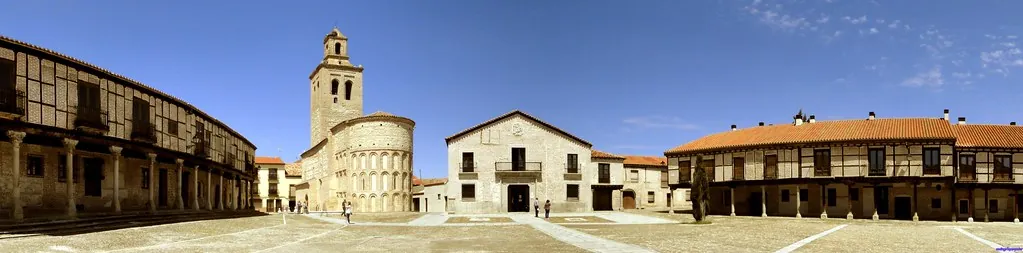
Vista aérea de Muñosancho
Instituto Geográfico Nacional · CC-BY 4.0 scne.es
Castilla y León · Cradle of Kingdoms

Muñosancho

The church bell strikes noon, yet nobody appears. A single stork lifts off the tower, circles once above cereal fields the colour of parchment, and...

87 inhabitants · INE 2025
905m Altitude

Why Visit

Mountain Church of San Juan Bautista Cycling routes

Best Time to Visit

summer

San Juan Festival (June) junio

Things to See & Do
in Muñosancho

Heritage

  • Church of San Juan Bautista
  • cereal fields

Activities

  • Cycling routes
  • Rural tourism

Festivals
& & Traditions

Fecha junio

Fiestas de San Juan (junio)

Las fiestas locales son el momento perfecto para vivir la autenticidad de Muñosancho.

Full Article
about Muñosancho

Agricultural municipality on the plain; includes the village of Villamayor

Ocultar artículo Leer artículo completo

Stone, Sky and Silence at 905 Metres

The church bell strikes noon, yet nobody appears. A single stork lifts off the tower, circles once above cereal fields the colour of parchment, and glides south toward the Sierra de Ávila. In Munosancho, population ninety, the loudest sound is often the wind combing through barley stubble. At nine hundred and five metres above sea level, the village sits squarely on Spain’s northern plateau, the Meseta, where horizons feel wider than the day itself.

Most motorists flash past on the N-502 that links Ávila to Salamanca, unaware the turn-off even exists. Those who do swing left at kilometre sixty-seven face twelve kilometres of empty tarmac that wriggles across wheat estates the size of English counties. Phone signal dies after the first ridge; by the second, Madrid’s radio stations dissolve into static. What remains is a settlement that looks almost embarrassed to have interrupted the plains.

A Walk Through Tapial and Sun-bleached Timber

No souvenir stalls guard the entrance, no brown heritage signs point the way. Park by the brick water trough at the top of the hill – there is nowhere else – and the village reveals itself in a single sweep: two parallel streets, a cluster of two-storey houses the colour of weathered leather, and the tower of San Pedro Apóstol rising like an afterthought. Everything is built from the same palette: limestone for the corners, tapial (mud-laid walls) for the infill, terracotta tiles fired in local kilns a century ago. The effect is less picture-postcard, more working blueprint for rural survival.

Step inside the church and the temperature drops ten degrees. The interior is plain, almost protestant: a single nave, rough-hewn pews, walls limewashed the shade of old parchment. A 16th-century font sits off-centre, still used for baptisms when grandchildren return each August. Look up and you’ll notice the roof beams are poplar, hand-adzed and pegged, darkened by four hundred years of frankincense and wood-smoke. Outside again, keep an eye out for the palomar opposite the bakery: a square dovecote whose upper tier is crumbling like stale cake, yet whose nesting holes still echo with soft cooing every evening.

Spend twenty minutes walking the grid of lanes and you will have seen the lot – but the details reward a slower pace. Iron door-knockers shaped like falconers’ gloves; a stone trough where women once soaked chickpeas overnight; a timber balcony added in 1932 so the doctor’s wife could watch processions without leaving her chair. Each house has a name rather than a number: Casa de los Tres Chorritos, Casa del Medio – titles earned through water rights, birth order or simply gossip. Ask for directions and locals still use them.

What the Fields Remember

Leave the last streetlight behind and a lattice of farm tracks fans outward, etched by tractors whose tyres are wider than the lanes themselves. The going underfoot is firm – chalky soil baked hard – but boots are advisable; thistles here could teach Scottish ones a lesson. Head east for twenty minutes and you reach a Bronze-Age burial mound locals call El Morrillo, barely noticeable until you are on top of it. From the summit the view is pure geometry: square plots, dead-straight drove roads, and the faint blue outline of the Gredos mountains seventy kilometres beyond. Bring binoculars and the illusion dissolves into life: skylarks threading the thermals, great bustards lumbering skyward like overweight cargo planes, and red kites tilting against a wind that tastes of thyme and dry earth.

There are no signed footpaths, no heritage waymarks. Instead, farmers will point you toward the next village with a wave of the hand and the words “todo llano” – it’s all flat – which is true until you hit an unexpected barranco carved by winter torrents. Stick to the broadest track and you can reach Solosancho in an hour, where the only bar opens at nine and still serves coffee for €1.20. If you prefer loops, bear south-west toward Muñogalindo; the return skirts an abandoned shepherd’s hut whose roof has collapsed inward, revealing a rusted bed-frame now home to a family of geckos.

Eating (or Not) on the Plateau

Munosancho has no shop, no bakery, no pub. The last grocery closed when its proprietor, Doña Feli, died in 2017 at ninety-four. Plan accordingly: stock up in Arévalo (twenty-five minutes’ drive) or bring a packed lunch and ask politely to sit on the stone bench outside the church – no one will object, though they may wonder why you aren’t eating in your car like Spanish day-trippers.

If you crave a tablecloth, drive ten kilometres to Solosancho where Mesón Moraña serves a weekday menú del día for €12. Expect a bowl of judiones – butter beans the size of conkers stewed with morcilla and bay – followed by chuletón for two, a T-bone thick as a bible and charred on an oak-wood grill. Vegetarians get pimientos del piquillo stuffed with goat’s cheese; nobody goes hungry. Wine comes in a plain glass bottle filled from the cask and costs €2 a quarter-litre; it tastes better after you’ve walked the fields.

Sunday lunch demands forward planning. Half the county drives to grandmothers’ houses at one o’clock sharp; restaurants lock their doors. Aim for Saturday instead, or reserve at La Casa del Cura in nearby Navarrevisca, where roast suckling lamb arrives with a crust so crisp it shatters like toffee.

When the Sky Turns Gold, and Other Practicalities

Sunset is the village’s nightly masterpiece. Around eight-thirty the sun drops below the sierra, flooding the cereal stubble in molten light so intense it seems to hum. Locals emerge onto doorsteps with coffee cups and regard the spectacle in companionable silence; visitors are welcome to join, but conversation stays low – the plateau feels too exposed for loud voices.

Accommodation within Munosancho itself is limited to one self-catering cottage, Casa Rural El Pajar, converted from a hayloft and sleeping four. Expect stone floors, wool blankets, and a wood-burning stove that takes the edge off autumn nights when the mercury can dip to five degrees even in September. At €90 a night it’s warm, clean and honest, though you’ll need to bring groceries and kindling. Phone reception flickers between 3G and none; broadband is a polite fiction. The owner leaves a stack of walking notes and OS photocopies, but no television – the stars serve that purpose once light pollution disappears.

If you prefer a hotel, base yourself in Arévalo or Ávila. Both lie forty minutes away on fast roads, allowing day-trips that include wall-to-wall castles, Romanesque churches and, in Arévalo’s case, a surprisingly good craft brewery. Hire cars at Madrid airport; the last petrol before the wilderness is at the N-502 service station – fill up, because Monday closures extend to fuel pumps in villages.

A Final Word of Honesty

Munosancho will not change your life. There are no zip-wires, no Michelin stars, no gift-shop fridge magnets. Come in July and the heat is furnace-dry; come in February and the wind razors every patch of exposed skin. The village bar is a memory, the bakery sells nothing, and the only soundtrack after ten at night is the occasional bark of a guard-dog echoing across the plains.

Yet for travellers who measure value in silence, space and the slow reveal of detail, Munosancho offers something increasingly scarce: a landscape that refuses to perform for tourists. Bring boots, binoculars and a sense of temporal humility. Walk the tracks, nod at the storks, buy beans in Arévalo and cook them while the sun sets. Then switch off the light and let the Meseta teach you its oldest lesson – that sometimes the most interesting thing on the horizon is the horizon itself.

Key Facts

Region
Castilla y León
District
La Moraña
INE Code
05142
Coast
No
Mountain
Yes
Season
summer

Livability & Services

Key data for living or remote work

2024
TransportTrain nearby
Housing~5€/m² rent · Affordable
CoastBeach nearby
January Climate4°C avg
Sources: INE, CNMC, Ministry of Health, AEMET

Planning Your Visit?

Discover more villages in the La Moraña.

View full region →

More villages in La Moraña

Traveler Reviews