Full Article
about Narros de Saldueña
Known for the Castle of the Duke of Montellano.
Hide article Read full article
A Detour Worth Taking
Narros de Saldueña is the kind of place you can drive through without ever realising what you have missed. It sits in the comarca of La Moraña, in the province of Ávila, and has around a hundred residents. Many people arrive by chance, often after taking a minor road that promises to shave a few minutes off the journey.
At first glance there is little that announces itself. No grand monuments, no obvious tourist attractions, nothing designed to pull in crowds. And that is precisely why it is worth stopping. Stretch your legs, step away from the car and the village begins to make sense.
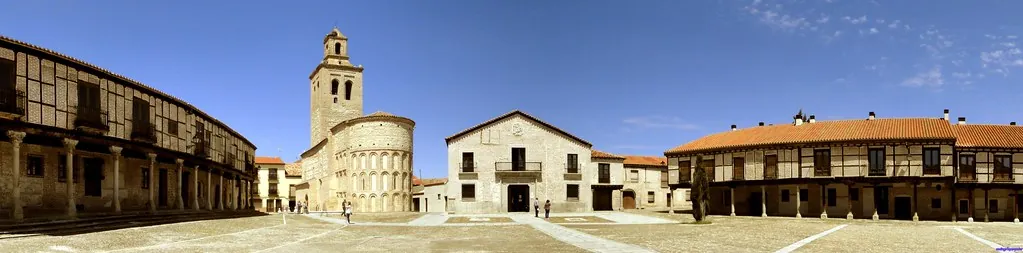
At roughly 900 metres above sea level, Narros de Saldueña shares the practical architecture typical of the Castilian plateau. Stone and adobe houses line short streets that are usually quiet. Thick walls and small windows speak of winters that demand insulation and summers that require shade. Large wooden gateways, once built to admit carts, now stand as reminders of a more agricultural rhythm of life. A few renovated façades interrupt the uniformity, yet overall the impression is of a place altered only when necessary.
Streets Shaped by Work and Weather
The village centre is compact. You can cross it in ten minutes, yet it rewards a slower pace. Details begin to emerge: rammed earth walls, whitewashed façades, enclosed yards attached directly to the house, heavy wooden doors worn smooth by time.
These homes were designed with daily labour in mind rather than decoration. For generations, life here revolved around farming and livestock. That practical focus is still visible in the layout of the buildings, where living space and working space sit side by side.
The parish church marks the heart of Narros de Saldueña. It is not monumental in scale, but it acts as a clear focal point. The square gathers around it. Conversations linger nearby after mass. In summer, when the sun presses down hard on the plateau, its shade becomes a natural meeting spot. In a village of this size, the church is less about spectacle and more about orientation. Everything seems to arrange itself around it.
Silence is part of the experience. In cities not far away, traffic and constant movement set the tone. Here, the pace is slower and the background noise is often little more than wind or the occasional passing vehicle on the outskirts.
The Open Expanse of La Moraña
Step beyond the last houses and the defining feature of the area appears: the broad cereal plains of La Moraña. This landscape is open and expansive, and it shifts character with the seasons.
In spring, green fields stretch across the horizon. By summer, the colours turn golden as the harvest approaches. Autumn brings freshly turned soil and reddish tones that feel unmistakably Meseta, the high central plateau of Spain. From a distance the view can seem almost uniform, as if the same field were repeated again and again.
Walking a little further reveals subtler variations. A small stream cuts through a dip in the land. Isolated trees stand alone against the sky. Agricultural tracks criss-cross between plots, forming a quiet network of routes used by farmers rather than visitors.
This is also a landscape associated with steppe birds. With patience, it is sometimes possible to spot great bustards, little bustards or harriers gliding low over the crops. Sightings are never guaranteed. The countryside follows its own rhythms and rewards those willing to wait and watch. For anyone who enjoys scanning the horizon and paying attention to movement in the distance, there is plenty of sky to hold your gaze.
Walking Without a Plan
One of the simplest things to do in Narros de Saldueña is also the most fitting: head out along the agricultural tracks that surround the village. They are flat, easy to follow and require no special preparation. It is perfectly possible to choose one at random and start walking.
The pleasure lies less in covering distance and more in settling into a slower rhythm. Notice footprints pressed into the dust. Look at birds perched along the cables. Watch how the colour of the fields shifts from one plot to the next. These are small details, yet they shape the experience.
Spring and autumn are usually the most comfortable seasons for walking here. In summer, the sun over La Moraña can be intense. In winter, the wind has a reputation for being sharp and persistent, the sort that makes returning to the car feel especially welcome. The conditions are part of the character of the plateau, and they influence how long you linger.
There are no marked tourist routes or interpretation panels explaining what you are seeing. The appeal is precisely that nothing has been overly curated. It is a landscape that functions first for agriculture, with visitors fitting quietly into that existing pattern.
Getting There, Keeping It Simple
Narros de Saldueña lies about 30 kilometres from Ávila and is reached by secondary roads that are generally quiet. The drive is straightforward, with open countryside stretching out on either side for much of the way.
From Madrid, the usual approach is to take the A‑6 towards the area of Adanero, continue in the direction of Ávila and then turn onto local roads that pass through several villages in La Moraña. The journey itself reinforces the sense of space that defines the region.
It is best to arrive without a checklist of sights to tick off. Narros de Saldueña works well as a calm pause rather than a destination packed with landmarks. Stop for a short walk, wander through its streets, stand for a while looking out over the fields. Often that is enough to understand what makes this small village in Castilla Leon distinctive.
There may be no grand attractions, yet the combination of modest architecture, open landscape and unhurried pace leaves a quiet impression. Sometimes the most interesting places are those that reveal themselves only when you decide to get out of the car and look around.