Full Article
about Narros del Castillo
A village with history and a striking Mudéjar church; a vanished fortress.
Hide article Read full article
A village on the plains of Ávila
Narros del Castillo sits in the middle of La Moraña, a wide agricultural plain in the west of the province of Ávila. The landscape is open and largely given over to farming. Broad cereal fields set the rhythm of the land, stretching out with very little interruption.
The village has around 150 residents and still keeps the scale and character typical of working rural settlements in this part of Castilla y León. Everything feels arranged for daily agricultural life rather than for visitors. Streets are short, houses are close together, and the layout reflects practical needs shaped over generations.
For centuries, La Moraña was closely tied to Ávila as a farming region. Its villages grew around small agricultural communities, and Narros del Castillo follows that same pattern. The built environment is modest, functional, and rooted in the routines of cultivation and seasonal work.
The name of the village hints at a medieval past. At some point there was a fortification here, although no clear remains of a castle survive today. The memory lingers more in the name than in visible structures. Even so, the layout of the village suggests an older origin, with streets that appear to adapt to an earlier settlement rather than following a rigid plan.
Santa María at the centre
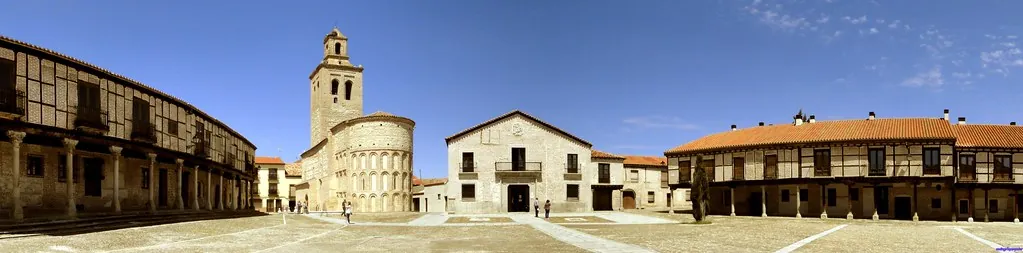
The parish church of Santa María stands at the heart of Narros del Castillo. Its tower rises above the low houses, making it the most visible building in the village. Constructed in stone, the church shows different phases of work, the result of gradual changes over time.
The current building reflects successive alterations rather than a single unified design. The nave is plain, with little ornamentation. Some arches and openings retain features associated with rural Mudéjar styles, a blend of Christian and Islamic building traditions that appeared across parts of Castilla. These details are subtle, but they point to a long history of shared techniques and materials.
More than its size or decoration, the church matters as a focal point. For centuries it gathered together both religious life and much of the village’s social activity. Its presence still defines the centre of Narros del Castillo.
Houses shaped by the land
The streets are lined with homes built from stone and adobe. Many have large doorways, originally designed to allow carts and farming tools to pass through easily. In some cases, carved stone pieces appear in the lintels, adding small but noticeable details to otherwise simple façades.
It is common to see interior courtyards or attached corrals. In this setting, the house and agricultural work were closely linked, often forming a single unit. The architecture reflects that direct relationship with the land, where living space and working space were not sharply separated.
Some older houses still preserve traditional heating systems known as glorias. These worked by channelling heat from smoke beneath the floor, warming the rooms above. It was a practical solution widely used across the Spanish plateau, particularly in areas with cold winters.
The shifting colours of La Moraña
The surroundings of Narros del Castillo are defined by the typical landscape of La Moraña: wide fields, open plots, and agricultural tracks connecting farms and nearby villages. There is very little variation in elevation, which gives the terrain a broad, uninterrupted feel.
Colour changes dramatically with the seasons. In spring, the fields turn green with young cereal crops. By summer, the tones shift to gold as the harvest approaches. Afterwards, the land becomes drier, marked by stubble and fallow fields.
With so little relief in the terrain, the sky takes on a strong presence. Clouds and light play a constant role in how the landscape is perceived throughout the day. Subtle shifts in weather can alter the mood of the entire plain.
Walking the agricultural tracks
Several agricultural tracks lead out from the village into the surrounding fields. These are simple paths, not designed as marked walking routes. Their primary purpose is to provide access to farmland.
Walking along them offers a clear sense of the scale of the region. The land is flat and open, with long views in every direction. Anyone planning to walk further afield should have a basic sense of orientation, as there is no signage to guide visitors.
In these fields, it is common to hear skylarks or to spot birds of prey circling above the crops. Observing them requires patience. There are no designated viewpoints or facilities, just the quiet of the open countryside.
A small village with a steady rhythm
Narros del Castillo does not revolve around major monuments. Its interest lies in how it preserves the structure and atmosphere of an agricultural village on the plains of Ávila.
Local festivities tend to take place in summer, when many former residents return. The celebrations linked to Santa María continue to shape the traditional calendar of the village, maintaining a connection between past and present.
The village itself can be explored quickly. What lingers afterwards is the landscape, and the sense of being in one of the most open parts of the province of Ávila, where daily life has long been tied to the land.