Full Article
about Orbita
Small town in La Moraña beside the A-6; Mudejar church and fields
Ocultar artículo Leer artículo completo
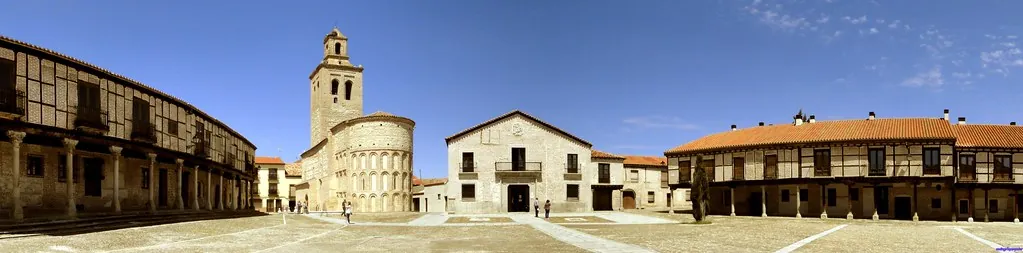
The church bell strikes noon and nobody hurries. A tractor idles outside the only bar, its driver sipping a caña that costs €1.20. This is Orbita, 70 souls scattered across the wheat ocean of La Moraña, 40 kilometres north of Ávila. No souvenir stalls, no guided tours, no Instagram hotspots—just the Spain that guidebooks forgot to mention still exists.
The architecture of everyday life
Adobe walls the colour of dry earth lean gently into lanes barely wide enough for a Citroën. Timber gates hang from medieval iron hinges; some open onto dusty courtyards where chickens scratch between flowerpots. The parish church—no great cathedral, simply the village’s gravitational centre—mixes brick and stone in the way builders here have done since the twelfth century. Step inside and the temperature drops five degrees; the air smells of wax and centuries of frankincense. Look up: the bell tower is open to storks, who clatter overhead like faulty clockwork.
Beyond the single plaza, houses thin into smallholdings. A corrugated-iron barn stores last season’s straw bales; a rusted harrow sits beside a pile of red roof tiles waiting for the next storm. Nothing is curated, nothing is “heritage.” It is simply still working.
Walking the square-grid fields
Leave the village on any cart track and within five minutes you are alone. The land spreads in kilometre-square panels of cereal, edged by poppies in May and stubbled gold by July. Waymarking is sporadic—look for the double-dash painted on concrete posts—so download the free Ávila province map before you set out. Distances feel longer than they are; the horizon is so wide that a neighbouring hamlet seems to recede as you approach.
Two easy loops start from the cemetery gate. The shorter (6 km, flat) swings past an abandoned sheep fold where eagle owls sometimes roost at dusk. The longer (12 km, still flat) links Orbita with Villar de Puercas and back along a farm track where bustards—Europe’s heaviest flying bird—step between the rows like wary parishioners arriving late to mass. Bring binoculars and a windproof; the plateau funnels every breeze into a steady push.
Cyclists find the same roads blissfully empty. Tarmac is rough but intact, gradients negligible, traffic one car every twenty minutes. The catch: the wind that fills your lungs can turn malignant. Outward leg with a tailwind feels heroic; the return journey can reduce even fit legs to jelly. Plan accordingly—loop clockwise if the forecast promises westerlies.
What you will (and won’t) eat
Orbita itself has no restaurant. The bar opens at seven for coffee and serves tortilla the size of a cartwheel until it runs out, usually by two. Expect to pay €2 for a slice, €1.50 for a glass of local red that arrives at whatever temperature the bottle has reached that afternoon.
For anything more elaborate, drive ten minutes to Arévalo. There, La Tahona de la Abuela does roast suckling lamb (€22 half portion, order ahead) and a thick bean stew flavoured with morcilla that could restart a stalled tractor. Vegetarians should ask for ajos molineros, a garlicky rice dish originally fed to millers during night shifts; most kitchens will oblige if warned.
Buy supplies before you arrive. The village shop closed in 2008; the nearest supermarket is a Condis in Arévalo, shut on Sunday afternoons with Spanish precision. Bring coffee, milk, and anything green—rural Castile treats vegetables as suspicious imports.
When to come, when to stay away
April and May turn the plateau into a pointillist canvas of crimson poppies and violet flax. Temperatures hover around 18 °C, nights cool enough for a jumper. September repeats the trick, adding the smell of freshly threshed barley.
July and August are fierce: 35 °C by eleven in the morning, shade confined to the lee of church walls. The village empties as families head to the coast; only the tractor drivers remain, starting at dawn and finishing by two. Accommodation exists—Casa Rural del Maestro on the edge of the village offers two bedrooms, stone floors, and a telescope for night-sky viewing—but you will need it mainly for siestas. Bring earplugs; storks clatter on the roof at first light.
Winter is monochrome and not cosy. Daytime 7 °C, nighttime minus five. The roads get gritted eventually, but “eventually” is elastic. If snow arrives—rare but possible—you may be stuck for a day. On the plus side, the sky achieves a cobalt intensity unknown to northern Europe, and every chimney puffs almond-scented smoke from burning prunings.
Nightfall without sodium
Street lighting consists of three lamps on timers; by midnight only the church is faintly outlined. Walk fifty metres beyond the last house and darkness becomes total. On clear nights the Milky Way spills overhead like carelessly thrown sugar. Meteor showers in August need no apparatus—just lie on the warm bonnet of your rental and count. The village’s altitude (880 m) thins the air enough for stars to snap into focus, yet you are still low enough to avoid altitude headaches.
Silence is equally pure. No motorway hum, no aircraft stacking over Madrid—only the occasional clank of a cowbell or the soft thud of a fruit falling in someone’s orchard. Light sleepers may find the absence of noise oddly loud.
Practical fragments
Getting here: Fly into Madrid, collect a hire car, and take the A-6 northwest for 90 minutes. Leave at junction 81 for Arévalo, then follow the CL-601 north for 18 km. The final turn is signposted “Orbita 6 km” in letters that look an afterthought. Petrol stations close at 22:00; fill up in Arévalo if you arrive late.
Where to sleep: Besides the aforementioned Casa Rural del Maestro (€90 per night, minimum two nights at weekends), the nearest hotel is the three-star Hotel Restaurante Casa de Tepa in Arévalo—comfortable, slightly fusty, with a pool that faces directly into the evening sun.
Wi-Fi: The bar has fibre broadband faster than most London cafés, but it switches off when the owner leaves at 21:30. The casa rural includes internet; download your box sets before you fly because the village has no cinema, no pub quiz, no nightlife beyond the storks.
Parting shot
Orbita will not change your life. It offers no epiphany, no bucket-list tick, no story that trumps dinner-party tales of San Sebastián tapas. What it does give is a calibration point: a place where the day is measured by shadow length, the week by market day in Arévalo, the year by the slow rotation of crops. Come if you need reminding that Spain still contains ordinary villages getting on with the business of staying alive. Leave the selfie stick at home; bring instead a tolerance for quiet and a willingness to nod at strangers who will, inevitably, nod back.