Full Article
about Pajares de Adaja
Town on the Adaja river; noted for its Mudéjar church and pine woods.
Ocultar artículo Leer artículo completo
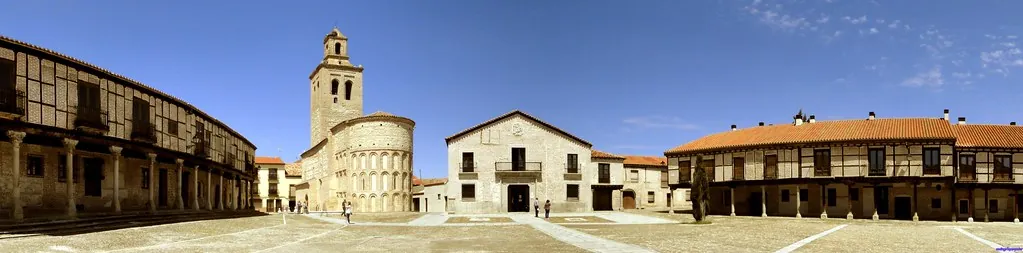
The thermometer reads six degrees cooler than Madrid, even though the capital lies only ninety minutes south-west. At 878 metres above sea level, Pajares de Adaja sits high enough for the air to carry a sharper edge, yet low enough to feel the full force of the Castilian plateau. There is no gradual climb; the village arrives suddenly after a straight road through wheat, the bell tower of the parish church pricking the horizon like a compass needle.
A Village That Measures Time by Grain, Not by Clocks
Five thousand souls are registered on the municipal roll, but on a Tuesday in March you will count fewer than fifty in the streets. The others are scattered across the surrounding grain belt or have shifted to Ávila, twenty-seven kilometres away, for weekday work. What remains is a working settlement rather than a museum: diesel pickups parked beside stone houses, the occasional combine harvester wedged into a cul-de-sac barely wider than its tyres, and the smell of straw that drifts in through open doorways.
The architecture refuses to choose between centuries. One façade is granite blocks mortared in the 1800s; its neighbour is 1970s brick painted a fading salmon pink. Clay roof tiles curl like dried leaves beside corrugated tin extensions. Nothing is staged, and that is the point. Visitors expecting a honey-coloured film set leave disappointed; those curious about how Castilians actually inhabit the plateau find the place quietly absorbing.
Walking the Grid That Isn’t
Pajares never bothered with a medieval labyrinth. The four main streets run parallel to the Adaja river, and three cross-streets stitch them together; the whole grid can be paced in twenty minutes. Yet the angles shift slightly, following the fall of the land, so the church tower keeps re-appearing from different vantage points like a landmark in a children’s puzzle book.
Outside the built strip, the soil takes over. Country lanes radiate for kilometres, dead-straight except where they kink to avoid a threshing floor or an abandoned dovecote. These tracks are public; there are no stiles, no Rights of Way signs, simply the understanding that anyone may walk the agricultural verges as long as the wheat is not trampled. In April the green is almost luminous, broken only by crimson poppies that the farmers tolerate because they attract pollinators. By July the same fields have bleached to blond, and the air quivers with heat that ricochets off the limestone sub-soil.
Bring water. Shade is scarce; holm oaks were felled centuries ago to make way for the plough. A circular route south to the ruined cortijo of El Carrascal and back is 7.5 km, flat enough for trainers rather than boots, but exposed throughout. On windy days the dust lifts and stings exposed ankles; in winter the same wind carries snow that horizontal-blinds the landscape and can close the N-502 for hours.
Birds, Bread and the Problem of Lunch
Dawn is the moment for ornithologists. Calandra larks rise first, trilling above the unharvested stubble, followed by hen harriers that quarter the field margins on wings held in a shallow V. You will hear the cuckoo long before you see it; the plateau acoustics carry the call for kilometres. No hides, no visitor centre, just patience and a pair of binoculars wedged against a dry-stone wall.
By ten o’clock the stomach reminds you that Pajares has no café. The single grocery opens only on weekday mornings, stocking UHT milk, tinned asparagus and the local beans that taste of chestnut when slowly stewed. If you want someone else to cook, you drive. In Mingorría, twelve minutes north-east, Mesón Asador La Fuente will serve lechazo (milk-fed lamb) roasted in a wood oven whose aroma drifts into the street. A quarter portion feeds two, costs €22, and arrives with a plate of pimientos de padrón that have more kick than their Galician cousins. Book ahead at weekends; the restaurant fills with families who treat Sunday lunch like a semi-religious obligation.
When the Village Closes Its Eyes
August fiestas flip the rhythm. The population quadruples as grandchildren return from Madrid and Valladolid. A temporary bar appears in the plaza, pumping out 1990s Spanish pop until three in the morning; grandparents pretend to disapprove but tap their feet just the same. The bull-run here involves heifers with padded horns, chased by teenagers who have spent the afternoon practising sprint starts along the football pitch. No tickets, no seating, simply turn up and stand behind the metal grilles that shopkeepers bolt across doorways for the occasion.
Outside fiesta week the silence can feel absolute. After eleven the only sound is the grain store’s conveyor belt if a late lorry arrives. Cloudless nights deliver star-scapes so clear that Orion seems within arm’s reach; the altitude thins the air and sharpens every constellation. Bring a jacket even in July—the temperature can drop fifteen degrees once the sun slips behind the Sierra de Ávila.
A Bed Under the Eaves
El Observatorio del Adaja is the only place to stay inside the village. The name is literal: the owner, a retired physics teacher, mounted a six-inch Schmidt-Cassegrain telescope on the roof. Guests sign up for ninety-minute sessions that track Jupiter’s moons above the light-free plateau. Rooms are simply furnished with beams rescued from a 1920s threshing floor; underfloor heating counters the night chill. Rates start at €85 including breakfast (strong coffee, home-made sponge cake, and honey from hives tucked behind the cemetery wall). There is no reception desk; the key hangs in a coded box and silence is requested after ten—not through snobbery, but because sound travels in the clear air and neighbours rise at five to load tractors.
If the observatory is full, the nearest accommodation is in Arévalo, twenty minutes by car. The parador there occupies a fifteenth-century castle, its keep converted into a cocktail lounge where the moat once stood. Double rooms cost twice the village rate, but the roast suckling pig is superb and the walls muffle the dawn tractors.
Getting There, Leaving Again
No train reaches Pajares. From Madrid, drive the A-6 to Ávila, then take the N-502 north-west for twenty-seven kilometres. The turn-off is signalled only by a small white stone; miss it and you will meet the junction for the AVE railway works, half-built and abandoned when the high-speed route was re-routed. Car hire is essential; buses run twice weekly from Ávila market place but depart at 6 a.m. and return at midday, giving you four hours on the ground—enough for the grid walk, a coffee from a flask, and little else.
Fill the tank before you leave the motorway. The village garage closed in 2008, and the nearest petrol is a twenty-minute detour. In winter carry chains; the plateau ices early, and the council gritter covers school routes first, tourism second.
Worth the Journey?
Pajares de Adaja will never feature on a regional tourism poster. It offers no souvenir shops, no Michelin stars, no selfie-ready viewpoints. What it does provide is a calibration point: a chance to recalibrate your sense of scale against an landscape that has fed Spain since the Iron Age, and to watch a community that still negotiates daily life with the sky rather than the clock. Come for the clarity of the light, the crunch of stubble underfoot, and the realisation that twenty-four hours can stretch satisfyingly long when nobody is trying to sell you anything. If that sounds like thin gruel, stay on the motorway. The exit ramp will still be there when you change your mind.