Full Article
about Papatrigo
Farming town with an interesting church; it keeps rural traditions alive.
Hide article Read full article
Evening Light on the Plains of La Moraña
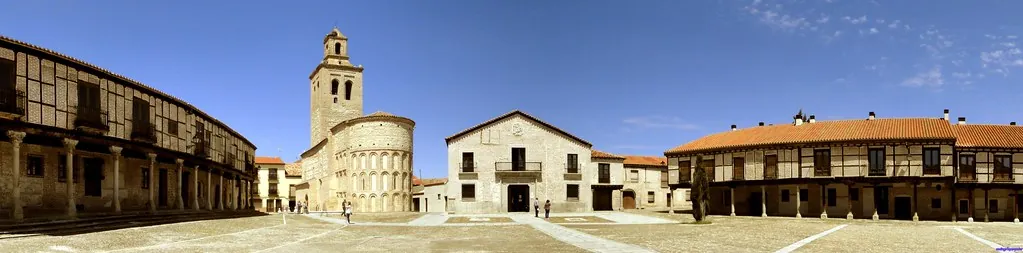
Late in the day, the light spreads low and wide across the fields of La Moraña. In Papatrigo, that light brushes against adobe façades and lingers for a moment on the church tower before fading into the cereal fields beyond. The air carries the scent of dry earth and straw, and sometimes the faint dust stirred up by a car moving slowly along the road.
Papatrigo is a small municipality in the comarca of La Moraña, in the province of Ávila, with just over two hundred registered residents. The village stands in the middle of a broad grain-growing plain. Its streets are straight, the houses low, with yards and corrals tucked behind them, and the horizon open in every direction. Here, the landscape holds as much presence as the buildings. In summer everything turns gold. In winter the fields are bare and the wind is easier to hear.
There are no grand monuments and no historic quarter arranged neatly on a map. Instead, there are threshing floors on the outskirts, large gateways built for carts, and the particular quiet of small villages where the sound of a door opening or a tractor starting up still carries across the street.
Adobe Houses and the Tower of San Andrés
The clearest outline in Papatrigo’s skyline is the church of San Andrés. Its tower rises above the rooftops and acts as a reference point when approaching along any of the country tracks that lead in from the fields. The building combines stone and brick, common materials in this part of Ávila, where adobe was for centuries the most accessible resource.
Walking through the streets reveals solid, heavy houses with thick walls that keep interiors cool during the hot months. Many have large wooden gates and small windows. Behind them are often patios or corrals that once stored tools, animals or harvested grain.
Around the edge of the village, a few agricultural structures still remain: partially collapsed dovecotes, old barns and the eras, the open threshing floors where grain was once separated from chaff. These details speak of La Moraña’s cereal-growing past. In Papatrigo, that past is not distant history but fairly recent memory.
Walking the Edge of the Village
In Papatrigo, the most natural walk is not through a centre filled with sights, but along the edge where the streets dissolve into dirt tracks. A few minutes on foot is enough for the village to fall behind, replaced by plots of wheat or barley stretching out almost without trees.
The light shifts dramatically with the seasons. In spring, green covers the landscape and the wind moves through the young stalks in a way that resembles water. By July and August, the colour turns to gold and fine dust clings to shoes.
Anyone planning a walk is better off choosing early morning or the end of the afternoon. La Moraña offers very little shade, and on hot days the sun beats directly down on the paths. The experience here depends largely on paying attention to small changes: cracked adobe walls, the sound of wind passing through grain, the way light settles on the old threshing floors.
Other Villages Across La Moraña
Papatrigo sits within a patchwork of small villages scattered across La Moraña. Many share a similar structure: straight streets, adobe houses and fields encircling the settlement. The repetition is part of the character of the comarca, a historic regional district whose identity is closely tied to agriculture.
A short distance away are places such as Arévalo, Fontiveros and Madrigal de las Altas Torres. These towns preserve larger historic ensembles and more substantial old buildings. For visitors unfamiliar with the area, they provide a useful contrast. Papatrigo represents the quieter, more understated face of the plain, while those neighbouring towns show a greater architectural scale.
Because distances are short and the local roads run straight across the flatlands, many people exploring La Moraña combine several villages in a single day. The journey itself becomes part of the experience, with the open landscape present at every turn.
Summer Festivities and the Return of Voices
For much of the year, life in Papatrigo moves at an unhurried pace. With a small population, daily routines are calm and predictable. In August, however, the atmosphere shifts. The village celebrates its patronal festivities in honour of Nuestra Señora de la Natividad, and many former residents return.
During those days, the square and surrounding streets regain a level of activity that recalls decades past. Conversations stretch on, music is heard, and children run back and forth. The change is noticeable, even in a place where silence is part of everyday life.
For the rest of the year, celebrations are far more discreet and shared mainly among the neighbours who live there permanently.
Reaching Papatrigo and Choosing the Moment
Papatrigo lies in the province of Ávila, within the comarca of La Moraña. The usual way to arrive is by car along local roads that cut across the plain from nearby towns such as Arévalo. The approach offers little in the way of dramatic scenery. Instead, the land opens wide, and the village appears gradually, marked by the tower of San Andrés.
It helps to come with the expectation of a quiet stroll rather than a packed itinerary. Papatrigo is best understood without haste and without a long checklist of attractions. The appeal lies in observation and in allowing the setting to set the pace.
In high summer, midday heat can be intense. The most comfortable time for a walk is early in the morning or when the sun begins to lower over the fields of La Moraña. As evening approaches, the light softens again, spreading across the plains just as it did at the start of the day, touching adobe walls and the church tower before slipping back into the open countryside.