Full Article
about Pedro-Rodríguez
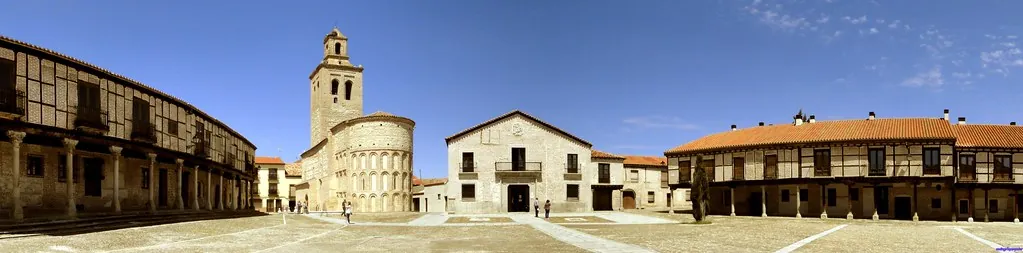
Plain town with a Romanesque-Mudéjar church; farming atmosphere
Hide article Read full article
When a wrong turn feels right
You know those drives where you miss the exit you planned and end up on a smaller road? Pedro-Rodríguez is that kind of place. One minute it’s fields, the next you’re slowing down past a line of stone houses, wondering if you should even stop. It’s in La Moraña, in Ávila, and has about as many people as a couple of extended families. Life here moves with the harvest, not the holiday calendar. The quiet isn't manufactured for you; it's just what's left when there aren't many engines running.
This isn't a checklist village. You come here to reset your pace, to see what Castile looks like when it’s not trying to show you anything.
Living on the flat
La Moraña doesn’t do hills. It does sky, and lots of it. Pedro-Rodríguez sits in that expanse like it grew from the same soil as the barley. The streets are practical, the houses built from what was around: stone, adobe, lime. They look tough, built for winters that bite and summers that bake.
Walking around, you get it fast. That big gate is for a tractor. That wall has seen a few generations come and go. It feels less like a preserved postcard and more like a working blueprint for getting by out here.
Don't overthink it. A slow loop through the main lanes is your plan. You'll be done in fifteen minutes, and that's fine—the village isn't pretending to be a capital.
The anchor in the square
If there's a visual landmark, it's the church of San Pedro. You'll spot its tower from the road long before you arrive, poking up above the rooftops.
Architecturally, it's a bit of a patchwork—a common story for rural churches that were fixed up when they could be. But its real role isn't in the guidebooks. It's how life still seems to orbit around it: the square empties out after mass, conversations happen in its shadow. It feels less like a monument to visit and more like the village's steady heartbeat.
Where the village ends and the work begins
The real character of Pedro-Rodríguez starts where the pavement stops. Walk five minutes in any direction and you're in cereal country. Spring is all sharp green lines; by early summer it turns into that pale gold blanket Castilla is famous for.
This is where you see the mechanics of the place. Tractors tracing paths along dirt tracks, clouds of dust hanging in the air after they pass. The wind here is a permanent resident—it finds you.
Those same farm tracks are your walking or cycling routes. They go for miles with zero traffic. Just bring water and something for your head; shade is a luxury this landscape doesn't provide.
It won't take your breath away with drama. But it might slow your breathing down with its sheer scale and that clear, hard light.
Skywatching for beginners
These open fields are home to birds built for plains: great bustards, harriers, others that prefer space over trees.
There’s no fancy hide or signposted spot. You just pull onto a trackside, cut the engine, and wait. Sometimes you stare at nothing for twenty minutes. Other times, movement cuts across the sky or rustles deep in the crop.
It’s hit or miss, which feels honest for here. Nothing’s put on for show.
Making sense of the map: Arévalo and neighbours
Pedro-Rodríguez makes more sense as part of a set piece. A short drive gets you to Arévalo, which actually feels like a town. Its mudéjar brickwork gives it texture, and its main plaza has that proper Castilian weight to it—a useful contrast to village quiet.
All across La Moraña, other small pueblos dot the plain like variations on a theme: same essential parts (church, square), but each with its own slight twist in layout or atmosphere. Drifting between them gives you a better feel for the region than fixating on one dot on the map.
So do you stop?
Look, you don’t plan a day trip here. You use it as a pause. A place to stretch your legs, see some properly old walls, and remember what villages are like when their main job isn't entertaining you. You get back in the car feeling like you understood something small but solid. And sometimes, on these kinds of roads, that’s exactly what you needed