Full Article
about Pozanco
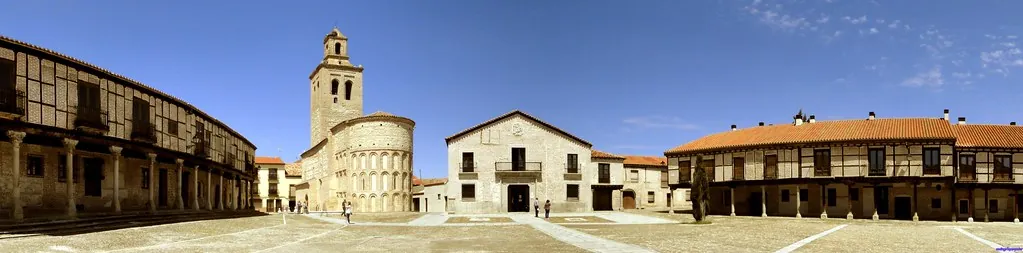
Small farming village; parish church amid crop fields
Hide article Read full article
A village shaped by the land
Pozanco sits in the heart of La Moraña, a wide agricultural plain in the province of Ávila. The terrain is almost completely flat, with cereal fields stretching across the horizon. At close to 900 metres above sea level, the village has a small population of around fifty residents.
The landscape explains much of what Pozanco is. For centuries, La Moraña has been organised around cereal farming. The village follows that same pattern. Its built area is compact, surrounded by open plots that extend outward without interruption. Houses are built with stone, adobe and brick, materials common across this part of Ávila and suited to the climate.
There is little dramatic scenery. The sense of place comes from continuity, from the steady relationship between people and farmland that has remained largely intact.
The church and the village centre
The parish church, dedicated to San Pedro, is the most recognisable building in Pozanco. Its tower can be seen from the paths leading into the village, a visual marker across the flat surroundings. It is not a large or elaborate structure, but it helps explain how local life has been organised.
For generations, the church served as a reference point. The tower marked the centre of the settlement and helped orient those working in nearby fields. In a landscape where elevation changes are minimal, such landmarks take on added significance.
Pozanco can be explored in a short walk. A single main street runs through the village, with modest houses on either side. These homes tend to have thick walls and small openings, practical features in a region exposed to seasonal extremes. Some buildings preserve wooden elements in corridors or enclosed galleries, showing traditional construction methods.
On the outskirts, traditional dovecotes remain visible. Many are now in disrepair, but their cylindrical shape is still clearly recognisable and typical of La Moraña. For centuries, these structures formed part of the domestic economy, providing meat and fertiliser. Even in ruin, they complete the picture of rural life here.
The changing colours of La Moraña
The appeal of Pozanco is tied to the landscape that surrounds it. La Moraña is a region of long horizons and very little relief. At first glance, it may seem uniform, yet its appearance shifts with the seasons and the agricultural cycle.
In spring, cereal crops cover the fields in an uninterrupted green. By summer, the harvest leaves behind a golden tone. Later, ochre shades and bare soil take over until the next sowing begins. These changes bring variation to a setting that might otherwise feel unchanging.
Its character reveals itself gradually, especially when explored at a slower pace along the agricultural tracks that extend from the village. Small details become more apparent over time, from subtle differences in colour to the way the land is divided.
Walking the tracks and observing the surroundings
A network of dirt tracks spreads out from Pozanco, used by farmers to access their land. These routes are not marked as formal walking trails, though the flat terrain makes them easy to follow.
One practical detail is the clay soil. After rain, the ground becomes heavy and sticky, with mud that clings to footwear or bicycle wheels. Conditions change quickly with the weather.
The open fields provide habitat for steppe birds. Species such as the sisón, along with various larks, can still be observed in the region, although sightings have become less frequent. Watching wildlife here requires patience and quiet; the landscape offers little natural cover.
Walking here is less about reaching a specific destination and more about experiencing the scale and stillness of the surroundings. The absence of marked routes reinforces that sense of openness.
Before you go
Pozanco is a very small village with no shops or tourist services. Visitors usually come from nearby towns within the comarca or from Ávila. The scale of the place means facilities are limited, and a visit is often brief.
Local celebrations tend to take place in summer, when residents who live elsewhere return. These are simple events, linked to the parish and to community life rather than large public festivities.
You will find quiet, open fields and a compact cluster of houses. The village works as a window onto La Moraña rather than as a destination filled with attractions. Its small size reflects how this region has lived for centuries, shaped by agriculture and a close relationship with the land.