Full Article
about Riocabado
Municipality on the plain; parish church and quiet crop-filled surroundings
Hide article Read full article
Morning Light in a Moraña Village
Early in the day, when the sun is still low in the eastern sky, tourism in Riocabado almost slips by unnoticed. A tractor moves slowly along the main street, leaving behind that familiar blend of diesel and freshly turned earth that forms part of everyday life in the villages of La Moraña. The houses, many built of stone and adobe, have large wooden gates worn smooth by decades of use.
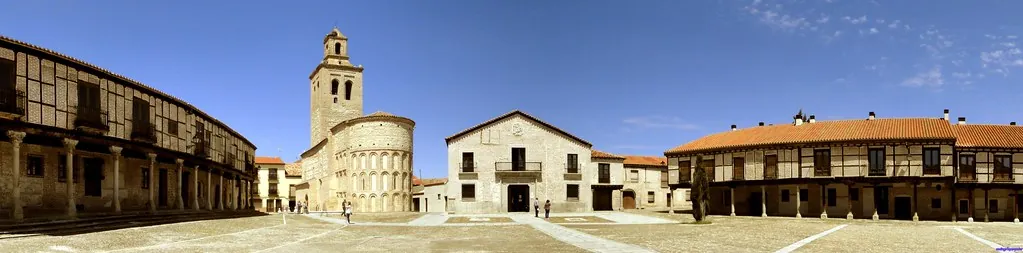
On the small square stands the Iglesia de la Natividad, its square tower rising above the rooftops. The bells continue to mark out the hours. Inside, there are no dramatic restorations or grand artistic surprises. A fairly austere stone font sits near a simple altarpiece that has likely been repaired more than once over time. Locals place the church’s origins around the 16th century, although, as with many churches in La Moraña, it has seen additions and alterations in later periods.
Riocabado does not announce itself with major landmarks. Its appeal lies in atmosphere and continuity, in the sense that daily life still sets the rhythm.
The Wide Horizon of La Moraña
Riocabado sits on the Moraña plateau at around 800 to 900 metres above sea level. This is not a landscape of mountains or dense woodland. It works in the opposite way: through openness, through a vast horizon where fields shift colour with the seasons.
In spring, damp greens dominate the newly sown crops. By mid-summer, everything turns the golden shade of ripe cereal. As evening falls, the sun catches the dry ears of grain in a low, almost orange light. Autumn brings more ochre tones, and the wind lifts a fine dust that hangs for a few seconds above the tracks before settling again.
It is a landscape that rewards patience. At first glance, especially if passing through quickly, it can seem repetitive. Stay a while and small variations begin to emerge: subtle changes in colour, texture and light that give the plateau its character.
Corrals, Wells and Unmarked Tracks
A dirt track leads out from the square towards a small group of constructions known locally as La Fuente y Los Corrales. Here, traditional livestock enclosures can still be seen: stone walls, low wooden gates and the remains of fenced areas where animals were once kept.
Old wells and open yards appear along the way. They offer a clear sense of how the village economy functioned for centuries, closely tied to agriculture and livestock farming. These structures are not presented as open-air exhibits. They remain part of the working landscape, even if their original use has faded.
The streets of Riocabado are short and slightly irregular. There are no tourist signs and no marked routes. The usual approach is simply to wander: turn a corner and come across a façade with ageing iron window grilles, an old cart propped against a wall, or a large gateway left ajar, revealing an inner courtyard beyond.
There is no set order in which to see the village. Its scale encourages slow walking and unplanned detours.
Subtle Details in Stone and Brick
In Riocabado, heritage is measured less by quantity than by small details. The tower of the Iglesia de la Natividad shows clear signs of having been reinforced at different moments in its history. On one of its walls, an inscription records a 19th-century repair.
Around the church, many houses retain their traditional structure: plain façades, roofs covered with curved terracotta tiles known in Spain as teja árabe, and small windows protected by iron grilles. Some properties have been renovated with clear respect for what was there before. Others reveal more recent layers of work, with brick or cement visible between older sections of wall.
This mix does not feel staged. It reflects gradual change rather than a single plan. The result is a built environment where centuries overlap in quiet ways.
Walking the Agricultural Paths
Beyond the edge of the village, everything returns to open countryside. Rural tracks leave Riocabado in several directions, crossing plots of cereal, scattered olive groves and kitchen gardens where potatoes or seasonal vegetables are grown.
There are no signposted walking routes. The tracks are identified by the marks left by tractors and by boundary stones separating one field from another. Anyone planning a longer walk should carry water and keep a map on their phone. On this kind of plain, where one field can look very much like the next, it is easy to lose a sense of direction.
Early in the day, particularly in spring and autumn, birds of prey are often seen gliding low over the crops. This is also an area where great bustards, known in Spanish as avutardas, sometimes appear in small groups. Spotting them requires distance and patience. The openness of the terrain helps, but it also means there is little cover.
The experience of walking here is defined by space and sky. Sound carries differently across the flat land, and the absence of shade in many areas shapes the rhythm of any outing.
A Quiet Base in the Comarca
Riocabado is a small village, with just over a hundred inhabitants. Life remains calm even in summer. There is no structured tourist offer, so many visitors treat it as a brief stop or as a base for exploring the wider comarca, a term used in Spain for a local district or county.
A short distance away lies Arévalo, which holds much of the historical heritage of the area. Other villages in La Moraña also feature Mudéjar churches, traditional houses and broad squares closely linked to the agricultural past of the region.
For those considering a visit, one practical point stands out: avoid the central hours of summer days. On this open plain, the sun falls directly with little or no shade. Riocabado is better appreciated early in the morning, when the light is soft and the air cooler, or later in the afternoon as temperatures ease and the fields regain some of their colour.
Riocabado does not rely on spectacle. Its identity is shaped by continuity, by fields that change with the seasons and by buildings that show their age without disguising it. In the wide landscape of La Moraña, it offers a place to slow down and look more closely at what at first seems simple.