Full Article
about Rivilla de Barajas
Small town known for its ruined castle and hunting fair.
Hide article Read full article
A Small Village on the Moraña Plain
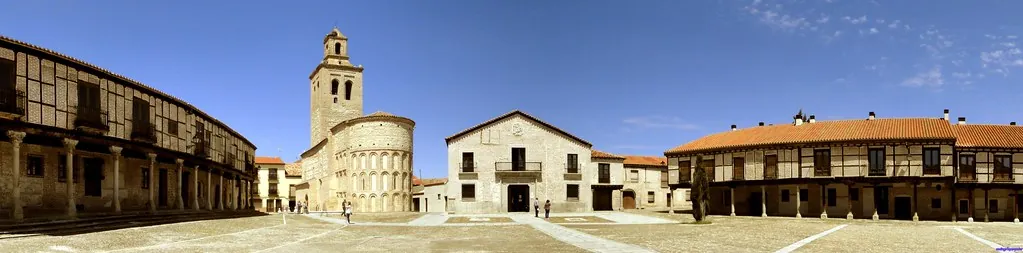
Rivilla de Barajas lies in the heart of La Moraña, a broad agricultural plain in the province of Ávila, Castilla Leon. This is a landscape shaped by cereal fields, where wheat and barley set the rhythm of the year and the horizon stretches out in long, uninterrupted lines. At around 900 metres above sea level and with barely fifty residents, the village fits the classic model of a morañego settlement: short streets, low houses and buildings made of adobe and rammed earth, designed to withstand cold winters and dry summers.
The quiet here does not feel staged or curated for visitors. It is simply the natural pace of a place that has always lived from the land and followed its own agricultural calendar. In this part of Castile, villages often function as small pieces of a larger rural whole. Rivilla de Barajas makes most sense when seen in that context, not as an isolated point on the map but as one of many communities scattered across La Moraña.
There are no headline monuments or constant activity. What gives the village its interest is the way it preserves traditional forms of building and organising space in a region that has otherwise undergone significant change over time.
Traditional Architecture in La Moraña
The strongest impression in Rivilla de Barajas comes from its popular architecture. A walk along its streets reveals walls of adobe, rammed earth and brick, materials used across the area for centuries. Some houses have been repaired with care, maintaining their original appearance. Others stand closed up, and a few are empty, a common sight in small villages across Spain’s central plateau where populations have declined.
The earthy tones of the façades, ochres, reddish hues and sandy shades, are part of the village’s identity. These colours were never chosen for decoration. They come directly from the soil used to build the houses, giving the settlement a visual unity that feels entirely rooted in its surroundings.
At the centre of the village stands the parish church. Like many churches in La Moraña, it is a simple structure. The doorway is plain, with little ornament, and the bell gable rises above the roofline more out of practicality than artistic ambition. In villages of this size, the church has long served an obvious social function as well as a religious one. It was, and to some extent remains, the meeting point and the place where key moments of the year were marked.
Light and Landscape on the Open Plain
Beyond the last houses, the landscape of La Moraña opens out immediately. Large cereal plots, agricultural tracks and a remarkably clean horizon define the surroundings. The terrain is almost flat, with only slight undulations that barely interrupt the view.
With so little relief, light takes on a leading role. In the early morning and again towards sunset, the colours of the fields shift quickly, especially in spring and early summer when the cereal is still green or just beginning to turn gold. The changes are subtle yet noticeable, and the sense of space is constant.
Most of the tracks leading out of Rivilla de Barajas are working agricultural routes used daily by farmers. They are not signposted as official walking trails, but they allow for straightforward exploration of the surrounding countryside. Anyone setting out should be prepared for the conditions of an open plain. Shade is scarce and the wind often blows with some force, so carrying water and protection from the sun is sensible.
Between Villages and Steppe Birds
The flat terrain makes it easy to move on foot or by bicycle between several villages in the area. Many of these paths have been used for decades in agricultural work. Respect for farming activity is essential, including giving way to machinery and staying on established tracks rather than crossing cultivated land.
La Moraña’s open fields are also home to steppe birds, species adapted to wide, treeless landscapes. The great bustard, known in Spanish as avutarda, and the little bustard, or sisón, can still be seen here. They are easier to spot in spring, when crops have not yet reached full height and visibility is better. A pair of binoculars and some patience are usually enough. The general quiet of the area works in favour of anyone hoping to observe wildlife.
Birdwatching here does not revolve around hides or marked observation points. It is a matter of scanning the fields carefully and allowing time. The experience is closely tied to the agricultural environment, where wildlife and farming share the same space.
A Village That Fills in Summer
Like many small settlements in Castile, Rivilla de Barajas changes with the seasons. In winter, movement is minimal and daily life is subdued. During the summer months, families who still maintain houses in the village return for a period of time. For a few days or weeks, the streets regain a level of activity that contrasts with the quieter months.
Patron saint festivities are usually held during this period. Celebrations are simple and closely linked to those who continue to regard the village as their place of origin. A mass, a procession and gatherings among neighbours form the core of these events. The emphasis is less on spectacle and more on reunion and continuity.
For visitors, this seasonal shift offers two different perspectives. Outside summer, the village provides an almost uninterrupted sense of calm. In summer, there is a brief glimpse of how it feels when doors are open and more voices carry along the short streets.
A Brief Stop to Understand La Moraña
Rivilla de Barajas can be explored in a short time. It is not a destination defined by a checklist of sights. Instead, it works as a quiet stop for understanding the landscape of La Moraña and its traditional ways of building and inhabiting space.
A visit is often best combined with a walk along the surrounding agricultural tracks or with time spent in other nearby villages in the comarca. Seen together, these settlements reveal the broader pattern of rural life on the Castilian plain: modest architecture, open horizons and a way of life shaped above all by the fields.
In Rivilla de Barajas, the interest lies in the details. The texture of an adobe wall, the tone of sunlit earth, the sound of wind crossing cereal fields. It is a place that reflects the character of La Moraña itself, defined less by landmarks and more by landscape and continuity.