Full Article
about Salvadiós
Farming village with an odd name; parish church set on flat farmland.
Hide article Read full article
A Pause in the Landscape
Some places seem to exist purely to make you slow down. Salvadiós, in the Moraña region of Castilla y León, gives exactly that impression. It appears almost unexpectedly along a local road: flat fields stretching as far as the eye can see, and then, in the middle of it all, a small cluster of houses, as if the landscape itself had paused for a moment.
Tourism in Salvadiós works differently from more typical destinations. There is no sense of rushing between landmarks or ticking sights off a list. The point is simpler. Look around, take a walk, and get a feel for what life is like in a village with only a few dozen residents.
A Small Village That Still Functions
Salvadiós has around seventy inhabitants. That alone sets the tone. Everything moves more slowly, and there is little need to put on appearances.
The houses follow the traditional style of La Moraña. Adobe and stone are common, with simple façades and large wooden gates that hint at a more agricultural past. Some buildings display coats of arms or carved details above their doorways, small signs that they have been standing here for a long time.
What stands out is that many of these buildings still serve their original purpose. This is not a staged version of rural life. People live here, and the village continues to function as it always has.
The Church at the Centre
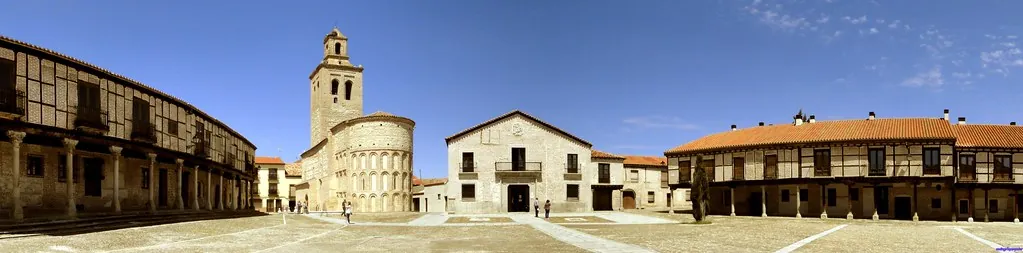
The parish church, dedicated to the Asunción, occupies its expected place: right at the centre of the village, both physically and visually.
It is not a building designed to impress. Its character is solid and restrained, with that distinctly Castilian feel shaped by centuries of wind and cold. The bell tower can be seen from almost any approach to the village, acting as a constant reference point.
The church is sometimes closed, which is common in small villages. If it happens to be open, the interior reflects the same simplicity as the outside. The space is quiet, unadorned, and built in stone. There is no sense of excess, just a calm, grounded atmosphere.
The Open Fields of La Moraña
The landscape around Salvadiós defines the area more than anything else. This is cereal country.
In spring, the fields turn green. By summer, they shift into golden tones as wheat and barley take over. Wind is a constant presence here, and when it blows, the fields ripple like water.
There are no mountains or dense forests to break the horizon. The setting is not dramatic in a conventional sense, yet it has a hypnotic quality. A short walk is enough to leave behind all other sounds except the wind.
Walking the Agricultural Tracks
Paths lead out from the village in all directions, offering plenty of options for walking or cycling. These are not marked routes, and there are no information boards. They are working tracks used by local farmers.
That is part of their appeal. They cut through cultivated plots and pass the occasional old hayloft or a partly collapsed enclosure. Each element gives a small clue about how this land has been used over generations.
It helps to have a rough sense of direction before setting out, as many of the paths look very similar. The uniformity of the terrain can make it easy to lose your bearings.
Traces of Rural Life
Some of the most telling aspects of Salvadiós appear in its smaller details. Animal pens, stables, heavy wooden gates, and adobe walls repaired again and again over time all remain part of the village fabric.
A number of buildings show the effects of age, but they continue to tell the story of the place more clearly than any signboard could. The marks of daily work and long use are visible everywhere.
A slow walk through the village reveals how closely life here has always been tied to the land. Agriculture is not just a backdrop. It has shaped the layout, the buildings, and the rhythm of daily life.
When Night Falls
Night brings a different kind of experience. In this part of La Moraña, artificial light is minimal, and that becomes obvious as soon as darkness sets in.
During summer, when the air is clearer, the sky fills with stars. Bands of light become visible without any special equipment. Sitting outside and looking up is enough.
It is easy to understand why people who live here speak so much about the sky. The absence of noise and light creates a sense of stillness that is difficult to find elsewhere.
A Different Kind of Visit
Salvadiós does not try to attract attention, and it does not need to. It remains a small village in La Moraña where the landscape sets the pace and life follows an older rhythm.
Stopping here, even briefly, offers a way to understand how this part of Castilla breathes. There is no need for a long plan or a list of sights. Time, space, and a willingness to slow down are enough.