Full Article
about San Juan de la Encinilla
Small farming village; Mudejar church and cereal fields
Ocultar artículo Leer artículo completo
Seventy souls, nine hundred metres above sea level, and wheat that runs to the edge of the world. San Juan de la Encinilla sits in the centre of Spain’s empty quarter, a single church tower the only punctuation on a horizon so flat it feels cartographic. Stand on the village edge at dusk and the silence is mathematical: one part wind, one part distant tractor, eight parts absolute nothing.
This is La Moraña, a slab of Castilian plateau that tourists sprint across on the A-6 motorway between Madrid and Galicia. They fill up in Arévalo, twenty minutes north, and never notice the turning. What they miss is a working lesson in rural contraction: streets that narrow each year as houses return to earth, a bar that opens when the owner’s arthritis allows, and a population graph that looks like a ski jump. The village has lost 80 % of its inhabitants since 1950; the remaining seventy are outnumbered by their own chimneys.
Adobe, Wheat and the Long View
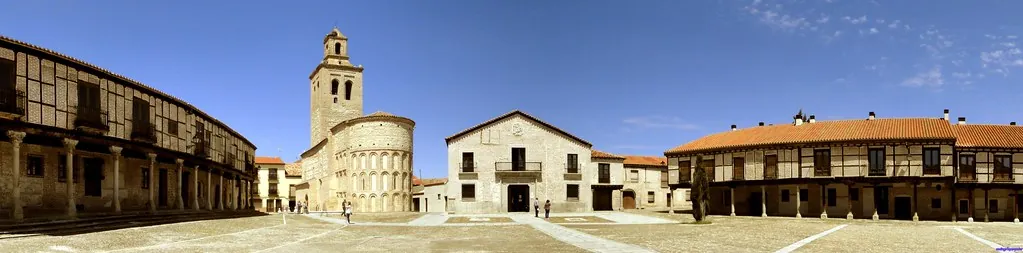
The built fabric is emphatically domestic. Adobe walls the colour of biscuit, roofs of Arabic tile mellowed to tortoiseshell, timber doors hand-forged by men who have since had streets named after them. There is no plaza mayor in the Salamanca style, just a widening where the church catches the afternoon sun. The parish of San Juan Bautista is modest even by provincial standards: masonry and rubble stone, a single nave, a bell turret that wouldn’t trouble a London skyline. Step inside and the temperature drops ten degrees; the air smells of candle smoke and centuries of grain harvests brought in as offering.
What the village lacks in monuments it returns in panorama. Every lane ends in a farm track, and every track climbs a low swell that reveals the next, and the next, until the curvature of the earth intervenes. In June the wheat is still green-gold; by mid-July it has bleached to the colour of lions. The only verticals are the concrete silos of Palacios de Goda, five kilometres west, and the occasional holm oak that survived the plough. Photographers arrive expecting Tuscany and get Kazakhstan: exhilarating, intimidating, and impossible to frame without a wide-angle lens.
Legumes, Lamb and the Logistics of Lunch
Eating requires planning. The village’s last shop closed when the proprietor retired in 2018; bread arrives in a white van on Tuesdays and Fridays, and you need to be at the square before ten or it sells out. For anything perishable, Arévalo is the supply run: Mercadona for yoghurt, the municipal market for meat, a bakery that still sells talo—anise-flavoured flatbread—wrapped in wax paper.
What you can source locally is beans. Garbanzos from last year’s harvest, mottled like thrush eggs, change hands in unmarked kilo bags. Simmer them with a ham bone from the matanza, add bay from the neighbour’s hedge, and you have cocido that tastes of frost and wood smoke. Lechazo—milk-fed lamb roasted in a clay dish—must be ordered a day ahead from the butcher in Palacios, who only slaughters on Thursdays. Price: €22 per kilo, minimum order two. He will deliver to the village petrol station; you collect at six and hope your rental car boot is wipe-clean.
The single exception to self-catering is Hotel Rural Freya, three rooms signed off the main street. Danish owners bought the ruin in 2004, installed under-floor heating and poured gin-and-tonics that would pass muster in Hampstead. Dinner is available if you book before noon: sopa castellana thick with paprika, segovian-style cochinillo that collapses at the touch of a fork, almond tart with local honey. Set menu €28, house wine included. Mobile signal dies in the dining room; pay in cash because the card machine can’t reach the router.
Flat Roads, Big Sky and the Art of Doing Very Little
Cyclists discover the plateau by accident: Madrid clubs ride the railway path from Arévalo to Medina del Campo, see a signpost reading “San Juan 8 km”, and detour on a whim. The road is single-lane tarmac, traffic nil, gradient imperceptible. Horizon swimming, tyres humming, the only hazard is agricultural: grain lorries at harvest time leave a slick of chaff that turns corners into marbles. Bring two tubes and a pump; the nearest bike shop is forty kilometres away in Ávila.
Walkers fare better. Paths are not waymarked, but they don’t need to be. Pick any farm track, walk for an hour, and you will intersect another village. Fuente el Saúz lies 45 minutes north-east across fallow fields; Papatrigo another 40 beyond. The reward is avian: great bustards loafing stubble like feathered suitcases, hen harriers quartering the margins, calandra larks pouring sound from an empty sky. Binoculars essential; the birds are skittish and the land offers no cover.
Night brings a different map. At 910 m the atmosphere thins; stars arrive in industrial quantities. There is no street lighting beyond a single sodium bulb outside the ayuntamiento, so darkness is absolute. Stand in the football field—goalposts without nets, grass grazed by sheep—and the Milky Way becomes a river you could wade through. Shooting stars are so common you stop pointing them out. The ISS passes at 22:42 most August evenings; the village WhatsApp group sends a two-minute warning so everyone can look up.
June Fires, August Empties and the Calendar of Return
Festivity is compressed into four days around 24 June. Emigrants drive from Barcelona, Basel, Bournemouth. The population quadruples; cars line the wheat verges like coloured beads. A sound system appears on a trailer, powered by a generator that competes with the cicadas. Teenagers who have never met dance reggaetón; grandparents gossip over plastic cups of vermouth. At midnight the bonfire is lit in the same hollow where their grandparents burned scrub; someone produces a guitar, and the old songs surface with the sparks. By dawn on the 27th the cars are gone, the wheat stubble trampled, and the village shrinks back to its real size.
Winter reverses the equation. January fog rolls in off the Duero basin and sits for weeks; temperatures drop to –12 °C at night. The adobe houses, built for summer heat, grow mould on their northern walls. Heating is diesel or pellets; a 15 kg bag costs €4.80 and lasts two days. Pipes freeze; the elderly move in with relatives down the hill. Only the church bell keeps the hour, and even that sounds muffled by the mist.
How to Arrive, Where to Stay, When to Leave
Public transport is theoretical. There is a bus on Tuesdays and Fridays from Arévalo at 13:15, returning at 06:30 next day. It carries pensioners, not suitcases. Car hire from Madrid-Barajas is the practical choice: take the A-6 to Arévalo, exit 180, then CL-501 south for 18 km. The turning is unsigned; GPS co-ordinates 40.8158, -4.6903. Petrol in the village is 8 cents dearer than the motorway; fill up in Arévalo.
Accommodation options fit on one hand. Hotel Rural Freya: three doubles, €75 low season, €95 July–October, breakfast €8. Closed January. Alternative: Casa Rural La Encina, two kilometres outside the village, pool shared with the owner’s family, minimum stay two nights. Bring groceries; they don’t do meals. Camping is tolerated in the municipal field, but there are no showers and the farmer will move you if irrigation starts at dawn.
Come in late May for green wheat and nesting birds, or mid-September when the stubble turns bronze and the sky rinses clear. Avoid August weekends unless you enjoy sharing a village with 300 returning cousins. Leave before the harvest dust triggers your asthma, or after the first frost has silvered the thistle and the plateau feels finally, irrevocably, honest about how empty it really is.