Full Article
about San Pascual
Small municipality in La Moraña; includes the abandoned hamlet of El Tomillar.
Hide article Read full article
A village where everything slows down
Some places tell you exactly what they are the moment you see them on a map. San Pascual is one of those. You arrive along a road that cuts through open fields and, as soon as you step out of the car, it feels as if the volume of the world has been turned down.
That is more or less what travelling to San Pascual means. It is a pause in the middle of the Moraña, a rural area in the province of Ávila, and the village itself is tiny, just a handful of residents surrounded by cereal fields stretching as far as the eye can see.
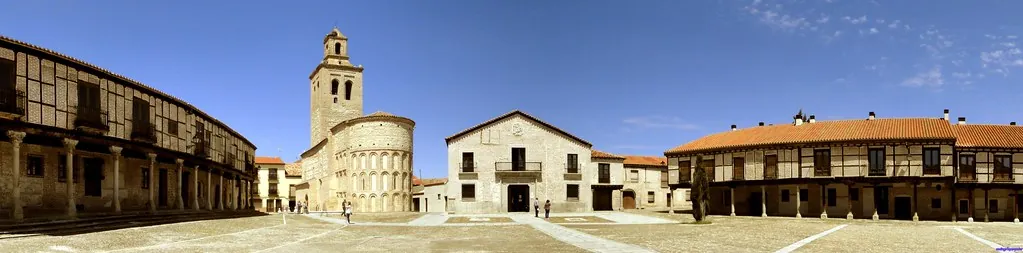
There are no headline sights here, no museums or landmark buildings to draw a crowd. Instead, what you find is a small cluster of traditional houses and a parish church that still defines the centre of village life. The architecture is typical of this part of Castile: stone walls, sometimes worn and weathered, large wooden gates that have seen decades of use, and enclosed yards where much of daily life once unfolded. In some of these spaces, old bread ovens can still be made out.
A walk through the streets does not take long, and there is no point pretending otherwise. Yet there is something in that short walk that encourages you to look around and piece together how this landscape has always worked: farming, livestock and a vast sky overhead.
The surroundings are unmistakably Moraña. Gently rolling cereal fields form long, open horizons with very little interruption. In spring, green dominates, broken by patches of yellow broom. By summer, everything turns golden, and the contrast with the broad Castilian sky becomes striking in its simplicity. Here and there, scattered holm oaks break the uniformity just enough to catch the eye.
The small details that define the village
The most recognisable point in San Pascual is its parish church, dedicated to San Pascual Bailón. It is not a monumental building, and it does not try to be. Like many churches in rural Castile, it has changed over time, adapting as repairs and needs arose.
Its bell gable rises above the surrounding rooftops and works as a useful reference point when moving through the village. In a place this small, that is all the orientation needed.
Beyond any single building, what stands out is the overall picture. Stone houses, often left unrendered, line the streets. Large gateways hint at a time when carts regularly passed through. Behind the façades, old yards and corrals can still be identified. Some homes retain ovens or small interior courtyards where bread was baked or small animals were kept.
These are modest features, but together they tell a clear story of everyday life not so long ago. At the same time, many houses are closed or show the visible passage of time. In villages of this size, that is a common reality. Part of the appeal lies precisely there: nothing has been dressed up or restored for visitors. What you see is simply what remains.
Walking out into the fields
Anyone arriving in search of marked walking routes with signposts and colour-coded trails will not find them here. San Pascual offers something much simpler. The paths that exist are agricultural tracks, the same ones tractors use to move between fields. That, however, is enough for a long and unhurried walk.
This type of landscape can feel almost empty at first glance. Yet, given a bit of time, it begins to reveal small details. The movement of clouds across the wide sky becomes more noticeable. Wind ripples through the cereal crops. A bird of prey might appear, gliding over the fields with little effort.
With patience, it is also possible to spot steppe birds, species that still inhabit this part of the Moraña. Great bustards, little bustards and harriers can sometimes be seen moving over the farmland. They are not always easy to distinguish at a distance, so binoculars can make a difference.
There is no fixed route to follow and no particular viewpoint to aim for. The experience is simply about walking, stopping now and then, and taking in the quiet rhythm of the countryside.
A brief stop in the Moraña
San Pascual is not a place designed to fill an entire day. It works better as a short stop, the kind where you arrive, take a walk, look around, and then continue your journey through the region.
If you are looking for somewhere to eat or a bit more activity, the usual approach is to head to a nearby, slightly larger village. Across this part of the Moraña, food remains closely tied to tradition. Legumes, cured meats and products from the traditional pig slaughter still play a central role in local cooking.
In the end, San Pascual is exactly what it appears to be: a very small village, moving at its own pace, surrounded by open farmland. And when travelling through Castile, that kind of brief, quiet stop can often stay with you more than a packed itinerary ever could.