Full Article
about San Pedro del Arroyo
A communications hub in La Moraña; noted for the Roman villa of El Vergel.
Ocultar artículo Leer artículo completo
San Pedro del Arroyo sits at 935 metres, high enough for the air to feel thin and clean, yet low enough for the horizon to stretch like a taut golden wire. From the village edge the land rolls away in every direction, a checkerboard of cereal fields that flashes bronze in late June and vivid green after April rain. It is the sort of place where larks, not lorries, provide the morning soundtrack and where the single cash machine occasionally refuses to dispense anything more than a polite apology.
The Roman Villa That Isn’t in the Guidebooks
Most visitors arrive for one reason only: the ruined villa known locally as El Vergel. A short gravel lane leads past the cemetery to a low, barn-like shelter that protects what remains of a 4th-century farmhouse. Inside, a small projection room overlays virtual mosaics onto the dusty floors, revealing banquet scenes and geometric borders in lurid technicolour. The effect is faintly sci-fi, yet it works: children stop kicking stones and start asking questions about under-floor heating. Opening hours are strictly 10:00-14:00 and 16:00-19:00, Tuesday to Sunday; turn up on Monday and you will find only locked gates and an uninterested cat.
Admission is free, but English-language tours must be booked through the provincial tourist office in Ávila at least 24 hours ahead. Without a guide you are left with a single laminated sheet that switches between academic Spanish and cheery emojis, neither of which quite explains why the Romans chose this windswept plateau.
A Village That Refuses to Pose
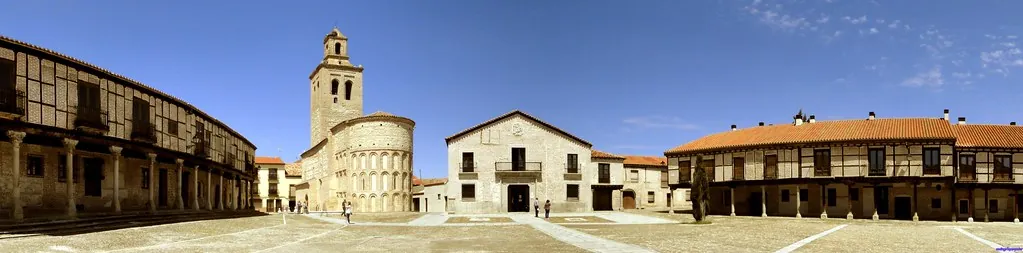
Back in the centre, the 16th-century church of San Pedro rises above a handful of narrow lanes paved with round river stones. The building is handsome in the plain way of rural Castile: thick walls, a squat tower, a timber door blistered by centuries of sun. Step inside and the temperature drops; the interior is dim, scented with wax and old wood, the walls stripped of ornament except for a single Baroque retablo that glints with too much gold paint. Mass is still read here on Sundays, followed by a slow-motion exodus of parishioners who linger on the plaza to discuss rainfall and grandchildren.
There are no souvenir stalls, no tasting menus, no artisan ice-cream parlours. What you do find are stone houses the colour of burnt cream, many still fronted by wooden gates wide enough for a donkey cart. Peer through the iron grille of a half-open door and you may catch a glimpse of a courtyard paved with stable stones, perhaps a pomegranate tree leaning against the wall. Some façades have been restored with crisp new mortar; others slump gently, their rooflines sagging like tired eyelids. Both states exist side by side without apology.
Walking Into the Wind
The real diversion here is the countryside itself. A lattice of farm tracks fans out from the last streetlamp, each one bounded by dry-stone walls and waist-high wheat. In April the fields glow emerald, studded with poppies that sway like red semaphore flags. By July the same land has turned to gold stubble that crackles underfoot. The gradients are gentle—this is cycling territory rather than serious hiking—yet the altitude means sunscreen is essential even when the breeze feels cool.
Ornithologists bring binoculars for great bustards and little bustards, both of which can be spotted performing their ponderous mating displays in spring. The birds favour the fallow strips between crops, so stick to the signed paths and resist the urge to march straight across the wheat; farmers tolerate walkers but draw the line at trampled harvests. Wind is the constant companion: it whistles across the plateau, rattling the thistle heads and rendering umbrellas useless.
Where to Eat and What to Expect
Hunger is best solved at El Mesón, the only restaurant that opens reliably outside fiesta week. The dining room is a converted barn with stone walls half a metre thick; voices echo, and the television in the corner plays football on mute. The weekday menú del día costs €12 and runs to three courses plus a carafe of sharp young red. Roast lamb appears more often than not, slow-cooked until the bones pull free with no resistance; even visitors who claim not to like lamb tend to finish the portion. Pudding is usually natillas, a set custard dusted with cinnamon that tastes like nursery food translated into Spanish.
Evening options shrink to a single bar where locals nurse small beers and discuss crop prices. Food service stops at 22:00 sharp; order after 21:45 and the cook will emerge from the kitchen, wipe her hands on her apron, and explain—politely but firmly—that the grill is now closed. Cash is king: the village ATM sometimes runs dry on Saturday night, and the nearest alternative is a twenty-minute drive to Arévalo.
Timing Your Visit
Spring, particularly late April and May, delivers green fields and comfortable daytime temperatures around 18°C. September is almost as good, with stubble fires sending thin columns of smoke into a porcelain sky. Mid-summer is fiercely hot; thermometers brush 35°C by noon and shade is scarce. Winter brings fierce night frosts and a wind that slices straight through Barbour jackets; hotels in the area close from January to March because heating bills outweigh takings.
The patronal fiestas at the end of June inject brief noise into the calendar. A small funfair sets up behind the football pitch, brass bands march through the streets, and everyone seems to own a euphonium. Rooms are impossible to find unless you book months ahead; the rest of the year you can have the village almost to yourself.
Getting There, Getting Away
Public transport is patchy. The nearest railhead is Arévalo, 25 minutes away by car, itself reached from Madrid on the high-speed AVE in 55 minutes. Car hire is therefore essential; without wheels you are marooned. Petrol stations are equally thin on the ground—fill up in Arévalo before you head into the fields. Drivers should note that Google Maps occasionally confuses San Pedro del Arroyo with San Pedro de Arévalo, a larger village 40 kilometres distant; the postcode 05260 keeps you on the correct road.
The Honest Verdict
San Pedro del Arroyo will not change your life. It offers no jaw-dropping views, no Michelin stars, no boutique hotels. What it does provide is a slice of working Castile where the modern world feels like a faint rumour. Come for the Roman mosaics, stay for the lamb and the larks, then leave before the wind drives you mad. If that sounds like faint praise, it isn’t meant to; sometimes a quiet afternoon on a golden plateau is exactly enough.