Full Article
about San Vicente de Arévalo
A farming town with an interesting Mudéjar church and a long-standing resin-making tradition.
Hide article Read full article
Mid-morning in San Vicente de Arévalo has its own rhythm. At the crossroads that runs through the village, dogs tend to be heard before any passing cars. A tractor might roll by at an unhurried pace, while the dry sounds of the countryside carry in from nearby fields: metal, dust, cereal shifting in the wind. Light falls cleanly on the adobe façades, often tinged pink or a sun-worn beige. When the breeze lifts a little earth, the smell is unmistakable, stubble, straw, dry soil.
San Vicente de Arévalo sits in La Moraña, a region where the landscape stretches flat and the sky feels unusually wide. With just over a hundred residents, the village still reflects a way of building closely tied to the land itself. Walls of rammed earth, adobe and simple brick are common, along with interior courtyards where tools or firewood are still kept.
Around San Pedro
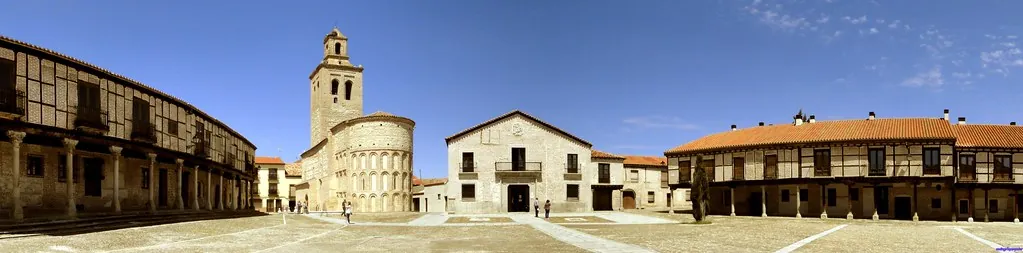
The village gathers around the church of San Pedro, whose square tower is visible from a distance when approaching by road. The building appears to have been constructed in stages, something quite typical in this part of the region, and combines brick with masonry. Its entrance features decorative elements reminiscent of late Mudéjar style, a form of architecture shaped by Islamic influence that is widespread in the wider Arévalo area.
Inside, the atmosphere is restrained. There is a simple altarpiece, thick walls that keep the interior cool even in summer, and a quiet that feels particular to rural churches where few people pass through during the day. At certain times, especially in the afternoon, light enters at a sharp angle through high windows, laying golden bands across the floor.
The main streets cluster around the church. Some houses still have heavy wooden doors studded with large nails and black metal bars across the windows. It is not unusual to find small courtyards behind the houses, or modest cellars dug below street level. These spaces were once part of everyday agricultural life and still hint at how closely work and home were linked.
Walking the Fields of La Moraña
Several agricultural tracks begin at the edge of the village. They are not marked as hiking routes, yet they are used daily to reach the surrounding farmland. These are wide, compacted earth paths, easy enough to follow without guidance.
The landscape here is typical of the more open parts of La Moraña. Large plots stretch out with very few trees, and the colours shift noticeably with the seasons. In spring, green spreads evenly across the fields and the air often carries the scent of fresh grass. By late summer, the land turns yellow and the ground gives off a dry crunch underfoot.
There is little shade, so carrying water and wearing a hat makes sense if heading out on foot. Early morning or late afternoon tends to be the most comfortable time, when the light softens and a slight breeze usually picks up.
Close to Arévalo
San Vicente de Arévalo lies very near to Arévalo, which acts as the historical and commercial centre for this part of the province. There, the architectural heritage is more immediately visible. Several Mudéjar churches stand within the town, along with broad arcaded squares and a castle that dominates one of the approaches into the city.
Many visitors reach San Vicente as a short stop within a wider route around the comarca. Within a few kilometres, other small settlements appear, where traditional brick houses are still preserved. Dovecotes are scattered across the landscape, and there are also remains of defensive structures linked to the medieval history of the area.
Food, Seasons and Everyday Traditions
Local cooking revolves around what the surrounding fields and nearby livestock provide. The dishes are substantial. Dried legumes from the region feature heavily, alongside slow-cooked stews and roast lamb during family celebrations. Bread, made with flour from the area, remains a regular part of daily meals.
In winter, some households still carry out matanzas domésticas, the traditional home slaughter and preparation of pork. It is a practice that has become less common over time, yet it continues to form part of rural life in many villages across Castilla. During those weeks, the scent of smoke and paprika lingers through the streets.
Spring brings small romerías, local pilgrimages to nearby hermitages either within the municipal area or in neighbouring villages. These are not large-scale events. They tend to be simple gatherings of neighbours, with shared food and traditional music.
A Place to Pause
San Vicente de Arévalo can be seen quickly, yet it makes more sense to take it slowly, even if only for a morning. In late spring, the countryside feels particularly alive, with strong contrasts in colour across the fields. Early autumn also has its appeal, when temperatures ease and the paths begin to see more use again.
At the height of summer, the middle of the day is best avoided. The sun is intense and shade is scarce.
There are no major monuments or a dramatic historic centre here. What the village offers is something quieter: a small agricultural community where the patterns of life in La Moraña can still be sensed. Walking at an unhurried pace, listening to the wind moving through the stubble, and paying attention to the details of the houses is enough to begin understanding it.