Full Article
about Sanchidrián
Well-connected municipality (A-6); birthplace of the musician Tomás Luis de Victoria
Hide article Read full article
Arrival Across La Moraña
At the hour when the sun falls almost straight down onto the plain, a car kicks up a thin veil of dust before entering the village. Gravel crunches under the tyres, blending with the distant hum of the road. This is often how tourism in Sanchidrián begins: a long straight stretch of countryside and, ahead, the square tower of the church outlined against the clear sky of La Moraña.
From a distance, the village seems to rest directly on the flat land. Adobe façades reflect ochre and reddish tones that shift as the afternoon moves on. Very little else is needed. The light does most of the work.
Sanchidrián sits at the western edge of La Moraña, a wide agricultural plain with barely any interruption. Around 720 people live here. The old N‑VI road passes nearby, linking the area quickly with Ávila and Madrid, but inside the village the pace changes. By mid-afternoon, the sounds are sparse: a door closing, a slow-moving car, the bells marking the time for mass.
The Church on the Slight Rise
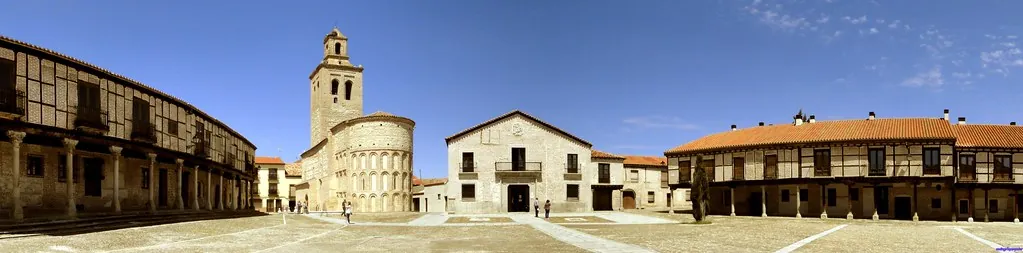
The church of San Martín occupies the most visible point in the village. Its tower can be seen from the surrounding fields. The current building appears to date from the 16th century, although it has undergone later alterations.
The structure is simple, built in masonry. Inside, a Baroque altarpiece with gilded carvings still catches the light when it enters through the side windows. The church is not always open, and outside service times it is often closed. Even so, it is worth walking around it at an unhurried pace. From this slight rise, the layout of Sanchidrián becomes clear: low houses, streets crossing without much symmetry, and beyond them, cereal fields stretching as far as the eye can see.
Adobe Streets and Wooden Gates
The village centre has no grand alignments or large squares. Streets such as Mayor and Santa María bend gently as they continue. Some houses reveal the adobe beneath worn layers of render. Others keep large dark wooden gates that hint at former stables or courtyards.
Iron window grilles cast strong shadows in the late afternoon light. In summer, when the heat presses down, shutters remain half-closed and the village slips into a kind of pause. It is easy to walk for several minutes without meeting anyone.
If visiting in July or August, early morning or the end of the day is the best time to move around. At midday, the sun falls hard on these streets, where trees are scarce.
Open Fields in Every Direction
Step outside the built-up area and the plain immediately takes over again. Cereal fields dominate the entire landscape. In spring, the green is almost continuous. By late summer, dry yellows appear along with the smell of straw.
The lack of trees gives the sky a strong presence. Dawn often begins with a soft grey that turns golden within minutes. At sunset, high clouds take on red tones while the fields are already in shadow.
Several agricultural tracks head out in different directions. They are not signposted for walking, but they are used daily for working the land. Care is needed when walking, especially if tractors pass by, which is common during harvest time.
Small Hermitages and Nearby Villages
Along these tracks, small hermitages appear, including those dedicated to Santo Cristo and Santa Ana. They are simple buildings, usually with a single nave, sometimes surrounded by a small open space where local gatherings take place on certain dates.
Following the same paths leads to other nearby villages. In this part of Ávila, settlements sit just a few kilometres apart. The landscape changes very little, yet each place keeps its own church, its own square, and its own adobe houses.
Food and the Rhythm of the Year
Local cooking remains closely tied to the land. Pulses play a central role, especially judiones, large white beans often served with meat or cured pork. In winter, hearty stews appear, suited to the cold of the plateau. Bread tends to have a thick crust and a dense crumb, the kind that keeps well for several days.
The festive calendar is understated. In summer, celebrations dedicated to San Martín take place, with processions along the main streets and gatherings around the square. During Semana Santa, Holy Week, simple religious floats are carried through the village by residents.
When to Visit
Spring and autumn are usually the most pleasant times to visit. The fields change colour and temperatures make it easy to walk along the tracks without hurry.
Summer brings strong heat at midday, although nights can cool down noticeably. In winter, the wind crosses the plain without obstacles, making the cold feel sharper than the thermometer suggests. Some days bring dense fog that covers the fields and wraps the village in a heavy silence.
Sanchidrián does not try to impress. It is a place of adobe, bells and long horizons. Sitting for a while on a quiet street is enough to understand its rhythm: the sound of wind brushing against the reeds of a courtyard fence, a blackbird singing somewhere nearby.