Full Article
about Sigeres
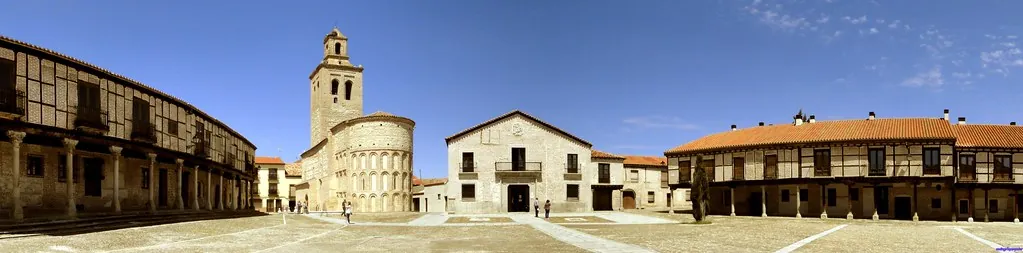
Small farming town; it still has an interesting church and traditional architecture.
Hide article Read full article
Midday stillness in a village of La Moraña
At midday, when the sun falls straight onto the plain, the church of San Pedro almost turns white in the glare. Inside, the air is cooler. The stone holds the night’s chill and carries a faint scent of old dust. At that hour, Sigeres is usually quiet. In the distance there might be the sound of a tractor, and occasionally the brief whistle of a goldfinch.
This small municipality in La Moraña, in Castilla y León, has around 41 inhabitants. It sits at roughly 960 metres above sea level, surrounded by dry-farmed cereal fields. Wheat, barley and long strips of land stretch out towards a very clean horizon. Many houses still follow the practical logic with which they were built: thick walls, few windows and wide gates that once opened onto yards or storage spaces. There are no showy restorations here. Instead, the village reflects how it has adapted over time to climate and agricultural work.
Walking through Sigeres takes very little time. In ten minutes it is possible to cross from one end to the other. The square tower of the church acts as a constant point of reference, rising above the low rooftops and helping with orientation through the streets. The church door tends to open only at certain times of the year or during celebrations. When it does, the interior is simple: wooden benches, pale walls and a few old religious images.
Behind the church, a street leads off and splits into narrower lanes. Some houses are lived in all year round; others remain closed for long stretches. Iron gates and enclosed yards are still there, even if livestock is no longer always present.
Fields that shape the horizon
In Sigeres, the landscape is not a backdrop. It is what sustains the village. The plain of La Moraña changes noticeably with the seasons. In April, the cereal is low and green, and the wind creates visible ripples across the fields. By late spring, scattered poppies begin to appear. In summer, everything turns golden, and the heat brings a dry scent, almost like warm straw.
From any of the farm tracks, the view stretches far into the distance. There are hardly any obstacles: perhaps an isolated holm oak, a cluster of almond trees or gentle rises in the land. On cloudy days, the sky takes up half the scene.
Walking at an unhurried pace
Several dirt tracks lead out from the village, used mainly by farmers. They are mostly flat, making them suitable for slow walks between fields and boundaries. Occasionally, there are traces of old kitchen gardens or small agricultural structures, now partly abandoned.
Early morning or late afternoon tends to be the best time to walk. The light is lower, and the countryside feels more active. Small birds move between the furrows, and sometimes a red kite can be seen gliding slowly overhead.
Steppe birds in La Moraña
The open farmland of this region continues to provide habitat for steppe birds. With a bit of patience, it is possible to spot great bustards or little bustards at a distance, especially in spring, when the cereal has not yet grown tall.
It is best to stick to the paths and avoid entering the fields. Binoculars are very useful, as the birds are often closer than expected but blend easily into the crops.
Nightfall and a dark sky
When night falls, the village becomes very dark. There is very little artificial light, and the sky appears clearly, particularly in winter. A short walk out along the tracks is enough to see the Milky Way quite distinctly on clear nights.
In colder months, the ground can freeze. Anyone heading out after dark will find a torch useful to avoid stumbling on uneven stretches of earth.
Eating and stopping nearby
There are very few services for visitors in Sigeres, so it helps to plan a stop with nearby villages in mind. In this part of Ávila, roast meats are common, along with slow-cooked pulses and hearty winter dishes. White wines from the Rueda area often appear on tables across the region.
Summer gatherings and the village rhythm
The main celebrations usually take place in summer, when people who now live elsewhere return. During those days, the village shifts slightly: more parked cars, open doors and long conversations as evening sets in.
For the rest of the year, Sigeres moves at a different pace. Very calm. The interest here does not lie in monuments or organised activities. It lies in observing how a small village in La Moraña still functions: wind moving through the cereal, a door opening mid-morning, the metallic sound of a tool in a yard. Small details that, in places like this, still shape the day.