Full Article
about Velayos
Well-connected farming village; parish church amid flat farmland.
Hide article Read full article
A village shaped by the plain
Tourism in Velayos begins with a simple idea: understanding where you are. This part of the province of Ávila, known as La Moraña, is a wide, almost level plain where villages sit far apart, separated by stretches of farmland. The landscape does not rely on dramatic features. Its character comes from the regularity of the terrain and from agriculture that has set the rhythm of life for centuries.
Velayos, with just over two hundred residents and standing at around 930 metres above sea level, fits neatly into this setting. It is a small settlement surrounded by open fields, part of a wider pattern that defines the region. The village does not try to stand out from its surroundings. Instead, it reflects them.
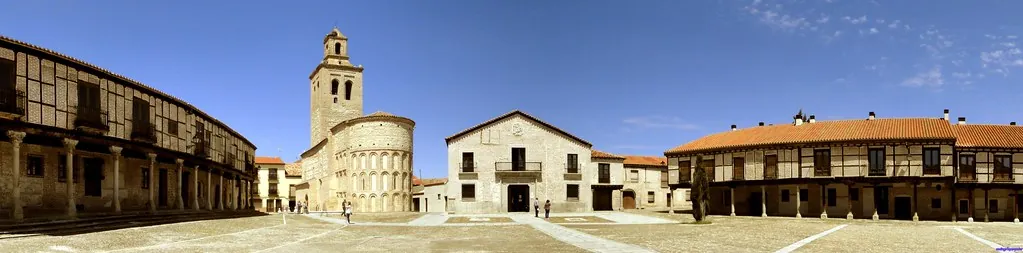
The built fabric follows the same logic seen across much of La Moraña. Thick walls and a mix of stone and adobe appear in the older houses. Streets remain on a human scale, shaped by the needs of an agricultural community rather than modern expansion. The climate of the Spanish plateau plays a role here. Winters are cold, summers dry, and the architecture responds with enclosed façades, small openings and interior courtyards that offer shelter from the wind.
Step beyond the village and the land is almost entirely given over to cereal crops. In spring, the fields form a continuous green surface. By summer, harvest turns everything gold, followed by fallow periods when the soil lies bare for months. It is a restrained landscape, though easy to read. Straight tracks cut across it, long boundaries define plots, and the occasional lone tree interrupts the horizon.
More than monuments, Velayos is understood through these everyday details. Agricultural paths connect fields and neighbouring villages. Old dovecotes appear scattered among the plots. A network of local roads crosses the plain with barely a curve. All of it speaks of a territory organised around farming and continuity.
San Isidro and the village centre
The main building in Velayos is the parish church dedicated to San Isidro, a figure closely associated with agriculture in Spain. Its current appearance reflects a series of alterations carried out over time, something quite common in rural churches across the province. Parts of the structure seem older, although it is not always easy to date them precisely without detailed records.
The church occupies a central position within the village and remains one of its most recognisable meeting points. In smaller municipalities like this, such buildings are often opened at specific times linked to worship or local celebrations. Visitors arriving without prior notice may therefore find it closed.
Around the edge of the built-up area, several traditional dovecotes can still be seen, some now abandoned. These structures were once tied to pigeon breeding, an activity that was widespread in La Moraña for centuries. Typically cylindrical or slightly polygonal, they are built with masonry and adobe. Even in their current state, they offer a clear insight into how rural households once organised their resources and food supply.
Walking the Moraña landscape
The agricultural tracks leading out of Velayos provide a straightforward way to explore the surrounding countryside. These are not signposted routes in the usual sense. They are working paths, created to reach fields, old dovecotes or nearby villages. Walking along them gives a direct view of how the landscape functions.
On clear days, looking south, the Sierra de Ávila sometimes appears in the distance. The contrast between the flat cereal plain and these far-off mountains is a defining feature of this part of the province. It adds depth to a landscape that might otherwise seem uniform at first glance.
The area is also known for birdlife adapted to open environments. With some patience, especially early in the day, it is not unusual to spot small birds of prey or steppe species moving across the fields. Their presence reinforces the sense of space and quiet that characterises La Moraña.
Reading the details
Velayos is small enough to be explored on foot in a short time. It is best approached without a rigid plan. The interest lies less in ticking off sights and more in observing how the place is put together.
Those drawn to rural architecture will find plenty to notice. The materials used in older houses, particularly the combination of stone and adobe, reflect both local resources and climatic needs. The scattered dovecotes in the surrounding fields add another layer of meaning. They are not decorative features but working structures that once formed part of everyday life.
Taken together, these elements provide a clear picture of how this agricultural region has functioned over time. Velayos does not present itself through standout landmarks. Instead, it offers a quiet, consistent landscape where patterns of land use, building and movement remain easy to trace.