Full Article
about Villaflor
Small municipality with an interesting church; landscape shifts from sierra to plain.
Hide article Read full article
Villaflor en la llanura
Villaflor se encuentra en La Moraña, una comarca de la provincia de Ávila. Está a unos 970 metros sobre el nivel del mar, sobre la planicie cerealista que ocupa esta parte de Castilla. El horizonte se dibuja con líneas rectas: caminos agrícolas, campos abiertos y pueblos lejanos que aparecen de pronto.
La escala es modesta, como en la mayoría de los pueblos morañegos. Las calles son sencillas, las casas están construidas con piedra, adobe y muros encalados, y los corrales cerrados recuerdan una economía ligada durante generaciones al campo. No hay mucho ornamento. La función siempre ha importado más que la apariencia.
La Moraña tiene un carácter discreto, aunque su historia se extiende a lo largo de siglos de cultivo. Entre las sierras al sur de la provincia y la llanura castellana más amplia, el terreno se vuelve casi completamente llano y abierto. Esta amplitud explica tanto la agricultura extensiva como la arquitectura. Las viviendas suelen ser bajas, con muros gruesos y patios resguardados, pensados para protegerse del viento que barre la meseta.
La iglesia y la estructura del pueblo
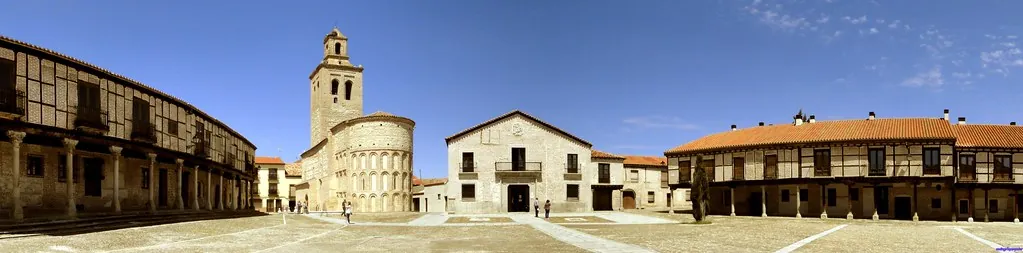
En el centro de Villaflor está la iglesia parroquial de Santiago. Su posición sigue organizando el trazado del pueblo. No es un edificio grande, pero sirve de ancla a las calles que lo rodean y da al conjunto un punto focal claro.
La estructura parece reflejar varias fases constructivas. Su base podría remontarse a la época moderna temprana, con reformas posteriores típicas de las iglesias rurales de la zona. Estas adaptaciones son comunes en los pueblos de La Moraña, donde las necesidades prácticas y los recursos limitados solían dar lugar a cambios graduales más que a rediseños completos.
Alrededor de la iglesia, las casas tradicionales muestran muros de adobe o mampostería y fachadas encaladas. Algunas portadas presentan escudos de piedra labrada que se reutilizaron o añadieron en reformas anteriores. Este detalle es relativamente frecuente en los pueblos morañegos, donde algunas familias acomodadas marcaban así sus viviendas. El efecto es sutil, pero apunta a capas de historia local incrustadas en edificios por lo demás muy funcionales.
Las calles no forman un laberinto complejo. Reflejan un trazado práctico ligado a las rutinas diarias del campo. Siguen visibles los corrales y los portones de madera, lo que refuerza la sensación de estar en un entorno agrícola en activo, no en un lugar reconvertido para el turismo.
El paisaje cerealista
Al pasar las últimas casas, la tierra se abre inmediatamente a las parcelas de cultivo. Dominan el trigo y la cebada, junto a otros cereales que se extienden por la llanura con pocas interrupciones. Los campos parecen continuar casi sin fin, rotos solo de vez en cuando por alguna encina aislada o pequeños rodales de árboles.
Este paisaje es también hábitat para aves esteparias. En ciertas épocas del año, se pueden ver avutardas, sisones y aguiluchos sobrevolando los campos, sobre todo al amanecer o al atardecer. No hay un espectáculo organizado ni un centro de visitantes para ello. Las aves son simplemente parte del entorno agrícola, compartiendo el terreno abierto modelado por siglos de cultivo.
La casi total horizontalidad del terreno hace que las distancias resulten engañosas. Los pueblos surgen de la llanura sin un acercamiento gradual. Los caminos y las pistas cortan líneas rectas a través de los campos, reforzando el sentido del orden que impone la actividad agraria.
A pie o en bicicleta
Las pistas agrícolas conectan Villaflor con los pueblos vecinos. Por lo general, son llanas y fáciles de seguir. Caminar o pedalear por ellas permite entender cómo funciona esta parte de Ávila: rutas largas y rectas, parcelas grandes y asentamientos que emergen de repente en mitad de la llanura.
La experiencia tiene menos que ver con alcanzar un mirador concreto y más con observar la organización del territorio. Los campos se dividen en parcelas amplias. El viento se mueve libremente por la meseta. El ritmo del paisaje cambia de forma sutil con las estaciones, según el estado de los cultivos.
Desde Villaflor, carreteras secundarias llevan a localidades de mayor peso histórico dentro de la comarca, como Madrigal de las Altas Torres o Arévalo. Esos núcleos contienen conjuntos monumentales más extensos y una presencia arquitectónica más rotunda. Villaflor, en cambio, mantiene una escala pequeña y centrada en su entorno agrario.
Para organizar la visita
Villaflor es muy pequeño, con alrededor de un centenar de habitantes. No es habitual encontrar servicios turísticos dentro del pueblo mismo. Lo normal es organizar la visita desde localidades mayores de los alrededores.
Un paseo por el pueblo no lleva mucho tiempo. El interés está en fijarse en los detalles de la arquitectura popular: los muros de adobe, los portones de madera, los corrales cerrados. Estos elementos muestran cómo se adaptaban las viviendas al clima y a la vida agrícola. Después de recorrer las calles, salir por una de las pistas que cruzan los campos ayuda a situar el asentamiento en su contexto más amplio.
La Moraña no depende de contrastes dramáticos ni de hitos monumentales en cada pueblo. En Villaflor, el interés reside en observar cómo se ha organizado y mantenido un territorio agrícola a lo largo de siglos, con relativamente pocos cambios en su forma básica. La iglesia de Santiago, las casas modestas y los interminables campos de cereal ilustran juntos una forma de ordenar el espacio que sigue estrechamente ligada a la tierra.
No es un destino pensado para un itinerario repleto. El valor del tiempo aquí viene de mirar con atención el paisaje y los edificios que lo sirven. Villaflor presenta un ejemplo claro del medio rural de Castilla y León, donde el cielo abierto, los caminos rectos y los campos en labor siguen definiendo la vida diaria.