Full Article
about Villanueva de Gómez
A village surrounded by pine forests; known for its quiet and natural setting.
Hide article Read full article
The first light hits the fields in long, flat sheets, turning the stubble the colour of old straw. The air is cool and carries the smell of dust and dry earth. In Villanueva de Gómez, the day starts with the sound of a metal shutter rolling up, then another, and then the low diesel rumble of a tractor heading out towards the endless plots. By eight, the sun is already strong on the back of your neck.
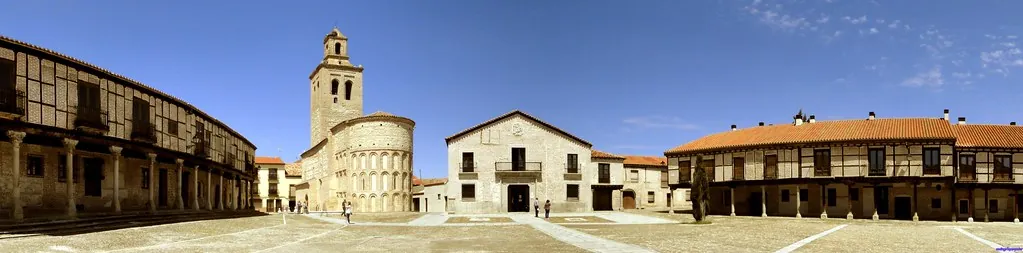
The village sits compact, a tight cluster of stone and adobe around a single square. From its edge, you see nothing but sky meeting land.
La arquitectura del uso
You won’t find ornate balconies or carved coats of arms here. The architecture is one of necessity. Walls are thick, built from a mix of rough stone and earth-toned adobe that holds the day’s heat long into the evening. Large, weathered wooden doors lead not to hallways but to courtyards—corrales—where you might see a parked tractor or hear chickens scratching.
The church of Santa María stands beside the square, a block of simple, sober stone. On windy days, which are most days, it offers no shelter at all. Scattered near it are low agricultural sheds, their roofs of curved tile, reminders that every space here once had a purpose tied to the fields.
Look for the small, arched doorways set into slight banks or tucked behind gates. These are the entrances to bodegas subterráneas, underground cellars for storing wine. Most are sealed now, their iron grilles rusted shut, but they speak of a time when each house kept its own harvest below ground.
Andar la llanura
Leave the last house behind and the world opens up completely. The land is relentlessly flat, divided into vast geometric parcels by straight dirt tracks. The wind is your constant companion; it hums in your ears and pushes at your back.
The colour of La Moraña changes with the crop and the season. In May, it’s a sharp, electric green. By late July, it’s a bleached gold, almost white at noon. After the harvest, it becomes a thousand shades of brown and grey—the colour of earth waiting.
Walking or cycling these tracks requires little effort but offers no distraction. There are no forests to enter, no riverbanks to follow. Your view is unimpeded for kilometres. This is the point: the immense, quiet expanse of it. A hawk circling on a thermal is an event. The sound of your own footsteps on the gritty path is the soundtrack.
If you go on foot, wear a hat in summer—there is no shade. If you cycle, remember the wind; what was a gentle push on your way out will be a stubborn wall on your return.
La caída de la noche
Darkness comes quickly and completely. By ten in summer, the square is empty save for a few plastic chairs left out from the evening’s conversation. The only lights are the yellow squares from kitchen windows.
With no city glow to wash it out, the night sky is profound. On a clear night, the Milky Way is a visible smear of dust across black velvet. The cold in winter is biting and drives you inside early; in August, you might sit on a doorstep just to feel the cool air finally arrive, listening to the muffled chatter from a television drifting through an open window.
The silence is so deep you hear your own pulse. Then, an owl calls from beyond the last streetlamp, and the distance feels infinite again.
El ritmo de las cosas
Life here moves with the agricultural calendar. During planting or harvest, you’ll see more activity: machines rolling through at dawn, men in boots talking by a gate. Outside those periods, especially in winter, Villanueva de Gómez is profoundly still. A car might pass every hour. An old man might sweep his doorstep at the same time each afternoon.
Summer brings a shift. Families return, and for a few days around the local fiesta, there’s music in the square at night and the smell of grilled meat in the air. Then it ends, and the quiet settles back like dust.
You don’t come here to visit museums or monuments. You come to walk paths that arrow into the distance, to feel the weight of the midday sun and the push of the wind, to see how the late afternoon light turns a simple adobe wall from grey to gold to grey again. Time doesn’t just pass slowly here; sometimes it feels like it has stopped altogether, held in place by the sheer breadth of the horizon.