Full Article
about Viñegra de Moraña
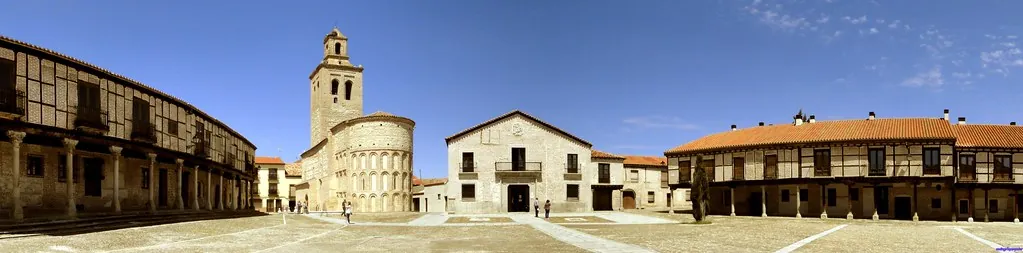
Small farming village; parish church set amid flat farmland.
Hide article Read full article
A village shaped by the land
Viñegra de Moraña sits in the middle of the wide, open plain of La Moraña, a comarca in the north of the province of Ávila where the landscape itself tells much of the story. Agriculture has long defined this area, especially cereal farming, which has structured both daily life and the appearance of the land for centuries. Today, the village has fewer than fifty inhabitants, yet it belongs to a much larger historical framework that took shape after the medieval repopulation promoted from the city of Ávila between the 11th and 12th centuries. During that period, these lands became part of Ávila’s extensive alfoz, a term used in medieval Spain for the rural territory governed by a town.
That historical background still echoes in the layout of the village and in the way it relates to its surroundings. Viñegra is not a place of expansion or recent transformation. Instead, it reflects continuity, with its form closely tied to the needs of an agricultural community that has changed slowly over time.
Streets, houses and rural architecture
The structure of the village follows a clear agricultural logic. Streets are short and practical, houses remain low, and plots quickly open out into fields. There has been little in the way of modern urban redevelopment, which allows older building traditions to remain visible.
Many homes are still built using adobe, rammed earth and stone. These materials were common across La Moraña because they were readily available to those working the land. Their continued presence gives the village a cohesive appearance and connects it directly to its past. Facades often feature large gateways and traces of old enclosures or corrals. These elements point to a way of life centred on farming and small-scale livestock rearing, where buildings needed to accommodate both people and animals.
This is not architecture designed for display. It is practical, rooted in necessity, and shaped by generations who adapted what they had at hand. The result is a built environment that feels consistent with the surrounding fields rather than separate from them.
The parish church at the centre
At the heart of the village stands the parish church, a modest building that has been altered at different points in time, as is common in many settlements across the comarca. Churches in this part of Ávila often include Mudejar brick elements, a construction tradition that spread widely through La Moraña during the Middle Ages. This style reflects the coexistence of cultural influences in medieval Spain, particularly in the use of brick and decorative patterns.
In Viñegra de Moraña, the artistic detail is less important than the role the church has played. It functioned as the main gathering place for the community and helped organise both religious and civic life. For a small village, this central role was essential. The church was where decisions were shared, routines were marked, and collective identity was reinforced.
Its position in the middle of the settlement underlines that importance. Even today, it remains a reference point within a village where public space is limited and everything lies close at hand.
A landscape of cereals and quiet traces
Beyond the houses, the defining feature of Viñegra de Moraña is the surrounding landscape. The typical scenery of La Moraña stretches out in all directions: cereal fields with few interruptions, agricultural tracks, and gentle rises that barely break the horizontal line of the plain.
At first glance, the terrain can appear uniform. A closer look reveals subtle signs of long-term human activity. Stone boundaries mark old divisions of land. Majanos, piles of stones cleared from fields, sit quietly at the edges. Old threshing floors, once used to separate grain before mechanisation transformed farming practices, still exist as reminders of earlier methods.
These elements are not arranged for display, yet they form a kind of record. Each one reflects accumulated work over generations, shaping a landscape that is both functional and historically layered.
Wildlife also plays a visible role here. Steppe birds continue to inhabit the area, closely linked to the type of dry farming practised for centuries. Storks nest on rooftops, while kites circle above the fields. At certain times of year, species such as great bustards and little bustards appear, associated with these open agricultural environments. Their presence is not incidental. It depends on the continuity of traditional farming systems that have maintained suitable habitats.
Walking the territory
Viñegra de Moraña is small and can be explored quickly on foot. The interest lies less in the size of the village itself and more in its surroundings. Walking along the paths that lead out from the centre offers a clearer sense of scale and context.
These routes connect with nearby settlements across La Moraña, forming a network that reflects long-standing patterns of movement between villages. They also allow close contact with the cereal landscape that defines the comarca. The experience is not about monuments or landmarks but about understanding how land, work and settlement fit together.
The openness of the terrain plays a key role in that experience. Distances feel different on a plain where the horizon stretches uninterrupted, and small changes in elevation or texture become more noticeable.
Practical context for a visit
Anyone planning to visit Viñegra de Moraña should keep its size in mind. In a village with such a small population, services are very limited, and everyday needs are typically met in larger nearby towns. This is part of the broader reality of rural areas in this part of Castilla y León, where many small settlements depend on a wider network for essential services.
The village lies about thirty kilometres from the city of Ávila. The journey follows local roads for most of the way, passing through open countryside that reflects the same agricultural character found around Viñegra itself. Travelling by car remains the most practical option for reaching and moving around the area.
The setting does not aim to impress with variety or spectacle. Its value lies in consistency, in the way landscape and settlement align, and in the continuity of practices that have shaped both. Viñegra de Moraña offers a clear example of how a small community fits into a larger rural system that has endured over centuries.