Full Article
about Santiago Millas
One of the best-preserved Maragato villages; birthplace of muleteers with large stone mansions.
Hide article Read full article
A Village That Still Feels Like a Village
There are places where time seems to move at a slightly different speed. Not frozen, just unhurried. That is the feeling in Santiago Millas, in the heart of the Maragatería region of León. With around 350 inhabitants, it is a small settlement where nothing appears arranged to impress. Stone houses, plots of land around the edges, and long stretches of quiet define the scene.
There are no bright signs or streets designed for identical photos. Santiago Millas simply functions as what it is: a working village. Daily life carries on much as it has for years, and that unforced normality shapes the experience of visiting.
The Maragato Muleteers and Their Mark
The history of Santiago Millas is closely linked to the maragato muleteers. For centuries, these traders transported goods between Galicia and the Castilian plateau, and the surrounding area developed with the roads in mind.
That past is still visible if you wander without rushing. Large gateways dominate many façades, and the houses are solid and restrained in appearance. They were built to store animals, carts and merchandise. There are no explanatory panels spelling this out, nor marked heritage trails. The story is embedded in the buildings themselves.
The architecture feels practical. Proportions and layouts respond to work rather than display. It is the sort of place where doors are broad because they had to be, and courtyards sit behind thick walls because that made sense for the way people lived and traded.
The Church of Santiago at the Centre
In small villages there is usually one building that anchors everything else. In Santiago Millas, that role belongs to the parish church dedicated to Santiago Apóstol.
Its tower is visible from several points around the village and acts as a reference point when walking through the streets. Inside, the atmosphere is simple. The altarpieces are modest, and there is the familiar scent of old wood found in many rural churches across León.
Access is not guaranteed. In villages of this size, keys often pass from hand to hand, and schedules do not operate in the way they do in towns or cities. If the door is open, step inside quietly. If not, the exterior and the setting still give a clear sense of its importance to local life.
Walking Without a Plan
There is no marked route through Santiago Millas and no carefully arranged historic quarter designed for swift sightseeing. The most rewarding approach is to walk without a fixed objective.
Some houses retain enormous wooden gates. Others display carved coats of arms above the entrance. In several cases, interior courtyards can be glimpsed behind walls, partly hidden from view. Restored homes sit alongside buildings still waiting their turn for renovation.
It is the kind of stroll where attention drifts towards details rather than monuments. A stone lintel, the grain of an old door, the way one house leans slightly into another. The rhythm is slow, and that is part of the point.
The Landscape of the Maragatería
The wider landscape around Santiago Millas is unmistakably that of the Maragatería. Gently undulating terrain stretches out into open meadows. Agricultural tracks wind between plots of land. From the village, this Leonese countryside looks straightforward at first glance, yet the light changes it noticeably over the course of a day.
There are no large mountains pressed up against the village itself, although the Montes de León lie relatively nearby. What stands out more immediately is the clarity of the air and the depth of the silence. For visitors arriving from a city, that quiet can feel striking at first.
This is not dramatic scenery in an obvious sense. Instead, it is a landscape that invites observation. Subtle shifts in colour, the pattern of fields, and the movement of wind across open ground become part of the experience.
Rural Paths and Gentle Routes
Several rural tracks lead out from Santiago Millas towards neighbouring villages and open countryside. Some are signposted, though markings can appear and disappear, as often happens with local routes.
They work well for unhurried walks. Cycling is also common along these paths, although a few slopes should be expected. The wind typical of the area can occasionally turn a straightforward stretch into something more demanding.
The appeal lies less in reaching a particular landmark and more in being out in the open landscape. These are everyday routes used by locals, not purpose-built tourist trails.
Local Food and the Cocido Maragato
Across the comarca, one dish stands out above the rest: the cocido maragato. Its most distinctive feature is the order in which it is served. The meats come first, and the soup arrives at the end.
Cecina and other cured meats are common on tables in the area, along with substantial homemade pastries. It does not take much travelling within the region to find places preparing these dishes in the traditional way.
Food here reflects the same practicality seen in the architecture. Recipes are rooted in local habits and ingredients, shaped by the needs of people who worked long days and required hearty meals.
Astorga Within Easy Reach
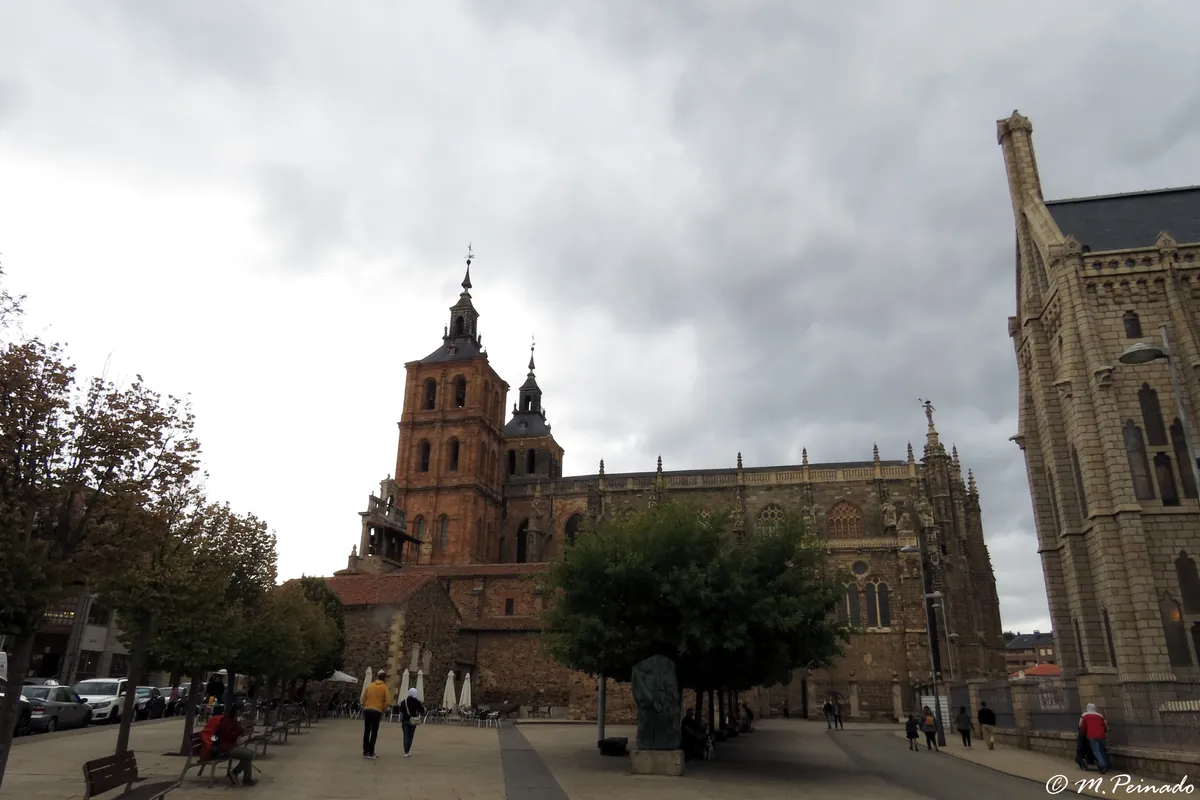
One advantage of stopping in Santiago Millas is its proximity to Astorga, around fifteen kilometres away. For those who wish to complement a quiet village visit with something more monumental, Astorga offers its cathedral and the Episcopal Palace designed by Gaudí.
The contrast is immediate. A short journey takes you from a small Maragatería village defined by silence and stone houses to a small city layered with history and striking architecture.
That combination allows for a varied day: calm streets in Santiago Millas, followed by the more elaborate setting of Astorga.
Festivals and Village Life
The main celebration centres on 25 July, the feast of Santiago Apóstol. Mass and a procession form part of the day, and many people who have moved away return to the village for the occasion.
During the summer, other informal activities take place. There may be music, traditional games or gatherings in the square. These are not events organised with tourism in mind. They are aimed at residents and at those who come back during the holiday period.
The atmosphere at such times is livelier, though it remains rooted in community rather than spectacle.
Is It Worth Stopping?
Santiago Millas is not a destination for grand monuments or a packed itinerary. It works best as a calm pause within a broader route through the Maragatería.
A visit might consist of little more than walking its streets, observing the architecture shaped by the maragato muleteers, and taking in the surrounding countryside. The value lies in understanding how the village fits into its landscape and history.
For travellers interested in rural León beyond the better-known stops, Santiago Millas offers something simple and unembellished: a place that continues at its own steady pace.