Full Article
about Boca de Huérgano
Gateway to the Picos de Europa from León; spectacular high-mountain setting with well-preserved forests.
Hide article Read full article
A pause in the Montaña de Riaño
Most people who arrive in Boca de Huérgano are on their way somewhere else. The usual plan is simple: stop for a short while, stretch your legs, then continue through the Montaña de Riaño. Parking is straightforward enough, either along the village’s wide streets or by the roadside. This is not a place designed to fill an entire day. It works better as a calm break if you are heading towards the mountain passes or travelling through the Esla valley.
The municipality has around four hundred residents, spread between the main village and several smaller settlements nearby. It stands at over 1,100 metres above sea level, and the altitude shapes daily life. Winters are long, frosts are common and in some years snow settles in for a while.
This is working countryside. Livestock farming dominates the landscape, with fenced meadows and barns still in use. The fields are not decorative, nor is the village arranged for effect. Boca de Huérgano continues to function much as it has for years, tied closely to the land around it.
The village and its setting
Within the village itself there are no major monuments. The main landmark is the church of San Pedro, built in stone and notably sober in style. It does not take long to look around.
The streets combine older stone houses with more recent renovations. Some properties are carefully maintained, others remain half-restored. That mix is typical of many villages in this part of Castilla y León, where population decline and seasonal returns shape the appearance of the streets.
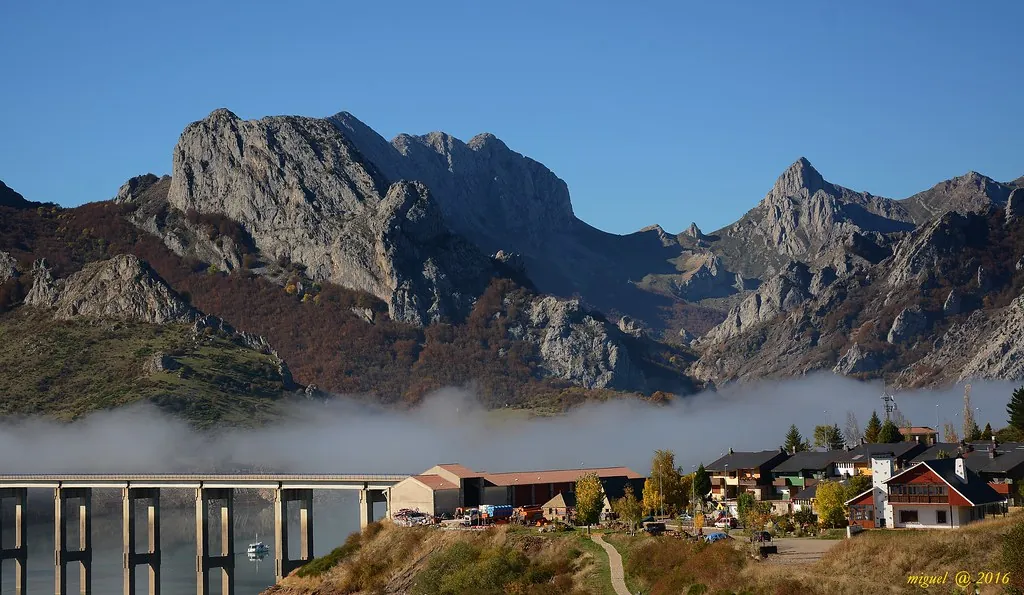
What draws attention lies beyond the built-up area. Boca de Huérgano sits in an open stretch of the Esla valley, and from many of the surrounding tracks there are clear views of the Cantabrian Mountains. On bright days the Mampodre massif appears in the distance, rising behind the nearer slopes.
The valley meadows are still actively used, and it is common to see cows or horses grazing. There are no formal viewpoints with railings or interpretive panels. Good views require a little effort, following the tracks that climb gently towards nearby cols.
Autumn changes the mood. Beech woods and oak groves on the surrounding hillsides take on colour, and morning mist often lingers low in the valley before lifting later in the day. The combination of open pasture and wooded slopes becomes more noticeable at that time of year.
Walking towards the mountains
Most people who spend time here do so to walk in the hills. Old paths leave from the surroundings of Boca de Huérgano, linking the valley with mountain passes and high summer grazing areas known locally as majadas.
Not all these routes are signposted. Some are simply livestock tracks or long-used footpaths maintained by custom rather than by official marking. Anyone planning to move away from the village centre would be wise to carry a map or a digital track on their phone.
The area also lies on the way to more widely known routes in the Montaña de Riaño and the Mampodre. Many mountaineers pause here before or after climbing nearby summits. Boca de Huérgano becomes a practical stopping point in the rhythm of a mountain day, whether at the start or the end.
Winter brings a different set of conditions. Snow can fall heavily in some years, especially at higher elevations. That makes snowshoeing or ski touring possible on the upper slopes, though this is not straightforward terrain. Cold temperatures are the norm, and the snowpack can change quickly. Anyone venturing higher up needs to be prepared for shifting conditions.
Early starts and quiet walking increase the chances of seeing wildlife. Roe deer are very likely. Red deer sometimes appear in autumn, particularly during the rut. Large birds of prey can be seen circling above the valley, taking advantage of thermals when the air warms.
Local rhythms and celebrations
The main festivities usually take place around San Pedro at the end of June. These are simple celebrations, organised primarily for local residents rather than for outside visitors. The focus is on gathering together rather than putting on a spectacle.
August feels different. Many people with family roots in the area return during the summer holidays, and the streets show more movement. Communal meals and neighbourhood get-togethers are often arranged, bringing a temporary increase in activity and conversation.
For the rest of the year, life settles into a quieter pace. Livestock farming continues, fieldwork fills the calendar and silence becomes more noticeable, particularly once winter arrives. The high altitude and long cold season reinforce that sense of stillness.
A short stop with wide horizons
Boca de Huérgano makes most sense as part of a wider journey through the Montaña de Riaño or on the way to the mountain passes that lead towards Cantabria. A brief walk through the village, a look at the church of San Pedro, then a short ramble along one of the valley tracks is often enough to understand the place.
The real interest lies outside the urban centre. The open floor of the Esla valley, the surrounding slopes and the distant outline of the Mampodre define the experience far more than any single building. There are no elaborate facilities or curated viewpoints to guide the visit. The appeal comes from stepping onto a path and looking out across working pasture towards the Cantabrian Mountains.
For travellers moving through this part of Castilla y León, that may be exactly what is needed: a modest village, a functioning rural landscape and space to walk for a while before continuing on through the high country.