Full Article
about Riaño
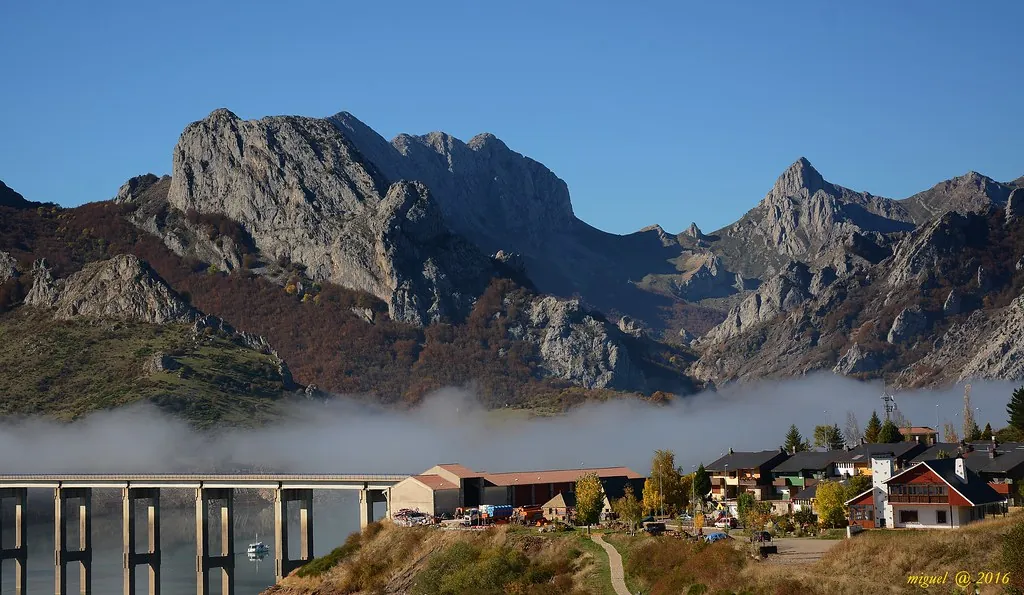
New town built after the reservoir; known for views of the "fiordo leonés" and Spain’s largest swing.
Hide article Read full article
The wind at this altitude has a particular sound, a low hum through the telephone wires that never really stops. It moves across the reservoir’s surface, breaking the mirror of the mountains into a thousand shifting pieces. From the road, the village appears as a line of dark slate roofs against the green, perched on a narrow peninsula of land. Many people pull over here, not for the view they expected, but for the sheer weight of the valley. Beneath that water, sixty metres down in some places, are the foundations of nine villages. Riaño is the one they remember.
Fewer than five hundred people live here now, at 1,130 metres. The new town, built in the 1980s, has wide streets and a certain orderly feel. But the air is thin and sharp, and the light has a clarity that makes distances hard to judge. Winters are long and hushed under snow; summers bring a dry heat that breaks with sudden evening chills. The constant is the reservoir—seven kilometres long—and the quiet, punctuated by cowbells from the meadows or the distant groan of a tractor.
What the water covers
From the mirador near the town hall, you can see how the water fills the old valleys, creating deep inlets that look like fjords from above. The colour changes by the hour: steel grey at dawn, a surprising turquoise under a midday sun, then a flat leaden sheet as clouds gather. A paved path follows part of the shoreline. If you walk it when the water level has dropped, usually in late summer or autumn, you’ll see things emerge. Not just stones, but straight lines that were walls, chunks of weathered concrete, the ghost of a road climbing out of the mud. It feels archaeological.
There’s a small museum that holds what was saved. It’s a single room with photographs of weddings in the plaza mayor, maps showing lost hamlets, and tools from workshops that no longer exist. You can be in and out in twenty minutes, but it’s a necessary twenty minutes. It turns the reservoir from a landscape feature into a story.
The modern church in the centre incorporates stones and carvings from the old one. Stepping inside is a strange sensation: the space is new and bright, but your fingers trace capitals worn smooth by centuries of weather, now sheltered from any rain.
Driving the high passes
The tarmac here is good and empty. Take the road towards San Glorio. You’ll climb through pastures where brown cows barely look up as you pass. The asphalt snakes upwards, and with each bend, Riaño shrinks below until it looks like a toy town at the water’s edge. On very clear days, to the north, the limestone teeth of the Picos de Europa become visible, a pale ridge against the sky.
You don’t need a destination. The point is the drive itself—the way the air cools as you gain altitude, the scent of broom and dry earth through the open window. Stop where others have pulled over; the views are never signed but are always obvious. Bring a jacket. Even in August, that constant wind has a bite at 1,500 metres.
Walking to see the shape of things
A web of old shepherd’s paths traces the hills immediately around town. They are not epic hikes; they are walks for perspective. One of them starts behind the football pitch and climbs gently through oaks to a modest summit. From there, you finally see it all: how Riaño sits on its slender spit of land, how the reservoir’s arms reach into three different valleys, how tiny cars move on the road to León.
In spring, these paths smell of damp soil and wild thyme. By October, everything is tawny and rust-coloured, and your footsteps crunch on beech leaves. Go early or late. That’s when you might see movement in the bracken—a roe deer flicking its ears, or a fox cutting across a distant field. The rule is simple: talk softly or not at all, and you stop being an intrusion.
The practical rhythm of water and seasons
The reservoir dictates terms. In July and August, you’ll see kayaks near the designated area by the village. The water is bitterly cold, fed by mountain springs. Mornings are often still; by two in the afternoon, the wind usually picks up, whipping up small whitecaps that make paddling hard work.
Come in winter if you can handle the cold. The village goes quiet. The snowline descends to meet the water’s edge, and on windless days, the only sound is the crackle of ice forming in puddles along the shore road. Many bars close for weeks at a time.
Eating for altitude
The food here is built for calories and climate. Look for cocido leonés, a hefty stew of chickpeas, cabbage, and several kinds of meat that will anchor you for hours. Trout from the Esla river system is common—simply grilled with garlic and parsley. The local cheeses are from sheep that graze these high pastures; they have a grassy, pungent tang that stays on your tongue.
Eat late, as people do here. Afterwards, walk down to where pavement meets water. The last light leaves first from valley floor while it still gilds mountaintops far across reservoir creating two different worlds within same glance This moment just before dark belongs entirely to place not its past

