Full Article
about Guardo
Key industrial and service hub in the Montaña Palentina; noted for its natural setting
Hide article Read full article
First impressions on the edge of the valley
Guardo has 5,502 residents and the asphalt in the centre is full of cracks. It is not a pretty town, and it does not try to be. On the roundabout at the entrance stands a four‑metre miner looking towards the road. It sums the place up neatly: for decades, everything here revolved around coal.
Set in the Montaña Palentina area of Castilla León, Guardo feels shaped by work more than by display. Roads cross it, the land rises and falls, and the town spreads along that slope. It can seem blunt at first glance, but that directness is part of its character.
Getting there and where to park
The N‑611 runs straight through Guardo, so it is hard to miss. Coming from León, the road enters through a narrow valley and then opens out just before reaching the town.
Parking by the sports centre usually works well and is the easiest option. The centre itself is on a slope, so it makes sense to leave the car lower down and walk up. In summer there is more traffic, though it rarely becomes a problem.
What remains of the past
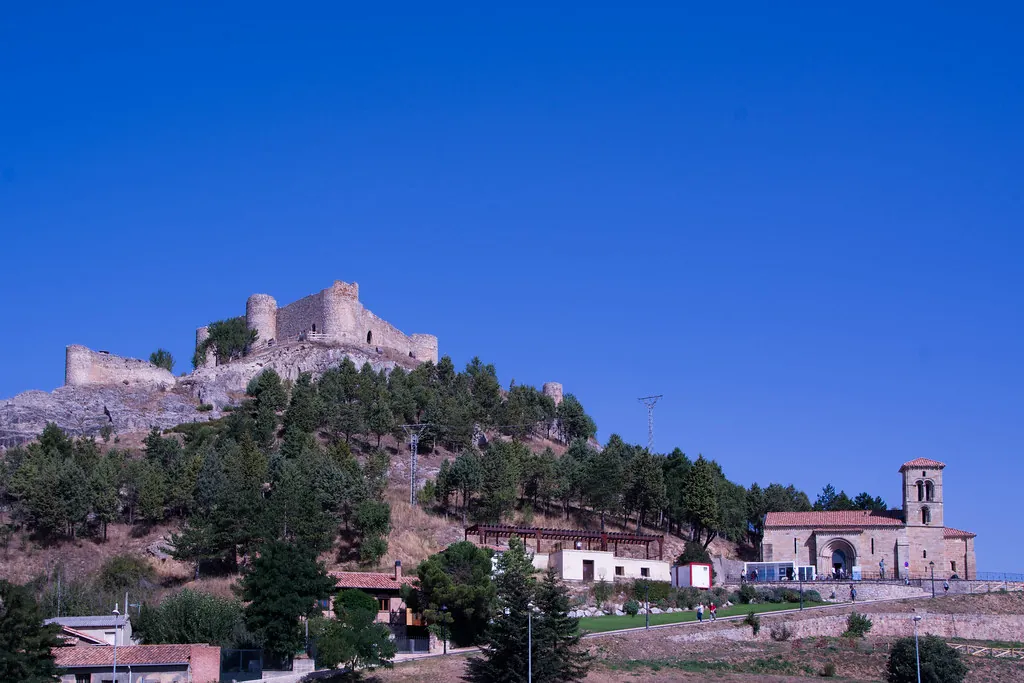
The medieval castle disappeared at the end of the nineteenth century. Its stones were reused in the construction of the Bilbao‑La Robla railway, a line that connected industrial areas across the north of Spain. Today there is little left beyond the memory and a high point where you can look down towards the river.
The church of San Juan Bautista is the oldest building still standing. It dates from the sixteenth century, built in plain stone with a simple interior. If it happens to be open, step inside for a moment. If not, carry on walking.
Mining reshaped Guardo during the twentieth century. Entire neighbourhoods of low houses were built for workers arriving from other mining areas. That part of town is still easy to recognise: straight streets, identical homes, everything laid out with the mine in mind. The layout feels practical rather than decorative, and it tells its own story without needing explanation.
Up to the Cristo del Amparo
A marked path leaves from the centre and climbs up to the hermitage of the Cristo del Amparo. It forms a circular route of around eight kilometres.
On the way, the path crosses the bridge of Almuhey. It is often described as Roman, although it has been repaired so many times that it is difficult to say how much of the original remains. What matters more is its place on the route, a quiet crossing before the climb continues.
The ascent itself is not particularly hard, though there are stretches without shade. On clear days the view opens out across the Carrión valley. From above, the shape of the land becomes clearer, the town below, the river cutting through it, and the surrounding slopes that define this part of Palencia.
The hermitage marks the high point of the walk. It is a simple place, but the setting gives it weight. After reaching it, the route loops back towards Guardo, closing the circle without rushing the descent.
Food, drink and a few dates to note
Food here is direct and rooted in the area. Lechazo asado, roast lamb, is the main reference point. It is usually prepared in a straightforward way, with an oven, the meat itself and wine from the region. There is little need for elaboration.
Blue cheese from nearby valleys also appears regularly. It reflects the surrounding landscape as much as the lamb does, tying the table to the hills around Guardo.
In mid‑June, the town usually celebrates the fiestas of San Antonio. During those days, the centre changes noticeably: music in the square, shared meals and plenty of noise at night. It is a lively stretch of time. Anyone looking for quiet would be better off choosing a different week.
Is it worth stopping?
Guardo is what it is: a relatively large town for the area, marked by mining and by the roads that pass through it. It does not dress itself up or try to compete with more polished destinations.
If you are travelling through the Montaña Palentina and have an hour to spare, it is worth a pause. Walk up to the Cristo del Amparo, take in the view over the Carrión valley, then head back down. That short loop is enough to understand the place.