Full Article
about Mudá
Small mountain village known for its European bison reserve; privileged natural setting and rural architecture.
Hide article Read full article
Early in the morning, when the light has only just begun to touch the meadows and the shadows still cling to the stone walls, Mudá seems to move a little more slowly than the rest of the valley. The air carries the scent of damp grass and old firewood. A door opens somewhere, a car starts, and for a few minutes there is little more than the soft sound of wind drifting down from the slopes.
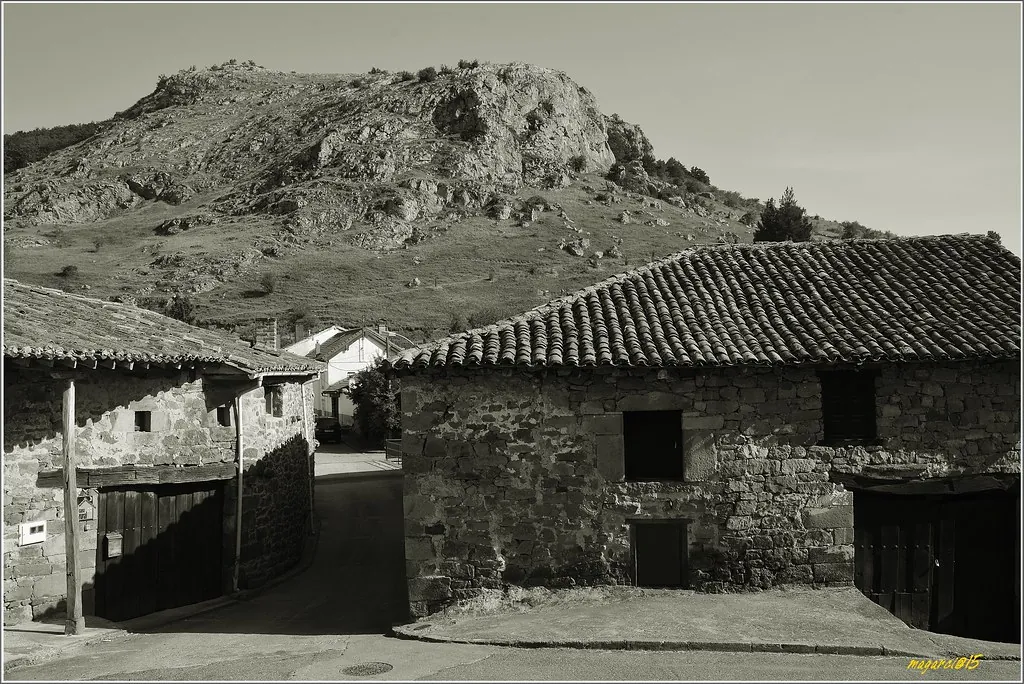
Mudá sits in the Montaña Palentina, in a tucked-away valley between hills where meadows mix with patches of oak woodland and higher ground covered in beech. The population is around eighty residents, although in summer families return and the village gains a bit more life. Houses follow the shape of the land, with thick stone walls, wooden balconies on some façades, and roofs that slope low to withstand the long winters common here.
The village at its centre
Within a few minutes’ walk, you reach the parish church of San Juan Bautista, set in one of the quieter parts of the village. It is a simple building in pale stone, with a tower rising above the surrounding rooftops. At certain times of day, light enters low through the windows, leaving much of the interior in shadow.
Around it are a few benches and a small open space where neighbours stop to talk. It is not unusual to see a tractor pass by, or someone walking a dog, while the bell tower marks the hours at an unhurried pace.
From different points in the village, between roofs and kitchen gardens, the outlines of nearby peaks come into view. Peña Redonda and Peña Lusa stand out against the horizon and shape much of the surrounding landscape in this part of the region.
Walking out from Mudá
Paths begin almost at the edge of the last houses. These are tracks and trails long used for moving livestock or reaching grazing areas, and many remain just as simple: bare earth, flattened grass, and the occasional wooden gate.
From here, it is possible to walk towards nearby mountain passes or climb gradually towards the surrounding hills. Not all routes are marked, so it is sensible to carry a map or ask someone in the village before setting out if the area is unfamiliar.
At dawn and again towards evening, the hills become more active. There might be the sudden beat of wings in the woods, or the crack of dry branches in the undergrowth. In soft ground, especially after rain, it is common to see tracks left by roe deer or wild boar.
Autumn woods and mushroom picking
With the arrival of autumn rains, many locals head into the woods carrying baskets. In the surrounding area, níscalos, a type of wild mushroom common in Spain, and other typical species of these forests appear. This is not an organised activity or something designed for visitors. It has been part of daily life here for decades.
If you are not familiar with the different varieties, the sensible approach is to go with someone who can identify them properly. In villages across the Montaña Palentina, this is repeated often: only pick what you can recognise with certainty, and avoid disturbing the ground more than necessary.
Traces of mining and herding
The landscape around Mudá still holds signs of earlier ways of life. There are remains of old structures linked to iron working, along with small buildings once used for shepherding. These do not come with information panels or marked routes. They appear unexpectedly among the vegetation or beside a stream, partly absorbed by time.
The wider region had mining activity for many years, and this can still be sensed in nearby valleys. Today, Mudá is shaped more by agriculture and livestock farming.
Before you set off
Mudá is a small village, and services are limited. If you plan to spend the day walking in the hills, it is best to bring water and something to eat. Shops are not open at all hours.
Winter can be harsh, with persistent cold, fog settling in the valley, and very short days. If visiting at that time of year, it is better to arrive later in the morning, once the sun has lifted some of the moisture from the ground and the paths are less slippery.
In contrast, late spring and autumn bring a clear, bright light to the valley. Meadows grow tall, the forests shift in colour, and the village returns to a quiet that becomes especially noticeable towards evening, when hardly anyone passes through the streets and the only sound is the distant ringing of a bell on the hillside.