Full Article
about Pomar de Valdivia
Municipality that includes several villages in the Las Loras area; known for the Covalagua natural site and the Cueva de los Franceses.
Hide article Read full article
A municipality scattered across the valley
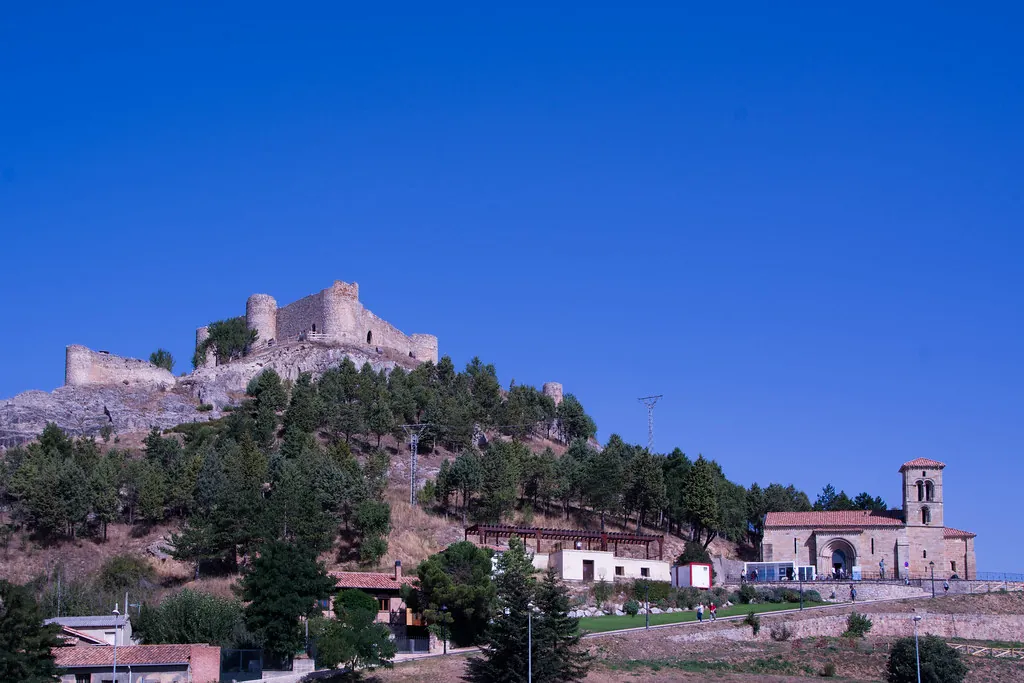
Pomar de Valdivia sits at a geographical hinge. It marks the western limit of the Montaña Palentina, where the Pisuerga river valley begins to tighten between the first significant slopes. Administratively, it is a single municipality, but in practice it is a collection of small villages—Pomar, Valdegama, Villallano, and others—spread across the valley floor and the lower reaches of the surrounding loras, those flat-topped limestone plateaus. This dispersion is its defining feature; there is no single centre.
The landscape dictates the terms here. Broad meadows are punctuated by outcrops of grey limestone and patches of oak woodland. The light changes the scene completely: on a clear day, it etches sharp lines on the hillsides; when the mountain mist descends, the valley closes in and turns quiet. This interplay is constant.
As a destination, Pomar de Valdivia functions less as a hub and more as a practical base. It is a place to stay while you explore the gorges, Romanesque chapels, and walking routes of this western part of the comarca.
Architecture shaped by necessity
In the village of Pomar itself, the parish church of San Juan Bautista occupies the high ground. Its current form is a mix: you can see the plain, robust volumes of late Romanesque work typical of the area, later modified by Renaissance and Baroque interventions. The bell gable is a local signature. Its elevated position was strategic, serving as a visual marker across the valley for centuries.
The older houses follow a mountain logic. Thick stone walls, steep slate roofs, and south-facing wooden balconies were solutions to long winters and damp Atlantic winds, not exercises in style. On some façades, you might notice a wider doorway or a faded coat of arms, remnants of the casonas that once indicated local lineage.
Between the scattered villages, a network of farm tracks and old paths connects meadows and fields. This explains the presence of small Romanesque churches in nearby hamlets; they were built to serve a dispersed population, not to attract visitors.
The river and the rock
The Pisuerga is still young here, flowing narrow and quick between pastures and riverside alders before carving deeper into the valley downstream. The land use is pastoral: cattle graze on the valley floor, while the sunnier slopes hold stands of oak.
The limestone cliffs that appear along certain stretches are more than scenery. They are active spaces. On days with good thermals, griffon vultures circle above them—a common sight if you pause to look up. From the higher ground on the loras, you get a clear sense of the transition: to the north, the land rises toward the Cantabrian Mountains; to the south, it begins to open into the plains.
The seasons rewrite the view. Spring is vividly green, autumn brings rust and gold, and winter often fills the valley basin with mist, dissolving the horizons.
Getting around: tracks and tarmac
To see the municipality, you need to move between its parts. A car is useful for hopping from Pomar to Valdegama or Villallano. From each village, traditional paths lead out into the fields or climb towards the plateaus. Some connect to longer, waymarked routes, but conditions can be muddy after rain—sturdy footwear is advised.
This scattered layout is key to understanding the area. You drive a short distance, then walk. From here, accessing other points in the western Montaña Palentina, like the nearby gorge of La Horadada, is straightforward.
Rhythm of the year
The annual pulse is most felt in summer, around the feast of San Juan Bautista in late June. People who live away return, and the different villages organise shared meals and gatherings. The schedule varies year to year; it’s a local affair, not a staged event.
In spring, some romerías still take place at hermitages in the surrounding countryside. These are quiet processions, part religious observance, part communal walk into the fields—a tradition that belongs to the calendar of village life.
Pomar de Valdivia doesn’t offer monumental sights. Its character lies in the relationship between stone villages and open land, in the sound of the river, and in watching weather move across the valley. For someone interested in the quiet architecture and layered landscapes of northern Castilla, it provides a genuine starting point.