Full Article
about Castromonte
Municipality in the highlands of Torozos, known for its church and the nearby medicinal spa.
Hide article Read full article
A Village on the High Plateau
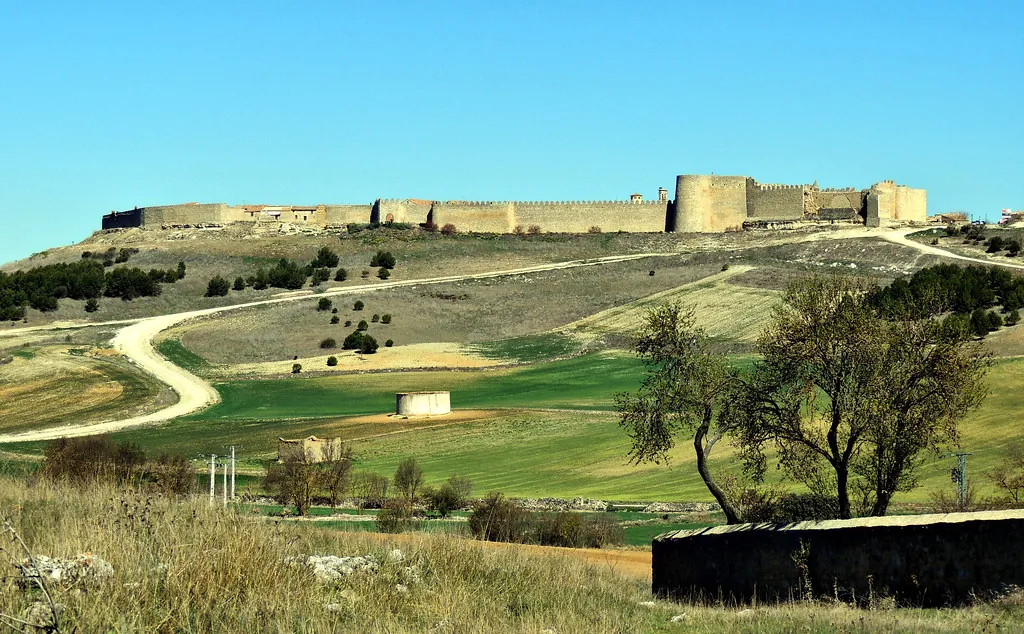
Tourism in Castromonte begins with the landscape. The village stands on the limestone platform of the Montes Torozos, in the north-west of the province of Valladolid, at around 840 metres above sea level. Up here the plateau opens out in every direction. Cereal fields stretch across gentle rises, and the horizon runs long and uninterrupted.
With a population of roughly 300, Castromonte does not feature on the best-known routes through Castilla y León. That absence explains much about its character. It remains an agricultural settlement, shaped by the rhythm of the countryside and by a landscape that has changed little in its essentials.
The village is easy to explore on foot. Streets are simple, lined with adobe and stone houses, wide gateways and enclosed yards that recall the original working purpose of many homes. There are no grand civic buildings or monumental squares. What defines Castromonte is its direct rural architecture, built for the climate and for daily labour rather than display.
Church, Houses and the Shape of the Past
The main landmark is the church of the Inmaculada Concepción. The current building dates from the 16th century, although it has undergone later alterations. Its structure is sober, with stone walls and a tower that can be recognised from the approaches to the village.
It is not a church noted for elaborate decoration. Its importance lies instead in the role it has played within a small community, where for centuries the parish church functioned as a meeting place and as a marker of the collective calendar.
Walking through the streets reveals clear examples of traditional Torozos architecture. Low houses, thick walls and interior courtyards offered protection from the wind that sweeps across the plateau. Some properties still preserve south-facing corridors or galleries, designed to catch the sun and temper the colder months.
In the surrounding countryside, scattered dovecotes remain visible. These structures are closely associated with this part of Valladolid. For a long time they formed part of the domestic economy, providing meat and fertiliser. Many are now in poor condition, yet they continue to punctuate the landscape and hint at older ways of life.
The Landscape of the Montes Torozos
Castromonte lies in one of the central sectors of the Montes Torozos. Despite the name, this is not a mountain range in the usual sense but an elevated plateau that falls away in soft edges towards the plains of the Duero and the Pisuerga rivers.
The setting combines holm oaks, Portuguese oaks and low scrub with wide expanses of cereal crops. In summer, golden tones dominate after the harvest. In winter, the scene turns more austere: open fields under broad skies, with little to interrupt the view.
There are no signposted viewpoints, and none are really necessary. Stepping out along any of the agricultural tracks is enough to grasp the scale of the territory. Within minutes of leaving the built-up area, the village drops from sight and the surroundings become entirely open.
These plains are also home to steppe birds and birds of prey. With patience, it is possible to spot red kites or kestrels. At certain times of year, great bustards appear in the quieter fields, their presence reinforcing the sense of space and stillness that defines the Torozos.
Walking the Páramo Tracks
Several rural paths lead out from Castromonte towards the páramo and nearby shallow valleys. The term páramo refers to this high, exposed tableland typical of parts of Castilla y León, shaped by agriculture and wind. The tracks are agricultural routes used by local residents to reach their fields.
The terrain is straightforward for walking. There are no major gradients, and the ground is generally even. What changes is the perception of distance. On clear days, the view extends for several kilometres, and the sky seems to occupy as much space as the land.
It is sensible to carry a map or GPS device. Paths intersect frequently and the landscape can feel uniform, something common in the Montes Torozos. The repetition of fields and low rises can make orientation less obvious than it first appears.
The experience here is less about reaching a specific landmark and more about absorbing the scale of the plateau. The silence, broken occasionally by farm machinery or birds overhead, forms part of the appeal.
Daily Life and Local Celebrations
Festivities linked to the Inmaculada Concepción are part of the local calendar. As in many villages in the area, summer brings increased activity. Families who live elsewhere return, and for a few weeks the population grows and the streets feel busier.
Celebrations maintain a distinctly local tone. Processions, shared meals and open-air dances organised by residents themselves shape the programme. They are not designed as tourist events, but as a continuation of village life and tradition.
Outside these moments, Castromonte returns to its usual rhythm. Agricultural work continues to mark the year, and the connection between settlement and surrounding land remains clear.
A Quiet Visit
Castromonte is a small village, best approached with the expectation of an unhurried walk and time spent observing the landscape. The urban centre can be covered quickly. The greater interest often lies beyond it: the tracks across the páramo, the scattered dovecotes and the way the settlement fits into the relief of the Montes Torozos.
This is a place where the defining feature is space. Space in the streets, space between villages, space across the plateau. For travellers curious about rural Castilla y León beyond its headline destinations, Castromonte offers a direct encounter with the geography and everyday architecture of the Torozos, unchanged in its fundamentals and still closely tied to the land.