Full Article
about Ciguñuela
A hilltop village in the Montes Torozos overlooking Valladolid, noted for its church and proximity to the capital.
Hide article Read full article
A village that slows you down
Some villages work like those roadside bars where you stop for five minutes and end up gazing out of the window for far longer than you expected. Cigunuela has a touch of that. It is not because there is a great deal going on, quite the opposite. It is the silence of the Montes Torozos that seems to lower your pace without asking permission.
Cigunuela is a small municipality in the province of Valladolid, in the heart of the Montes Torozos district, with just over 300 residents. Life here remains closely tied to the land. Cereal crops dominate, there is some livestock, and the agricultural calendar sets the rhythm of the year more reliably than any diary. You can sense it as you walk around. The sounds are garage doors opening, a tractor starting up, church bells marking the hour.
There are no shop windows designed with visitors in mind, no sense of an organised tourist destination. It is simply a village getting on with its own business.
Life around San Miguel Arcángel
As in many Castilian villages, the main reference point is the church. In Cigunuela it is dedicated to San Miguel Arcángel. The current building dates from around the 16th century, with later alterations. It is not a monumental church, yet it has the solid presence typical of temples on the Meseta. Stone walls, sober lines and a tower visible from various points in the surrounding area give it that steady character.
The main streets cluster around it. They are straight and fairly wide, lined with low houses built in brick or tapial, a traditional rammed earth technique common in rural Spain. Some homes still have large wooden gates and interior courtyards. In agricultural villages these spaces once combined living quarters, animal pens and storage under one roof.
A walk without a fixed route brings small details into view. Old adobe walls appear between newer façades. A dovecote rises above the rooftops. There are also underground wine cellars. In this part of Valladolid it was common to store wine and food in subterranean galleries where the temperature stays stable throughout the year.
The overall impression is not of preserved heritage arranged for display. It feels like a place where these elements continue as part of daily life.
The open landscape of the Montes Torozos
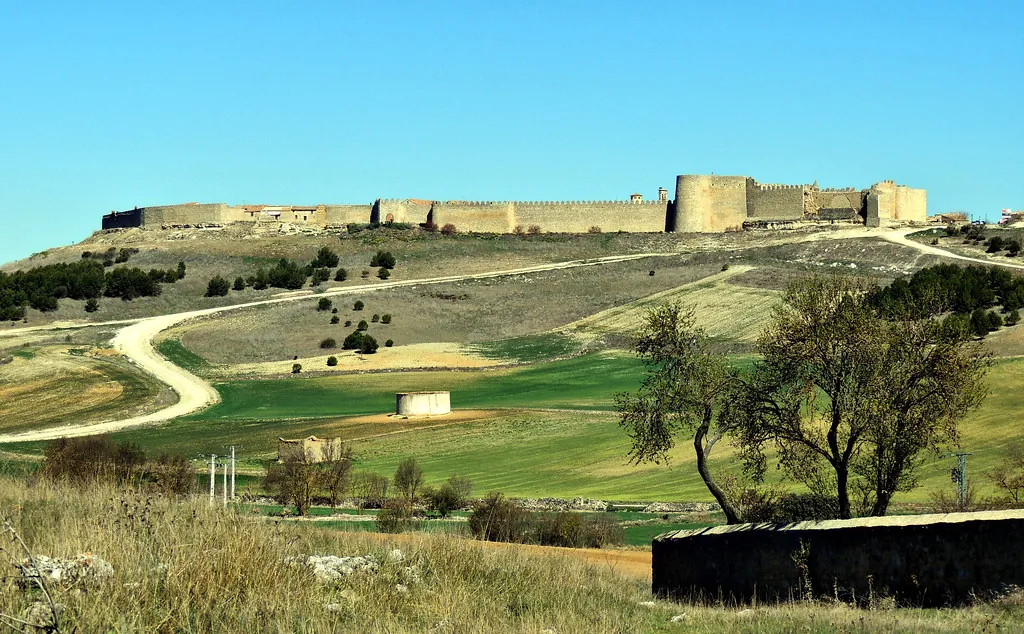
Cigunuela’s character becomes even clearer beyond the built-up area. The Montes Torozos are not mountains in the way the name might suggest. They form a large elevated platform, with wide expanses of páramo and occasional escarpments that break the horizontal line of the land.
The change is noticeable when arriving from Valladolid. The terrain opens up, the horizon stretches out and the sky seems larger. It is a landscape where shifts in light can transform the scene even when the ground itself hardly changes.
Holm oaks and quejigos grow scattered across the plateau, along with Mediterranean scrub. Several birds of prey inhabit this environment. With patience, it is possible to spot red kites, kestrels or even a golden eagle gliding over the fields. In more open areas, great bustards and little bustards are sometimes seen, though luck and binoculars help.
This is not dramatic countryside in the conventional sense. Its appeal lies in space, in the sense of exposure and in the way weather and light reshape the same fields hour by hour.
Tracks across the plateau
For those who enjoy walking or cycling, numerous agricultural tracks lead out from Cigunuela into the surrounding plateau. They are not marked hiking trails and there are no interpretative panels. These are dirt tracks used by farmers and hunters, often straight and at times so similar that it is easy to lose your bearings.
It helps to keep an eye on where you came from and to have a map on your phone or something similar. In return, there are kilometres of open countryside where you are unlikely to encounter many people. Perhaps a vehicle heading to the fields, or a flock being moved from one plot to another.
Common sense applies. Respect the crops, close any gates you pass through and avoid straying too far from the established tracks. The land here is a working landscape, shaped by agriculture rather than leisure.
The experience is simple: open ground, a wide horizon and the steady quiet that defines much of inland Castilla.
Food rooted in the land
The cooking associated with this part of Valladolid follows the patterns found across much of the province. Dishes are substantial and closely linked to livestock and cereal farming. Roast lamb holds an important place in celebrations and family gatherings, prepared in a wood-fired oven in the way it has long been done here.
There are also legume stews, cured sausages from the matanza, the traditional pig slaughter, and bread made from wheat grown in the surrounding comarca. This is not elaborate cuisine. It is food designed to sustain people after a day working in the fields.
Meals reflect the same directness found in the landscape. Ingredients come from nearby and recipes have been shaped by habit rather than fashion.
Understanding the quiet interior of Castilla
Cigunuela is not defined by grand monuments or packed itineraries. It is one of those places that helps explain how the interior of Castilla functions. Small villages, cereal fields stretching as far as the eye can see and a rhythm of life that lags behind the pace of the city clock.
A visit here makes most sense if approached calmly. A short walk through the streets around San Miguel Arcángel, time spent on one of the tracks that cross the páramo, and a pause to take in the landscape without hurry. Plans can be as simple as that.
In places like this, that simplicity tends to be enough.