Full Article
about Fuensaldaña
Known for its imposing castle, once the seat of the Cortes; a town near Valladolid with a winemaking tradition.
Hide article Read full article
A village shaped by water and open land
Tourism in Fuensaldaña often begins with a simple geographical fact. The village stands on the edge of the Montes Torozos, just where the flat cereal plains around Valladolid start to ripple gently. For centuries, water mattered here. The name appears to refer to a spring, probably the one that gave rise to the first settlement, and from that point the cluster of houses gradually expanded.
Fuensaldaña is mentioned in 11th‑century documents under similar forms to Font de Saldania. Over time it fell within the orbit of Valladolid and the noble families who controlled this part of the northern Meseta. Today just over two thousand people live here. The surrounding landscape remains largely unchanged: wide fields of grain and vines, barely any relief until the Montes Torozos begin to rise to the west.
The overall impression is one of space and horizon. This is agricultural Castile, defined by dry farming and long views rather than dramatic landmarks. That setting helps explain both the village’s defensive past and its enduring connection to wine.
The castle that became a parliament
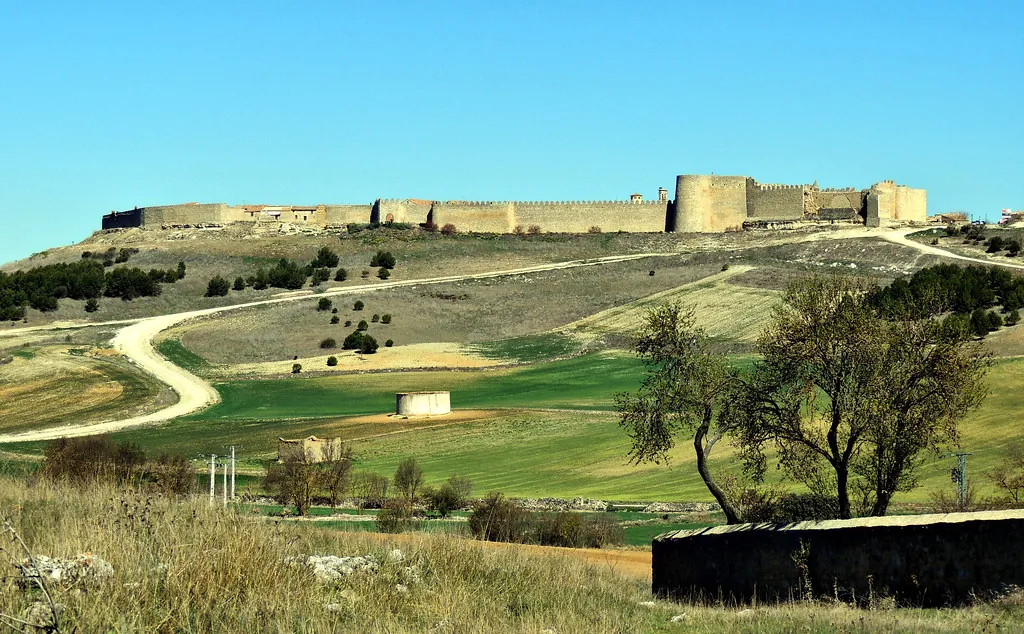
From the road, the outline that stands out is the Castle of Fuensaldaña. It has a square ground plan and a dominant keep, or torre del homenaje, rising above the rest of the structure. Its origins go back to the 13th century, although much of what can be seen today dates from 15th‑century reforms promoted by Alonso Pérez de Vivero, chief accountant to King Juan II of Castile. Those works transformed the fortress into a noble residence.
In the early 16th century, during the Revolt of the Comuneros, the castle changed hands for a time. After that period of unrest it entered a long phase of relative abandonment, only to be restored towards the end of the 20th century.
That restoration led to an unexpected new role. Between 1984 and 2009 the building served as the seat of the Cortes of Castilla y León, the regional parliament of Castile and León. The debating chamber was installed in the former parade ground. When the parliament later moved to Valladolid, the castle returned to its status as an institutional building open to visitors.
The keep can be explored on organised visits. The climb is narrow and steep, via a spiral staircase that feels true to its medieval origins. From the top, the defensive logic of the site becomes clear. The view stretches across the entire plain towards Valladolid, while to the west the first undulations of the Montes Torozos come into sight. It is an outlook that once allowed control over movement across the surrounding farmland.
Clarete country and underground cellars
Fuensaldaña belongs to the Denominación de Origen Cigales, a wine‑producing area long associated with clarete. For many years grapes here were sold in bulk or turned into wine for local consumption. Bottling developed later, when wineries in the district began to organise themselves more formally.
Local clarete, traditionally a blend of red and white grapes, has a pale shade that people in the area describe as “colour cebolla”, literally onion‑skin. It sits somewhere between a light red and a deep rosé, and has been part of everyday life in Cigales for generations.
At harvest time the activity around the village intensifies. Tractors and trailers loaded with bunches of grapes move constantly along the tracks that criss‑cross the fields. The rhythm of the agricultural year is still visible, and wine remains central to the local economy.
Beneath the built‑up area there are also underground cellars carved into the earth, a common feature in many villages of Cigales. Some are still used privately by families. They are not generally open as tourist attractions, although residents sometimes show them to visitors if the conversation leads that way. Their presence hints at a long tradition of storing and ageing wine below ground, where temperatures remain more stable.
Walking to San Cipriano
The municipal area covers around 40 square kilometres and is almost entirely devoted to dry farming. Wheat and barley dominate, with sugar beet or vineyards in some plots. The sensation is of open country, very typical of this part of the province of Valladolid.
A straightforward walk from the village leads to the Ermita de San Cipriano, about two kilometres away. The present building appears to date from the 16th century. It has a single nave and simple masonry construction. Mass is celebrated there once a year during the September festivities.
Those patronal festivities are usually concentrated around the same dates. There are open‑air dances and activities in the main square. It is a celebration shaped by its agricultural setting: plenty of life outdoors and timetables that depend as much on the atmosphere as on any official programme.
Several agricultural tracks also leave Fuensaldaña towards neighbouring villages. The route heading to Villanubla is completely flat and suitable for walking or cycling between open fields. Some residents recall that Félix Rodríguez de la Fuente, the well‑known Spanish naturalist and broadcaster, practised falconry in this area when he was young. There is no signposting to mark the spot, but the story remains part of local memory.
Practical notes for a visit
Fuensaldaña lies around 15 to 20 kilometres from Valladolid along the N‑601, with a clearly signposted turn‑off before reaching the Montes Torozos. The village can be reached in just a few minutes from the main road.
There is space to park near the castle. Visits inside are usually arranged through the town hall or the provincial authority, so it is sensible to check in advance if planning to enter or climb the tower.
The historic centre is small and can be explored at an unhurried pace in less than an hour. For walks in the surrounding countryside, closed footwear is advisable. Many of the paths are dirt tracks and, when the wind blows across the Meseta, they can become dusty.
In summer the sun beats down hard, with very little shade on the plain. In autumn and winter the scene changes completely as newly sprouting cereal alters the colour of the fields. Even then, the essential character of Fuensaldaña remains the same: a village defined by its castle, its vines and the wide Castilian landscape that stretches out in every direction.