Full Article
about Geria
Town at the confluence of the Pisuerga and Duero rivers; noted for its church and nearby river landscapes.
Hide article Read full article
Between the Torozos and the Pisuerga
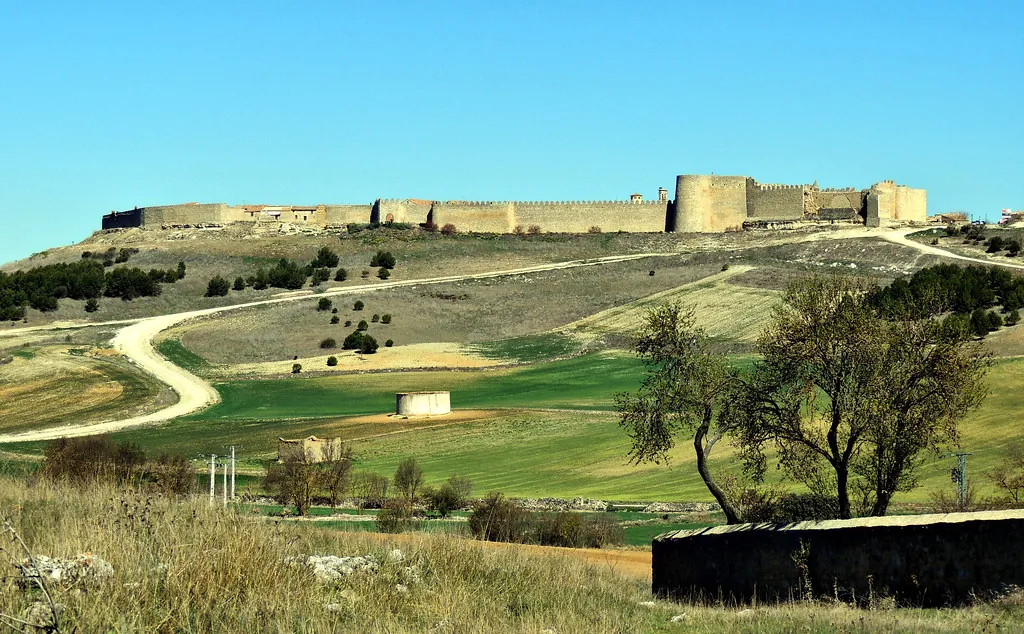
Geria stands on the southern edge of the Montes Torozos, a few kilometres west of Valladolid in the province of Valladolid, Castilla Leon. The village occupies a small rise where the land begins to slope down towards the valley of the Pisuerga river. That position, halfway between the limestone plateau of the Torozos and the lower ground of the valley, explains much of what you see around it: open cereal fields, scattered holm oaks and farm tracks stretching towards the horizon.
The municipality has around five hundred inhabitants today. As in much of this comarca, traditional life has revolved around dry farming and livestock. The older houses, built with adobe, rammed earth and local stone, reflect that agricultural background. Thick walls keep out the extremes of heat and cold, small windows limit exposure to wind, and interior courtyards once organised both domestic life and daily work.
Geria does not present itself as a tourist centre. It is a small, quiet village whose structure and rhythms still echo its farming past. Its interest lies in its setting and in the way that built form and landscape fit together.
The Church of the Asunción
At the centre of the village stands the parish church of the Asunción. The present building dates from the 16th century, although it underwent later alterations, particularly in the 18th century. The chancel retains features of late Gothic tradition, something quite common in rural churches across Castile, where that architectural language remained in use locally even as other styles were gaining ground elsewhere.
Inside, there is a Baroque main altarpiece. It is not monumental in scale, yet it is representative of the kind of religious decoration that reached many villages in the region during the 17th and 18th centuries. In smaller parishes such as this one, churches are not always open outside service times, so a visit may depend on circumstances.
The church anchors the village visually and historically. Around it, the streets adapt to the slope of the hill, and everyday life unfolds much as it has for generations.
Streets Shaped by the Land
The urban layout of Geria consists of short streets with a noticeable incline, adjusted to the mound on which the village was founded. There is no rigid grid. Houses were built according to the needs of each family and the possibilities of each period.
Adobe dwellings with stone plinths can still be seen, along with wooden gates and old animal pens attached to the rear. In some cases, coats of arms or simple decorative details appear on façades, suggesting that at certain moments particular families held a degree of standing within the community. Even so, what dominates is a highly functional architecture, designed for agricultural work and to withstand the climate of the páramo, the high, exposed plateau that characterises much of inland Castile.
Materials are local and practical. Walls are solid and surfaces largely unadorned. The overall impression is not of ornament but of endurance. These are buildings shaped by wind, temperature swings and the needs of a farming economy.
Walking through the village takes little time. Its scale encourages a slow pace, with attention shifting easily from façades to views that open between houses towards the surrounding countryside.
The Landscape of the Montes Torozos
Once outside the built-up area, the land opens almost immediately. Despite their name, the Montes Torozos are not mountains in the strict sense. They form an elevated platform of limestone páramos that occupies a large part of the northern province of Valladolid. The relief is gentle, yet the sense of space is constant.
Among the cereal fields are patches of holm oak woodland and small scarps where the ground breaks away. In these areas it is relatively common to see bird species associated with open landscapes of Spain’s interior, although their presence varies considerably depending on the time of year.
There are no designated viewpoints. Even so, a short walk along any of the tracks leading out of Geria is enough to gain broad views over the plain and towards other settlements in the distance. The horizon is wide, and the sky often feels as prominent as the land itself.
The transition between plateau and valley is subtle but perceptible. From the edge near the village, the terrain begins its descent towards the Pisuerga valley, marking the shift from the higher, drier ground of the Torozos to the lower lands below.
Paths, Seasons and Wind
The surroundings of Geria are criss-crossed by agricultural tracks and old drovers’ routes, traditional paths once used for moving livestock. These are straightforward routes without specific signposting. They are used mainly by farmers and local residents rather than walkers following marked trails.
Spring brings a noticeable change compared with the dry appearance of summer. Field margins fill with grasses and wildflowers, and the cereal crops cover the plateau in green. Later in the year, the tones shift back towards gold and ochre, reinforcing the sense of exposure that defines the area.
Wind is a frequent presence in this part of the Torozos. It can blow strongly across the open ground, and it forms part of the character of the place. The landscape is not dramatic in terms of height or ruggedness, yet it has a clarity that comes from space, light and air in constant movement.
Village Cooking and Nearby Wines
The food associated with Geria and its surroundings follows the traditions of inland Castile. Roast lamb remains central to many family celebrations and local festivities. Homemade cured meats such as chorizo and morcilla are common, alongside hearty legume stews suited to an agricultural way of life.
Wines from nearby denominations of origin, including Cigales and Rueda, often accompany these meals. Both are well-established wine regions within Castilla Leon, and their presence reflects Geria’s position within a broader rural landscape shaped by farming and viticulture.
The cuisine is direct and rooted in local produce. It mirrors the architecture and the landscape in its practicality and its connection to long-standing customs.
Before You Go
Geria is small and peaceful, without significant tourist infrastructure. It can be explored on foot in a short time.
It is best approached with the idea of walking, observing the landscape and gaining a sense of daily life on the edge of the Montes Torozos. Open fields, frequent wind and villages that have changed little in their basic structure over the centuries define this part of Castilla Leon. Geria offers a clear example of that continuity, set between the limestone plateau and the valley of the Pisuerga.