Full Article
about Mota del Marqués
Historic town dominated by the ruins of its castle and the church of San Martín; key landmark on the A-6
Ocultar artículo Leer artículo completo
The cereal fields begin just beyond the last house. No gradual green belt, no polite buffer—simply cobbles giving way to dust and the horizon tilting upwards like a loose sheet of ochre cardboard. Stand at the top of Calle del Castillo and you can watch the grain heads shuffle in a wind that smells of thyme and diesel from a distant combine. This is Mota del Marqués: one street, one bar, one ruined fortress and enough sky to make the Derbyshire Peaks feel hemmed in.
A Castle That Lost Its Keep but Kept the View
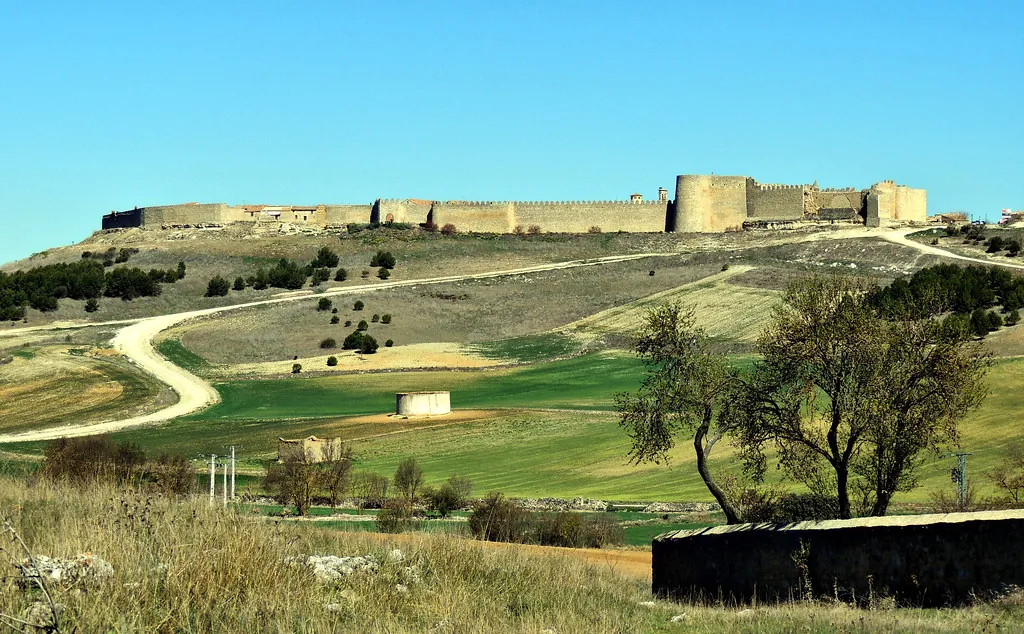
The Marquises of Ulloa stamped their name on the place in the fifteenth century and then, obligingly, disappeared. Their fortress is now a hollow tooth: a curtain wall here, a spiral of stone stairs that ends in mid-air, a tower you can still climb if you ignore the rusted bilingual sign that warns “RUINA”. The scramble takes ten minutes on ankle-turning gravel; trainers are fine, sandals an error. From the summit the meseta rolls away in every direction, the colour of digestive biscuits until mid-April, then abruptly green, then gold again by late June. Pilgrims on the Vía de la Plata Camino photograph themselves against it but rarely linger; the village is a lunchtime stamp rather than a bed for the night, and that keeps the atmosphere honest.
Inside the enclosure there are no ropes, no interpretation panels, no gift shop selling fridge magnets shaped like heraldic shields. Instead you get the smell of hot stone and the sound of larks arguing overhead. Bring a sandwich and you have the best picnic table in the province of Valladolid, though you’ll balance your orange juice on a lump of medieval mortar. Sunset is the obvious moment, but sunrise can be finer: the fields steam, the castle stones turn salmon, and you’ll share the ramparts only with a retired shepherd who walks up every dawn “para despertarme los pulmones”.
A Plaza Without a Cashpoint
The village centre is a concise square of houses the colour of yesterday’s cream. Their coats of arms—lions, stars, a puzzled-looking griffin—have softened under four centuries of sun so that the stone looks bruised rather than carved. The church of San Martín keeps similar hours to the British Library Reading Room: open when someone remembers, locked when they don’t. If you find the wooden doors ajar, step inside for a Baroque retablo whose gilded wood has the shade of burnished toffee; the sacristan will switch on the lights for a euro coin dropped into the box marked “electricidad”.
There is no ATM. None. The last machine stands eight kilometres back in Villardefrades, so fill your pocket before the final stretch. Cards work in the bar—just—but the municipal albergue still runs on the honour box: €5 in coins buys you a bunk, a lukewarm shower and a clothes line strung between two pear trees. The shop closed in 2022, so if you need toothpaste or blister plasters you’re hitch-hiking to Medina de Rioseco. This is not a catastrophe; it simply means you plan like a grown-up rather than hope like a toddler.
Lunch at the Only Counter in Town
Bar Ulloa opens at seven-thirty for coffee thick enough to mortar bricks. By eight the counter is crowded with farmers knocking back café con leche and anisette before heading out to inspect the barley. The owner, Mari-Carmen, speaks no English but recognises a British accent instantly: she’ll slide the tortilla onto brown bread if you blink forlornly at the crusty baguette. Kitchen proper starts at half past one, later than most Camino schedules, so stash a banana or buy a slab of queso de Villalón the night before.
The house red arrives in a two-litre bottle with a label that just says “Toro” and a drawing of a bull looking faintly surprised. €2.50 fills a glass the size of a yoghurt pot; at 14 % it is the colour of bishop’s socks and tastes of blackberries left in a hot car. Vegetarians survive on sopa castellana—a smoky broth of garlic, paprika and bread—provided you ask for it “sin jamón” before she flings in the scraps of last night’s shoulder. The pilgrim menu is €10 for three courses: soup, eggs with chips, supermarket yoghurt. It will not win a Michelin rosette; it will stop your stomach growling through the afternoon wind.
Walking Tracks That Expect You to Think
Footpaths radiate from the north edge of the village but don’t expect way-markers every fifty metres. The GR-14 long-distance route passes through, yet local farmers still treat the arrows as polite suggestions rather than instructions. A useful rule: keep the castle at your back and the antenna mast on the horizon and you’ll hit a circular loop of eleven kilometres that dips into the Torozos hills and returns via a stone bridge even the villagers call “el puente romano, aunque no es romano”. Spring brings poppies and the smell of wild thyme; August brings dust and the certainty of sunstroke. In winter the altitude—764 m—means sleet can sweep across the plateau without warning; if the sky turns the colour of wet cement, head down fast.
Cyclists find the same roads perfect for interval training: long straights where the only traffic is a tractor pulling a trailer of sugar beet, then sudden ramps that make quadriceps beg for mercy. The surface is decent, the dogs generally sleepy, the views uninterrupted all the way to the glass-green ridge of the Sierra de la Culebra twenty-five miles west.
Fiestas, Fireworks and a Roast Lamb Worth the Detour
San Martín arrives on 11 November, when the village population quadruples. The morning starts with a sung mass whose organ wheezes like an asthmatic accordion; the afternoon ends with a toro de fuego—a metal frame loaded with fireworks that career through the streets behind reckless teenagers. Visitors expecting Pamplona-style danger will be disappointed; visitors expecting singed eyebrows occasionally leave happy. The serious business is lunch: whole lamb, lechazo, roasted in a wood-fired clay oven until the skin forms a brittle parchment you crack like crème-brûlée. Locals book tables a month ahead; outsiders can usually squeeze in at the second sitting if they smile nicely and pay €25 for half a kilo of meat, ensalada rioja and a carafe of the surprised-bull wine.
If November feels remote, come in late April for the Romería de la Santa Cruz, when half the district hikes three kilometres to a granite cross planted in the middle of nowhere, then eats almond cake and drinks limonada laced with anisette. The event finishes by dusk; the plateau smells of blossom and gunpowder, and nobody checks whether you’ve paid your parish dues.
Leaving Before the Silence Settles
Stay past ten o’clock and the village folds in on itself like a paper bag. Lights go out, shutters rattle shut, the sky spreads its star-chart with an arrogance you rarely see south of the Cairngorms. Walk the empty main street and your footsteps echo off stone as if someone were following at a polite distance. It is beautiful, but it can feel watchful rather than welcoming, especially if the wind has teeth.
So fill your bottle at the stone trough by the entrance—water cold enough to make fillings ache—then shoulder your pack and set off down the camino track. Behind you the castle silhouette recedes, flat as a paper cut-out against the widening day. Ahead the meseta continues, kilometre after kilometre, until the next hill, the next village, the next bar that may or may not be open. Mota del Marqués does not sell itself, does not need to, and will forget you by the time the dust settles. That, rather than any superlative view, is precisely why the detour is worth the gravel under your boots.