Full Article
about Peñaflor de Hornija
Overlook village above the Hornija valley; known for its sweeping views and its church.
Hide article Read full article
A village above the plains
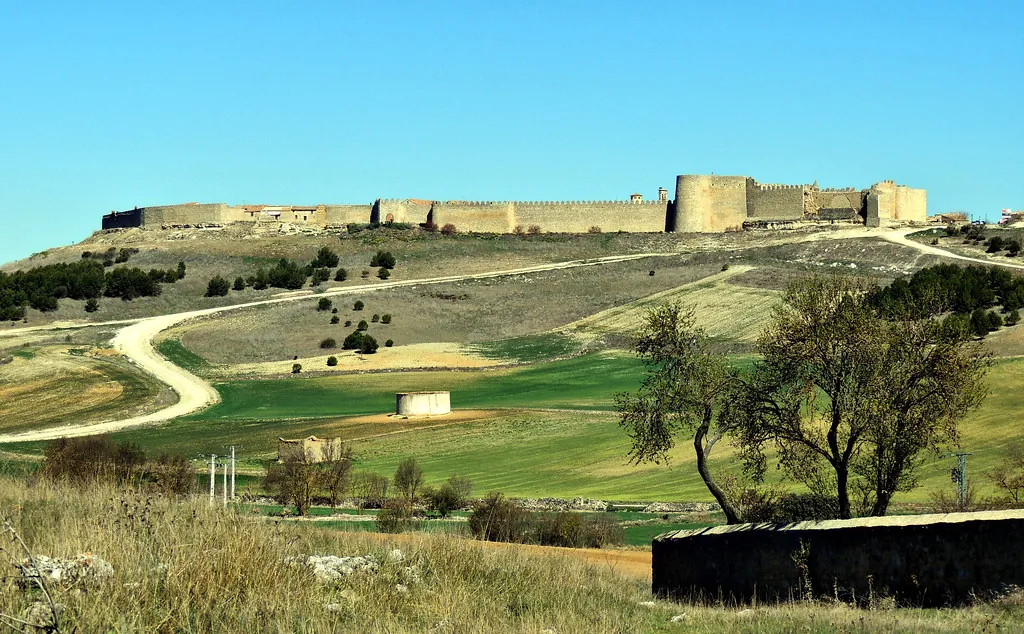
Peñaflor de Hornija sits on the upper reaches of the Montes Torozos, in the province of Valladolid, on a stretch of high plateau that reaches around 800 metres above sea level. With just over three hundred residents, it belongs to a network of small villages that still sustain the agricultural landscape of the region. The horizon feels wide and uninterrupted: cereal fields extend outward, straight tracks cut through the land, and clay soils shift in colour as the seasons change.
The elevated position of the village is no coincidence. Settlements across this area were often established on prominent points of the páramo, the high plain, where routes across the Meseta could be monitored. That same position now offers a clear reading of the landscape. Open fields dominate, with occasional lines of trees in shallow valleys. In autumn, low fog often settles below while the village remains above it.
Peñaflor de Hornija is not a destination defined by major monuments. Its appeal lies in understanding how a small agricultural community in the Montes Torozos is organised and how it adapts to its surroundings.
The shape of rural architecture
At the centre of the village stands the parish church dedicated to Nuestra Señora. Its origins date back to the 16th century, although later alterations have shaped its current appearance. The building is restrained, in keeping with the scale of the settlement, and constructed using materials typical of the area. Its significance comes less from decorative detail and more from its position. It anchors the village and helps structure the space of the main square.
Access to the interior is not always guaranteed, as it usually depends on religious services or specific moments in the calendar.
Short streets spread out from the church, forming a layout where traditional houses remain easy to recognise. Many are built with adobe and brick, often accompanied by courtyards or agricultural outbuildings. Some have been updated, while others retain their original character, with thick walls and small openings designed to cope with both winter cold and summer heat. This is not a monumental ensemble, but it offers a clear example of popular architecture in the Montes Torozos.
The surrounding landscape plays a central role in shaping daily life. The páramo stretches in all directions with a near-geometric regularity. Fields of cereal alternate with fallow land, while agricultural tracks connect plots and neighbouring villages. The visual character shifts over the year, moving from the greens of spring to the ochre tones that follow the harvest.
Walking across the Montes Torozos
Tracks leading out of Peñaflor de Hornija allow for walks across the plateau without steep gradients. These are working paths used by local residents to reach their land, yet they can also be followed on foot if care is taken to respect agricultural activity. The openness of the terrain makes it a good place to observe birds of prey, which often ride the air currents above the plain.
This is an exposed landscape. Shade is scarce and wind can rise quickly, so carrying water and protection from the sun is a sensible precaution for anyone planning to spend time outdoors.
Light plays a key role in how the plateau is perceived. Early morning and late afternoon change the scene considerably. Long shadows reveal the texture of the fields and help convey the true scale of the land.
During hunting season, activity in the surrounding countryside becomes more noticeable. Hunting forms part of the local economy, so it is worth being aware of this before setting out along certain routes.
Food and everyday life
The food associated with the village reflects the wider traditions of this part of Castilla. Cooking tends to be hearty, shaped by sheep farming, pulses, and products linked to traditional pig slaughter. These are dishes rooted in rural life and seasonal rhythms.
Visitors passing through often end up eating in nearby towns, where more services are available. Peñaflor de Hornija itself remains focused on its day-to-day agricultural routine rather than catering to tourism.
Understanding the place
Peñaflor de Hornija offers a clear view of what life is like on the páramo of the Montes Torozos. Small settlements, open farmland, and a direct relationship between people and the land define the experience here. The interest lies less in ticking off sights and more in observing how the village fits into its environment.
The landscape, the architecture, and the pace of life all point in the same direction. This is a place where the structure of the territory is easy to read, and where the connection between settlement and surroundings remains visible.