Full Article
about Tiedra
Medieval town with a restored castle and lavender fields; known for its astronomy center.
Hide article Read full article
A village shaped by height and horizon
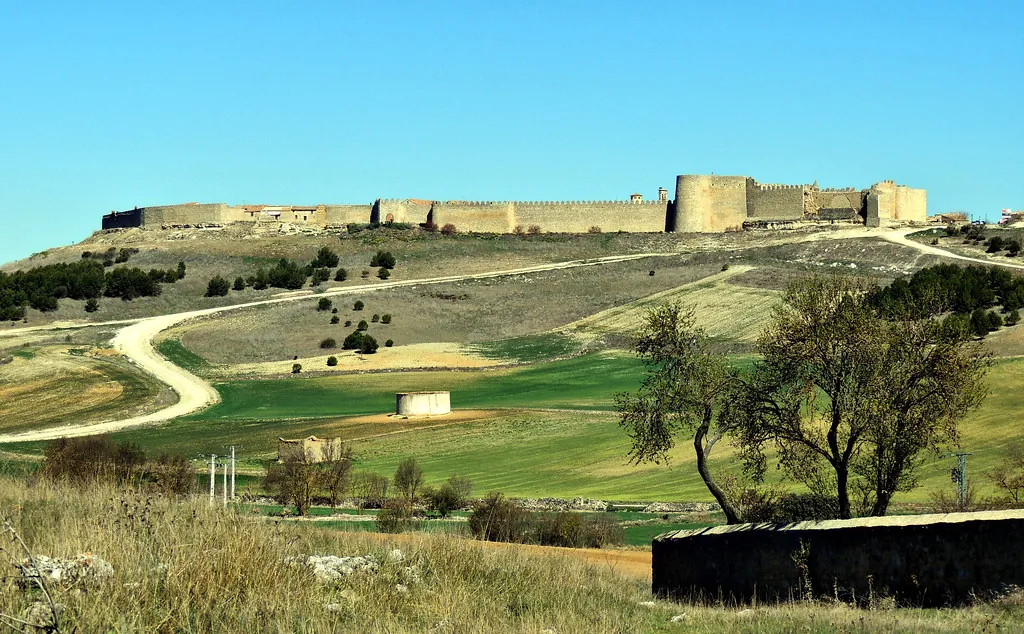
Tourism in Tiedra begins with geography. The village stands on an isolated rise within the Montes Torozos, a plateau of gentle relief that breaks abruptly in certain parts of the province of Valladolid. From a distance, the skyline is easy to recognise thanks to the castle at the highest point. Around 270 people live here today, but for centuries this was a watchful and useful place within a network of fortresses that controlled the surrounding territory.
Its position explains much of its past. During the Middle Ages, this area formed part of a shifting frontier between the Christian kingdoms and Al‑Ándalus, the Muslim-ruled territories of the Iberian Peninsula. The fortresses of the Torozos were used to observe movements across the plain and to protect the routes that crossed the plateau. Tiedra appears in medieval documents linked to that defensive role. The settlement grew around the castle and the farmland that surrounded it, tying daily life closely to both security and agriculture.
The castle and the logic of the plateau
The castle of Tiedra dates from the 13th century, although there may have been an earlier defensive structure on the same site. Its keep rises above the rest of the complex and can be seen from several kilometres away, marking the village’s position across the open landscape. Recent restoration has made it possible to explore part of the enclosure and get a sense of how a fortress of this kind once functioned.
From the top, the choice of location becomes clear. The view stretches across wide cereal fields typical of the Montes Torozos. There are no major mountains or sharp features; precisely because of that, any elevation carries strategic value. A small rise can mean visibility over long distances, which once made the difference between safety and vulnerability. The castle’s placement reflects that logic, turning a modest hill into a point of control.
San Miguel and the fabric of the village
The church of San Miguel Arcángel brings together Romanesque and Mudéjar elements, a combination often found in this part of Castile. Brick sits alongside stone, creating a contrast in both texture and colour. Later alterations, particularly during the Baroque period, have shaped the interior, adding another layer to the building’s history.
Beyond the church, the rest of Tiedra keeps a simple architectural style linked to agricultural life. Many houses combine stone, adobe and rammed earth. Large gateways hint at an earlier way of living, when homes shared space with yards, storage areas or stables. The streets do not follow a strict grid. Instead, they adapt to the slope that climbs towards the castle, creating a layout that feels practical rather than planned.
This built environment reflects how closely the village has been tied to the land. Materials come from the immediate surroundings, and the design of each building responds to everyday needs rather than decorative ambitions. Walking through the centre reveals small construction details that speak to that continuity.
The landscape of the Montes Torozos
The surroundings of Tiedra offer a clear picture of the wider region. Fields of cereal dominate the view, broken up by patches of scrubland and occasional clay escarpments that interrupt the otherwise horizontal terrain. The landscape may appear uniform at first glance, but these variations give it rhythm and texture.
The sky plays an important role here. Birds of prey are a frequent sight, making use of air currents above the plateau. Kites, harriers and vultures form part of the usual scene at many times of year. Their presence adds movement to an environment that might otherwise seem still.
Tracks and rural paths make it easy to move through the area. From certain points, other villages of the Montes Torozos come into view, often positioned on similar rises. This pattern reinforces the sense that elevation mattered across the whole comarca, not just in Tiedra.
Walking through Tiedra today
The village centre is small and can be explored on foot without difficulty. A walk often begins with the climb up to the castle, followed by a gradual descent through the streets. Along the way, the older houses and their construction details come into focus, offering insight into how people lived and worked here.
Tiedra is often visited alongside other nearby villages in the comarca. The routes between them cross the open plateau of the Montes Torozos, a landscape that helps explain why these settlements were built on high ground rather than in the plain. The journey itself becomes part of the experience, connecting one hilltop to another across a wide and exposed terrain.
In the end, Tiedra is best understood through its setting. The height of the village, the visibility of its castle and the openness of the surrounding fields all point to the same idea: this is a place where geography has always mattered.